
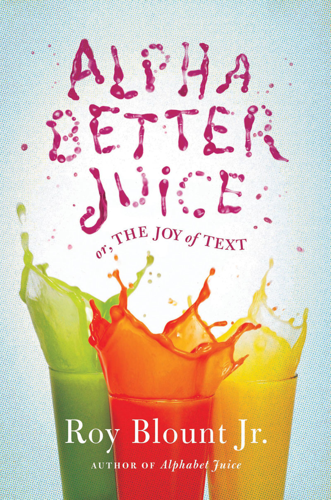
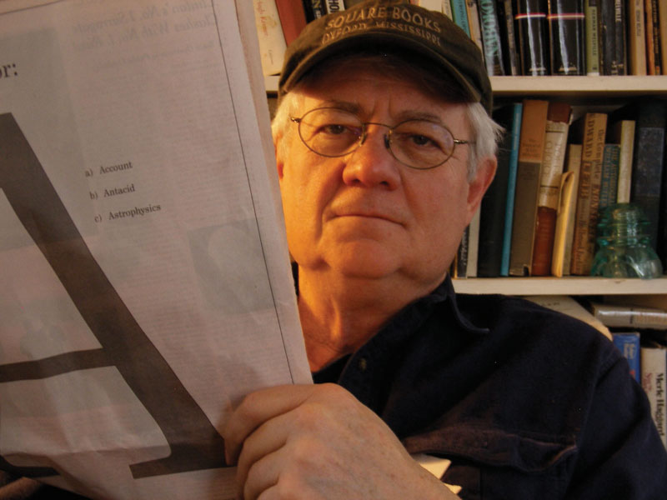

Roy Blount Jr. may be America's hardest working humorist. The Vanderbilt graduate is author of 22 books and hundreds of magazine articles, as well as a frequent speaker on National Public Radio programs, television and the lecture circuit — not to mention a member of the American Heritage Dictionary's usage panel. It is this last job that certifies him as an expert in what he termed in the subtitle of his 2008 book, Alphabet Juice, "The Energies, Gists, and Spirits of Letters, Words, and Combinations Thereof; Their Roots, Bones, Innards, Piths, Pips, and Secret Parts, Tinctures, Tonics, and Essences; With Examples of Their Usage Foul and Savory." He examines all these and more in his latest book, Alphabetter Juice: or, The Joy of Text, a companion of sorts to the first. Blount recently discussed the piths and pips of words with the Scene via email in advance of his upcoming Nashville appearance.
As with Alphabet Juice, in this book some entries are short, some are long, and many take off in surprising directions. How do you choose what words to examine, and what to say about them? Could you describe the process?
I'm reading something. Let's say I'm reading the package of Stim-U-Dents next to my laptop here. (I need something to chew on when I write, and I withdrew from Red Man after many years because I didn't want oral tobacco to rot my tongue away and kill me, as it did Freud, Babe Ruth and Ulysses S. Grant.) "Fights Gum Disease," says the Stim-U-Dent package. The word that jumps out at me is gum. Where does that come from, and does it come from the same place as chewing gum, and ... I start looking gum up, in all directions, and reflecting on how that word has cropped up in my life and in literature (and isn't there a Gum department store in Moscow or somewhere — what does that mean in Russian?) and I start taking notes. Doesn't everybody? I mean, gum. Doesn't that ring bells for most people?
Throughout the book, you celebrate the "sonicky" quality of words. Why is this important? With so much communication (including this interview) now taking place via typed electronic messages, have people lost track of how words sound?
I enjoy words orally and aurally. I have a deep urge to capture and share that sensuous pleasure on the page. That pleasure needs a revivalist push now, I think, and I feel called upon to step forward and provide it. By "it" I mean the push and also the pleasure. The Internet is an abstractifying medium, one of many forces that lead us to forget that language springs from the tongue, that all English is body English. Words are like food: Turn away, all ye whole-earth locavores, from processed, flavor-sapped phraseology. I mean that.
You explore grammar and usage of some words ("peeve" comes to mind) to a depth seldom achieved even by spinster English teachers. This begs the question, do copy editors tremble in fear when presented with one of your manuscripts? What is your relationship with copy editors and the editing process? Well, for one thing, you are using "begs the question" in its current, sorry-ass sense (see Alphabet Juice), which is depressing, but okay. I love copy editors, as long as they are up for engaging me fully and frankly, and FSG's copy editors are richly up to that. Good copy editors are to be treasured, they're throwbacks, they're like ... like gas stations where you can get reliable directions and free road maps and they will even clean off your windshield and their restrooms are spic and span. And you say to them, as my father used to say to his regular gas-station guy, whom we went to church with, "Thank you sir." (Where does "spic and span" come from? I don't know. I'll look it up.)
The book contains three original poems on crustaceans, under the entry for crustaceous. Might this signal a coming cycle of shellfish poems? Did you feel a similar urge to commit poetry while composing other entries?
"Commit." Hmm. I like to write verse, if that's what you mean. It was in freshman English at Vanderbilt that I was struck with how great poetry can be. I'm not a poet, but I like to write verse. Hardly any market for it, oddly enough, so I work it into my books whenever I can.
You seem to have an unlimited capacity to say funny and delightful things about words. ... May we regard Alphabetter Juice as the second installment in what will become an ongoing series?
I would love to do another book about words sometime, but probably not next. I still aspire to write a highly peculiar work of fiction.
Blount will speak and sign books at 6:15 p.m. July 1 as part of the Salon@615 series at Nashville Public Library. The event is free and open to the public.



