


A congressman, a state representative and a Metro councilman step onto a dam.
This is not the beginning of a joke.
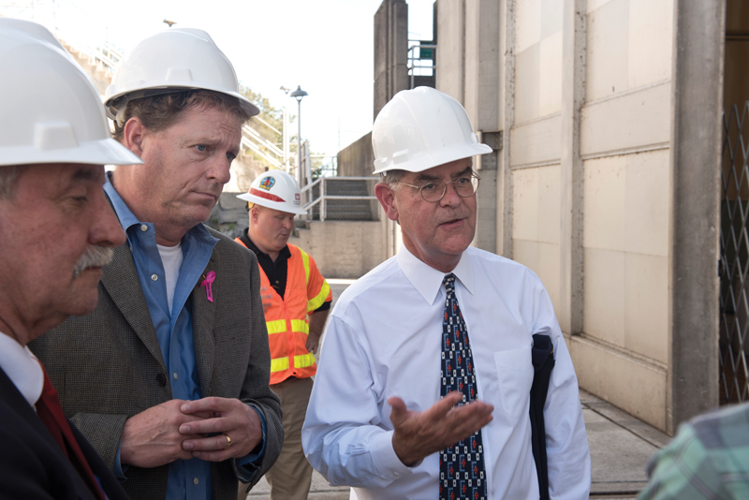
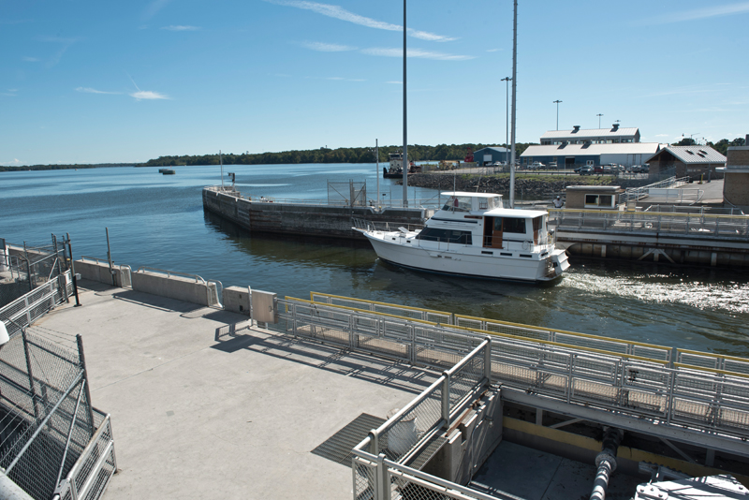
The trio of U.S. Rep. Jim Cooper, state Rep. Bill Beck and Councilman Larry Hagar stands atop the concrete bulwark of Old Hickory Dam, roughly 11.5 miles northeast of downtown Nashville, on a clear October afternoon. They watch as water fills the lock chamber, lifting a boat some 60 feet from the river below the dam and delivering it to the lake on the other side.
It's almost impossible not to be awed by the scale of the edifice, built in the early 1950s. And yet the musty Cumberland River laps against romantic notions of great civic projects. The sunlight shimmering on the water between the massive concrete walls is offset by the familiar, faintly fetid river smell. A dead duck floats in the rising water.
Like this part of town and the main road that runs through it, Old Hickory Dam is named after Andrew Jackson, whose 640-acre plantation, The Hermitage, is about 13 miles away. Jackson got the nickname because his troops said he was "tough as old hickory." And if the Good Lord's willing and the creek don't rise, the dam named in his honor is tougher still.
But is it tough enough to withstand dynamite blasts nearby? That's the question. A limestone quarry has been proposed on 141 acres of property adjacent to Old Hickory Dam. Neighbors want it stopped for a variety of reasons. The lawmakers are standing on one.
If none of the three legislators is successful in stopping the project, the quarry will eventually begin blasting deep in the ground, within eyesight of where they're standing today. Engineers say the half-century-old dam was built to sustain shocks far greater than a mere TNT pop-and-boom. They see no threat from the quarry.
Neighbors and legislators aren't so sure. In recent weeks, driven by what he considers a looming threat, Cooper has made it his mission to jog local residents' memories about what a devastating flood looks like. It's not just the one dam that has the Nashville congressman concerned; it's the chain of aging dams that includes Old Hickory — along with two dams that have been classified among the nation's riskiest.
Each lawmaker here is fighting the quarry in his own way. At the state level, Beck has been leaning on the Tennessee Department of Environment and Conservation to scrutinize the proposal. Republican Rep. Steve Dickerson, who represents this area in the state Senate, has been involved as well.
At the local level, Hagar filed a Metro Council bill in August that would restrict how close a quarry can be to a home, park or school. The bill stalled before it could come to a final vote, but he refiled earlier this month. It awaits two more readings, as well as a possible legal challenge.
Old Hickory neighbors have raised objections on a variety of fronts. They range from the presence of bald eagles nearby to the possible effects a quarry could have on the value and structural integrity of their homes. In many cases, those homes are older than the dam.
It's the dam, however, that's bringing concerns to a head.
To get to Old Hickory Dam, you drive down Swinging Bridge Road, passing "Stop the Dam Quarry" yard signs on the left and the proposed quarry site on the right. You hang a right on Cinder Road, passing wetlands and a recreation area until you reach an embankment — the earthen portion of the dam — that points straight toward the lock.
This is where Cooper's attention has been focused. Since plans for the quarry came to light, he has attended neighborhood meetings and sounded the alarm to various local officials. When the Scene requested a tour of the dam, Cooper made time in his schedule to come along and extended an invitation to the other legislators.
Cooper's concern on the topic is clear as he joins the Army Corps of Engineers' civil design and dam safety chief Mike Zoccola, accompanied by other corps staff. Before the group can even get their hard hats fastened, the congressman is politely but firmly grilling Zoccola, pressing him about dam safety.
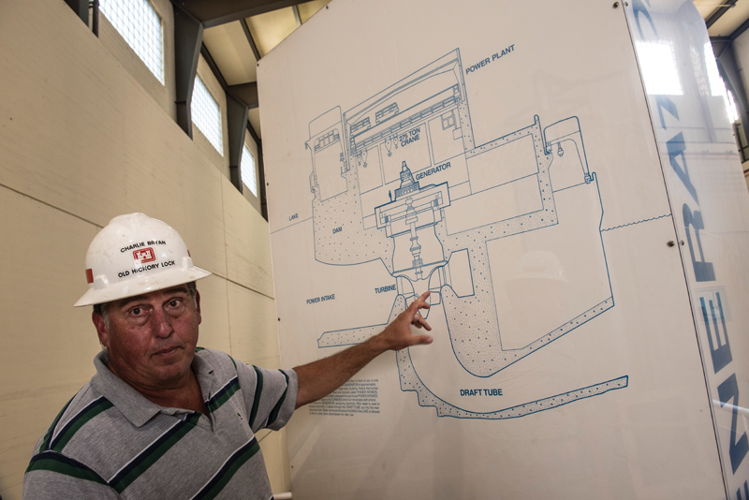
As the tour continues from one side of the lock to the other to the top of the dam wall, then down below to the loudly whirring turbines in the power house, Cooper inquires about the dam's intricacies as well as the possible effects of nearby blasting. His anxiety is heightened by recent events upstream: more than $1 billion in combined urgent repairs to Wolf Creek Dam (located 275 miles upstream near Jamestown, Ky.) and Center Hill Dam (70 miles east near Smithville). Repairs to the latter are not yet complete.
Cooper says those were just two more examples of the corps reacting to long-deferred emergencies rather than acting to head them off. It's why he's so concerned about Old Hickory Dam, despite assurances that all is well. Several days after his tour, he will publish an op-ed in The Tennessean outlining the threat he believes the quarry poses to the dam, and hence to Nashville.
The corps has, thus far, been unwilling to wade into the quarry dispute. A statement from public affairs specialist Lee Roberts notes that "the site of the proposed quarry is not located on federal land, so the public is encouraged to communicate and submit questions with state and local representatives and appropriate state agencies." Roberts also says the corps has yet to receive a regulatory permit application from the quarry company, which would initiate their official involvement. Even then, their jurisdiction would only be under the Clean Water Act and not related to the safety of the dam itself. On that topic, the corps says, it's just another neighbor.
After touring the dam's concrete portion, the party moves on to the earthen embankment that runs out from the dam to within feet of the property line now owned by the quarry operators. At Cooper's request, Zoccola shows the group the red piezometers planted in the grass alongside the road atop the embankment. The gauges are stuck at different elevations in the foundation, he explains, to monitor water pressure and detect any seepage.
Cooper asks if they would pick up vibrations from blasting at the quarry.
"If there were to be blasting in the quarry that caused pressures in the ground water — or pressures in the foundation, or opened something up so it now had more water getting underneath the dam through the foundation at this location — it would pick it up," Zoccola says.
"So this is kind of like the little Dutch boy with his finger in the dyke?" Cooper says. It gets a laugh from everyone but the engineer.
Zoccola pulls out a set of pictures from a Kentucky lock project, where blasting was done literally right next to a dam, creating a massive crater where the lock chamber was being excavated.
"That was drilled and blasted without incident," he says.
Still, Zoccola says he's put out a query to his counterparts in the corps seeking situations similar to the one proposed here with the quarry. Nothing so far.
"All of our dams undergo seismic analysis, and this one is no exception," he says. "And based on the seismic activity in the area, we come up with a design. The size of the ground-shaking that it would take to do damage to this dam — blasting a quarry would pale in comparison to what this was designed for."
Beck interjects with a question.
"If I understand you correctly, you're talking about a one-time seismic shift in your studies and your designs, but there's been no study or design for a decade or two decades of constant vibration or seismic shift," he says. "Is that safe to say?"
"That's safe to say," Zoccola replies.
Now 61, Jim Cooper has represented Nashville in the 5th Congressional District seat since 2002. A Rhodes scholar first elected at age 28 to represent Tennessee's 4th Congressional District in 1983, he is a policy wonk whose mild manner (if not his tenacity) fits his record as a political moderate. Not a particularly excitable man, the congressman punctuates surprising or startling facts with a wry, "Like, whoooaa."
He does this a lot when he talks about dams.
The subject has been on his mind a lot lately. It's why he asks a reporter to a planned meeting at the Green Hills Starbucks, then summons him to Cooper's home in Green Hills, where the congressman is trying to fix his carport roof before returning to Washington, D.C. He's still wearing an orange long-sleeve East Nashville United T-shirt and work pants when he beckons the reporter inside, where his family and their poodle, Sirius Black, are eating breakfast.
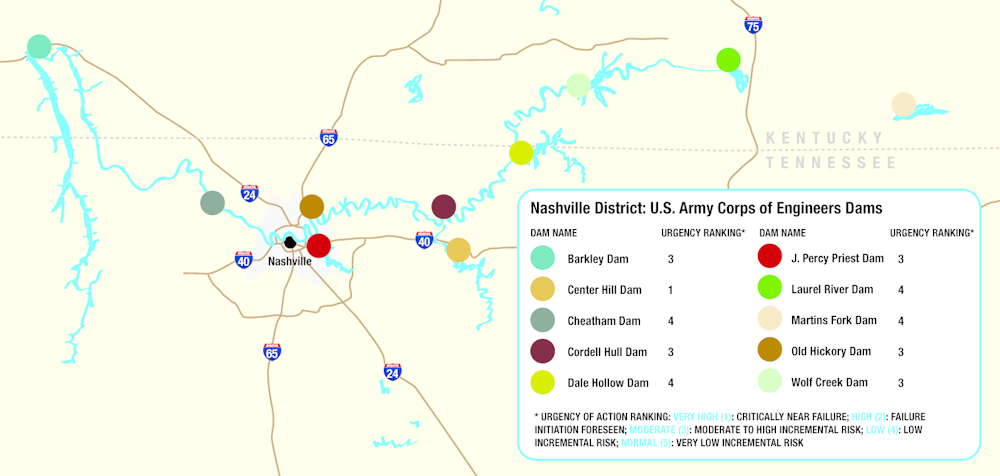
For years, he says, unbeknownst to most of the public downstream, two dams that directly affect Nashville have been rated among "the most dangerous dams in America." On the corps' Dam Safety Action Classification (DSAC) scale, with 1 most urgently in need of attention and 5 least, Wolf Creek and Center Hill dams were each rated a 1. Both faced problems with their limestone foundations.
After $700 million of work on Wolf Creek, it has been downgraded to a 3. But Center Hill is still a 1, awaiting completion of $400 million of work there. While Wolf Creek is on the Cumberland River, Center Hill is on the Caney Fork, which feeds into the Cumberland.
Because of its closer proximity, more Nashvillians are familiar with Center Hill Lake. But Cooper says people are less aware of Wolf Creek, which is much bigger than its name suggests — as are the implications of a dam failure there.
"People don't realize how big it is," he says. "Because it's called 'Wolf Creek,' they think it's small. But that dam impounds a lake that's bigger than all of our other lakes put together. Bigger than Dale Hollow, plus Center Hill, plus Cordell Hull, plus Old Hickory, plus Percy Priest. It's so big it changes the weather on the East Coast of the United States."
And closer to home?
"The water temperature at Old Hickory Lake for a month this summer was 25 degrees colder than Percy Priest Lake," he says. "Two almost adjacent lakes, 25 degree difference. Why was that? Because they let water out of Wolf Creek Dam — and it is so big that five days later, when the water got down here, it was still 25 degrees colder."
With two dams above Nashville thus considered by the corps to have reached the highest level of risk, Cooper says he was stunned when news of the Old Hickory quarry proposal crossed his desk.
"It could not happen at a worse place," he says.
"The risk factor for Nashville is extraordinary. Because this is the dam closest to us, it's a dam that's already 50-plus years old. The corps is not very good at warning you, like, 'Oh, Congressman this is going to be a problem 10 years from now or five years from now.' They say everything is fine until it's an emergency — and then they want $700 million to fix it. So right now they're saying everything's fine. I've been surprised so many times before."
In his view, there are two fundamental problems. The first is the blasting that will take place so close to the dam, in a state that trusts quarry operators to decide how much dynamite to use. Primarily, Cooper's concern is for that long, skinny embankment that stretches out nearest to the quarry site — and for what those piezometers might read after the blasting starts.
The second is a risk presented by the quarry itself. Entrepreneurs believe they know how to build a foolproof quarry, Cooper says — but remember Richland Creek? It filled the longtime REOStone quarry near Robertson Avenue with more than 7 billion gallons of rainwater in the 2010 flood. As he put it in his recent op-ed, "that collapse created a harmless lake" — but such a collapse at the Old Hickory quarry, so close to the dam, could be much worse.
"You dig this hole here, if there were to be a wall collapse, there's no more use for a dam," he tells the Scene. "It's gone, it's bypassed. Like, whoa — we would take this risk?"
There are other issues of federal concern too, of course. There are wetlands nearby the proposed quarry site, and bald eagles as well. Cooper is particularly unimpressed with the quarry owners' defense that the nearest bald eagle nest is 1,000 feet away from their property, 400 feet further than the point when some federal regulations would kick in.
"You're gonna dynamite around a bald eagle?" he says. "And quibble over a 400-foot difference?"
Although the business partners behind the quarry have remained anonymous, Cooper has placed multiple calls to the people presumed by project opponents to be the owners: the Hoover family who operate five limestone quarries in Tennessee, Alabama and Mississippi. So far, he's received no return calls. He has also met personally with all but four members of the new Metro Council to discuss the issue.
"You can build a quarry anywhere in 500 miles," he says. "We've got limestone everywhere. And to put it there, this could be the most sensitive spot in Tennessee to build a quarry — if you care about dam safety.
"It could go perfectly, but why take a risk? This is almost an existential risk for a city."
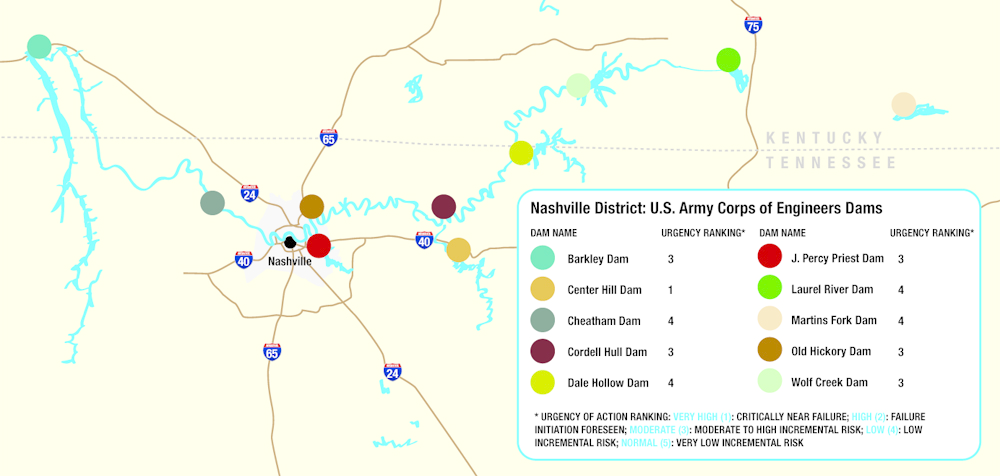
There are 10 dams in the corps' Nashville District (see map above), and their safety ratings vary. After the aforementioned repairs at Wolf Creek, which brought that dam up to a 3, only one dam remains a 1 — Center Hill. Five dams, including Old Hickory, J. Percy Priest, and Cordell Hull, are rated 3s, and the remaining four are rated 4.
It's important to note, however, that the dams serve different purposes. Dams designed for flood mitigation, like Percy Priest and Center Hill, are built higher and have the capacity to store water during a high rainfall event. Dams used solely for navigation and hydropower do not. Old Hickory is such a dam.
That comes up during the tour with Cooper, Beck and Hagar, as Mike Zoccola reminds the group that Old Hickory came within six inches of overflowing during the 2010 flood. Beck can't resist some gallows humor.
"It might help your PR to write on the dam really large, 'This is not for flood control,' " Beck says.
Several days later, Zoccola sits in his office in the corps' district headquarters at the federal building downtown at a table with maps and dam safety books. He explains how the corps assesses risk and approaches dam safety.
The corps does annual assessments called "periodic inspections," evaluations of the state of its dams. Among other things, these include surveying any cracks in the structure. Every five years, it conducts a "periodic assessment," during which a team of technical professionals gathers to brainstorm all the ways a given dam can fail and make a risk assessment. The DSAC scale for rating risk is relatively new, having been introduced in the early 2000s; it's part of an overall shift in the corps' approach to dam safety that focuses more on risk relative to other dams.
Risk, Zoccola says, is defined in simple terms as the probability of something happening multiplied by the consequence if it does.
"You could have a very high probability event that's really likely to occur, but not a lot of consequences if it does," he says. "Conversely, you can have a very low probability event but very high consequences, loss of life and economic damages, and that would result in a high risk."
Zoccola says problems at Wolf Creek first emerged in 1962. After that, examiners found sinkholes and muddy flows indicating that water had been seeping through the foundation. That resulted in the installation of a seepage barrier in the dam's foundation in the late '70s.
The problem, Zoccola says, was "highly solutioned limestone" — that is, "over geologic time, as water moves through cracks and open bedding planes in the rock, it actually dissolves the limestone" under the earthen dam. In the mid- to late '90s, there were indications it was happening again. Subsequent studies, in the early 2000s, concluded that the original wall hadn't gone deep enough or extended far enough. Soon after, the corps was given approval to install a second cutoff wall — the project it just completed last year.
The problems at Center Hill are similar because that dam sits on the same geologic strata of limestone, Zoccola explains, which resulted in the work that is still ongoing there. Which leads to the obvious question: What happens in the meantime, during the years and years when these dams are considered high risks?
According to Zoccola, the corps implements stopgap risk-reduction measures during that time. It lowers lake levels to relieve pressure on the dam and tries to maintain those levels, which must be done carefully not to induce flooding downstream. It also puts in place round-the-clock inspections and new instrumentation.
In addition to that, the corps has created inundation maps that illustrate a dam failure. They show how much of the city would be flooded and at what depths, how fast the water would rise, and even estimate loss of life if a dam failed with the lake at given water levels. That sort of info is factored into the risk ratings assigned to each dam.
Despite Cooper's concerns, though, Zoccola emphasizes that Old Hickory is not like Wolf Creek or Center Hill. The geology there, and the limestone under the dam, is different, he says.
"We don't have any evidence of the large openings, the large solution features like we had at Wolf Creek and Center Hill," Zoccola adds.
As for the quarry, Roberts reiterates that the corps hasn't received an expected application from the would-be quarry operators, noting again that the corps' jurisdiction is under the Clean Water Act.
"If we had a concern for our dam or our property — we have a rec area there as well — then we'd begin to communicate whatever those issues may be in hopes of resolving them," he says.
Given these factors, are the concerns raised by Cooper and others overblown?
"I won't characterize them as overblown," Zoccola says. "I would say they're legitimate questions that need to be answered. But what we are saying is that there is not a comparison between the foundation and the problems that we have at Wolf Creek and Center Hill to what exists at Old Hickory."
Recently, nearby residents began to stir at the sight of activity on the quarry property — curiously, at a time TDEC officials were away on retreat. Cooper, Beck and Hagar make it pretty clear they think the quarry company was trying to do more work at the property and become vested in it, so that state law could keep Hagar from restricting their operation. The work was eventually stopped by TDEC officials, who had been alerted and determined that it was not in line with current permits.
Tom White, the veteran land-use lawyer representing the owners of the would-be quarry site, could not be reached by press time. Last month, he told the Scene in response to neighborhood concerns that he viewed the dispute over the quarry as an open-and-shut case — his clients own a piece of property that is zoned to allow rock quarries. (See "Village of the Dam," Sept. 3.)
"I understand there are legitimate concerns, and we're reaching out to people with respect to the issues and how we work through them," he said. "But it's there as a matter of right. It's not a neighborhood vote about whether or not you allow a quarry on this site. It's one that's been allowed for 50-plus years."
Cooper openly says that the ongoing activity on the proposed quarry site doesn't suggest much respect for the law or regulatory bodies. But he is just as critical of the corps as a whole, the sort of bureaucracy that has always driven him nuts.
"The corps is cautious and slow with emphasis on slow," he says, during a final chat with the Scene by phone from Washington, D.C. "Their traditional approach is to be paid to study something. They have reacted at Wolf Creek and Center Hill to alarming changes in the ground situation. I just worry that by the time we see those changes at Old Hickory we'll owe $300 million, $500 million. Their posture is entirely reactive. "
Cooper recently met with Lt. Col. Stephen Murphy, the corps' commander of the Nashville District, and he says he told him that the quarry operators are clearly setting up to ask for forgiveness rather than permission. He says he's stunned that the corps hasn't become more involved.
Zoccola's insistence that the geology at Old Hickory is different than what led to problems at Wolf Creek and Center Hill is little comfort to the congressman.
"Well, all it takes is one crack in the rock to ruin your whole city," Cooper says. "So remember the history here. For decades we were told that Wolf Creek was just fine. Then, boom! — $700 million bill. While that was going on we were told every other dam was fine, the geology in other places is different. Then, boom! — problem at Center Hill. $400 million bill.
"I'm tired of being surprised, and I've told the corps that for years."



