


Photo: Daniel Meigs
As February gave way to March, the team at Hands On Nashville — the city’s volunteerism clearinghouse — was brainstorming ways to commemorate the 10th anniversary of Middle Tennessee’s devastating 2010 flood.
It was, if you’ll forgive the choice of words, a watershed event for HON. In the decade since that flood, Nashville has grown by leaps and bounds, and the nonprofit wanted to find ways to recapture the overwhelming community spirit that swept across the city even before the Cumberland River retreated back to its banks. For April of this year, HON hoped to engage 10,000 volunteers for projects across the city, in the run-up to the flood anniversary in early May.
Needless to say, HON needn’t have worried about its ability to revive the volunteer spirit of 2010. The March 3 tornado cut a trail of devastation from John C. Tune Airport in the west, across North Nashville, Buena Vista, Germantown, East Nashville, Donelson and Hermitage, clear to the Wilson County line, wreaking havoc, taking lives, and destroying homes and livelihoods. But when the sun rose that morning, the fearsome clouds dissipated, giving way to a sparkling cerulean sky. And Nashville got to work.
So many people wanted to sign up to volunteer that Hands On Nashville’s website crashed under the weight of the city’s giving spirit. While web developers and other IT types scrambled to get things back up and running, social media connected the helpers with those in need. Ad hoc groups scurried across town to clean up, or to just offer a cup of coffee or a shoulder to cry on.
In the week following the tornado, more than 26,000 people registered as volunteers with HON. In the six months after the flood, that number was 21,000.
“The impressive and beautiful thing about our city is that we are now up to 30,000 registrants,” HON chief operating officer Tara Tenorio says. “And of those 30,000, 21,000 are already signed up for specific projects.”
Tenorio emphasizes that disaster recovery doesn’t happen in just the first week or the first month — it’s a long process. The final case from the flood, after all, wasn’t closed until 2013.
But of course, the city — and the world — changed dramatically just five days after the tornado.
On March 8, Mayor John Cooper and Director of Health Michael Caldwell announced the first case of COVID-19 in Davidson County.
“Now, this obviously comes at a time when Nashville wants and needs to give each other a big hug — deserves to give each other a big hug,” Cooper said at the time. “And we still need to do that. Public Health will be talking about how we do that safely, with the best practices to keep our community safe.”
In the short term, Tenorio says, the announcement didn’t deter the metaphorical big hugs Nashvillians were handing out.
“Until Nashvillians were told explicitly to stay home, Nashvillains didn’t stay home,” she says. “It’s a small miracle the order of events was what it was. If [COVID-19] had been a known threat [in Nashville] before the tornado, I can’t imagine what the response would have been.”
The virus’ arrival did, of course, require HON and others to alter their volunteer procedures. First, on March 12, HON asked its partners to limit projects to 50 people or fewer. That number was reduced to 10 — per Metro, state and federal instruction — five days later. Hand sanitizer was stocked at project locations. Those feeling unwell were asked to stay at home.
Inevitably, though, the disease struck. On March 23, HON reported that a volunteer who worked numerous times at Greater Heights Missionary Baptist Church from March 5 through March 14 had tested positive for COVID-19. Operations at the church ceased for two weeks.
Tenorio says HON’s priority in this case — and any future ones — is to be as transparent as possible. Nevertheless, it has hardly deterred anyone.
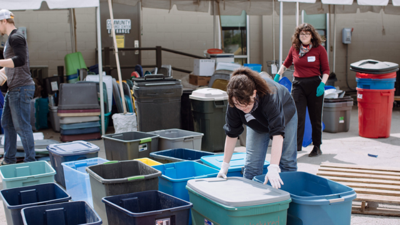
Hands On Nashville is now asking its partner groups to focus projects on urgent needs, specifically those related to food and shelter. It’s also urgent that the surfeit of donated items that came in during the initial tornado response continue to be sorted. So many items came in that at one point in the immediate aftermath, the Community Resource Center had to ask Nashvillians to pause their donations — the CRC ran out of room in its Omohundro Drive warehouse and exhausted its supply of pallets. Eventually the stock of pallets was replenished with the help of, among others, Nashville’s brewers. It’s so urgent that the donated items get into storage that the CRC secured a second warehouse, and HON is coordinating four shifts of 10 people each per day.
“Right now, we are thinking about things that pertain to hunger and materials people need to survive,” Tenorio says. “If you still have debris that you can’t get to, it’s not that that’s any less urgent, but we are trying to time those out to when people can be out in the world. There will be needs on the other side of the COVID response. A disaster is always defined by its long-term recovery efforts. What will be so important is that Nashvillians hold on to that momentum.”
For now, there are still plenty of ways to chip in. HON is helping staff temporary housing for the city’s homeless at The Fairgrounds Nashville. There are opportunities to make masks, both remotely and in person. Volunteers are needed at drive-up COVID-19 testing sites. Occasionally, there are at-home projects, like writing letters to residents of senior-care facilities, where visitation has been curtailed.
“People are so eager to help, and that has shifted since we headed into COVID territory,” Tenorio says. “We want to create structures so people can be out and be safe and still serving. The willingness of our community has shifted, but it’s still there.”



