
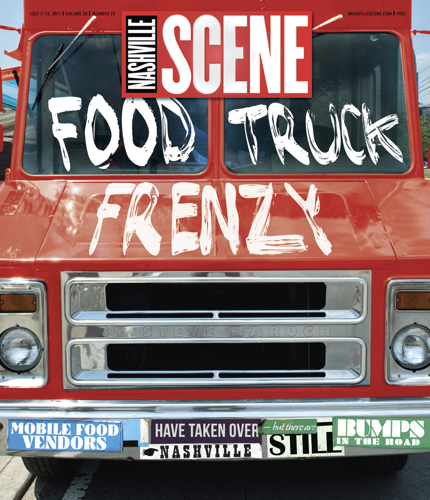
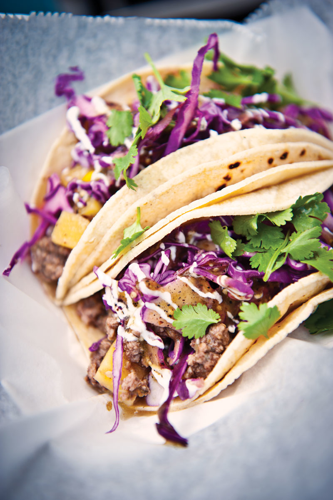
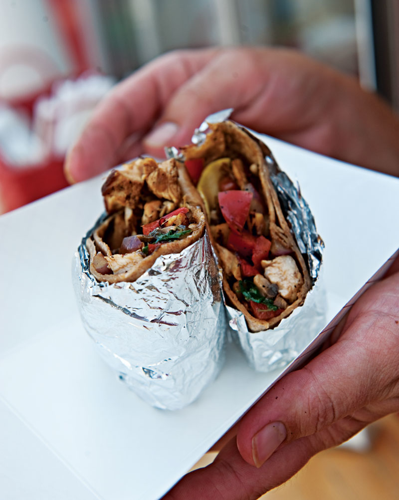
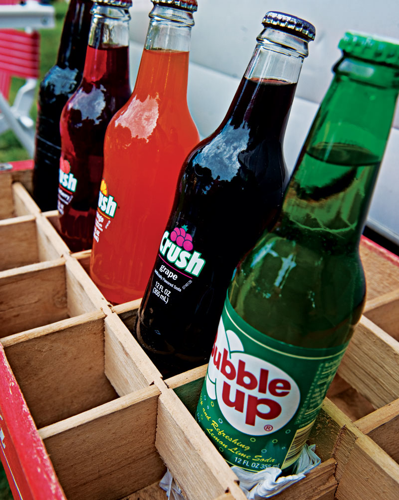
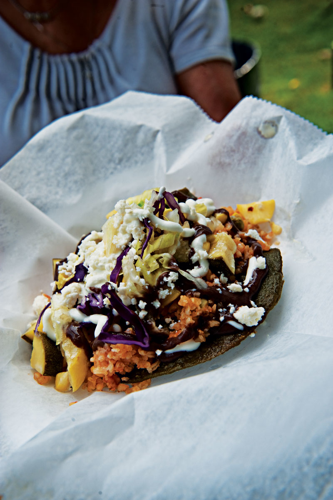

They have names like Mas Tacos Por Favor, Pizza Buds, Riffs, Labor of Love, Yayo's O.M.G., Jonbalaya, Bang Candy Co., Izzie's Ice, Tin Can Treats, The Latin Wagon, Like Nannie Fixed It, Barbie Burgers. They serve everything from authentic Philly cheesesteaks to Vietnamese banh mi, quinoa tacos to fruit-kissed Italian ice, biscuits and gravy to homemade marshmallows. They pull up at farmers' markets, outdoor concerts, parking lots, private parties and street corners — anywhere they can fit four wheels and, in some cases, a noisy outdoor generator.
A fleet of specialty food trucks has fanned out across Nashville, inspiring long lines, droves of Facebook fans and Twitter followers, and even a blog solely dedicated to following new entries to the scene and tracking their various whereabouts (nashfoodtrucks.wordpress.com). The Nashville food truck craze shows no sign of slowing, with new models either rolling out of the garage or getting fitted with stoves seemingly every other day. Even Monell's, the storied Southern dining institution, has a mobile unit in the works. And judging by the crowds of enthusiastic street-food diners lining up at low-slung windows cut into the sides of customized step vans, salvaged campers and box-office-size trailers across the city — spilling across sidewalks and green spaces in the process — it's clear the food trucks are here to stay. But where they're allowed to stay — and what to do about the crowds, noise and other side effects that follow them — presents a new set of challenges as Nashville's street-food subculture shifts into overdrive.
The fact that there are food trucks at all in Nashville — much less a booming micro-economy of rolling rapid-dispatch kitchens — owes to a bit of legal happenstance. A Metro ordinance proposed in 2005 would have outlawed mobile food vendors, and Music City's food truck revolution was almost crushed before it even began. But cooler, or at least truck-friendlier, heads prevailed. (Some felt the ordinance not-so-subtly targeted immigrants, since at the time taco trucks — many based along Nolensville Road and in other immigrant-dense areas of the city — made up the vast majority of the city's mobile food vendors.) That was five years ago this week.
Mas Tacos Por Favor — the blue, lantern-festooned Winnebago long familiar to East Nashvillians — was the first truck to really bridge the gap between the utilitarian taco trailers that are still a staple on Nolensville Road and a new generation of artfully decked-out, chef-driven (so to speak) mobile eateries. (A still-functioning MySpace page certifies Mas Tacos' O.G. status.) Mas Tacos did a steady business of late nights, private lunches and special events, eventually establishing itself enough to open a brick-and-mortar outpost last year on McFerrin Street in East Nashville, while still continuing its neighborhood runs.
The first crest of the new truck-wave hit Music City when The Grilled Cheeserie debuted its gourmet comfort food on wheels last November, to immediate foodie swoons. Chef-owner Crystal De Luna-Bogan, whose uncle owns over 100 food trucks and a large commissary in Los Angeles, had worked in catering for years, and decided to start The Grilled Cheeserie as a way to have her own restaurant without, well, opening a restaurant. The financial barriers to starting a food truck are so much lower that it allows creative foodsmiths an outlet without the constraints and overhead of a traditional restaurant. (There's the rub — or at least part of it — for owners of traditional restaurants. But more on that in a bit.)
"I did the restaurant thing for quite a while, and it didn't work out," says Riffs truck co-owner B.J. Lofback. After reading an article on Los Angeles' sprawling food truck scene, "I literally started looking for a truck right away," he says. With the help of "friends more handy than me," he built a customized food cruiser out of a decommissioned delivery van. The resulting Riffs truck, with a fold-out awning and a window that spans almost the entire length of one side, caught the eye of the truck-centric Food Network Canada show Eat St., which came to Nashville in May to film an episode for its second season.
So why us?
"Nashville is a foodie town," Eat St. director Peter Waal tells the Scene, as the crew films in Five Points on a sweltering, cicada-loud afternoon. Over the din of Barbie Burgers' portable generator, Waal says that, in his experience, great music towns are often great food towns. On that score, he says, "Nashville reminds me of Austin." (We have a way to go before we approach Austin's level of food-truck ubiquity, though.)
Because so many food trucks use social media to keep their fans apprised of their location, Waal — who's based in Vancouver — says it was relatively easy to narrow down the show's choices in Nashville. "If you ask enough people, the same trucks come up," he says. Riffs, Barbie Burgers and The Grilled Cheeserie made the cut for the episode. (No air date has been set, but the show airs in the U.S. on The Cooking Channel.) Eat St. may have filmed only three trucks while they were here, but Waal says he thinks the numbers will only continue to grow.
"I don't think we've seen the top yet," he says.
Once a truck (or trailer, in some cases) has been tricked out with the griddles, charbroilers, ovens, heat lamps, refrigerators, exhaust fans, generators, stoves and other necessary equipment, it's ready to roll. But finding somewhere to roll to — a reliable, visible and legal location where it's both welcome and able to do a brisk business — can be a tricky undertaking.
"I love being inside of a truck," says Riffs' Lofback. "I love being in front of my customers — you can't get that in any other situation." But he admits, "Finding a place to put the truck is difficult."
Tom Perkins more than agrees. He owns and operates Taste of Belgium, a trailer that specializes in authentic Belgian waffles. He serves every weekend at the Farmers' Market, but would like to also find a regular location somewhere downtown. He says the process typically goes something like this: He finds a parking lot that isn't being used. He asks if he can park his trailer there. The person he talks to says they don't own the property, and can't authorize it. They refer him to someone else. Eventually the buck gets passed so many times that Perkins just gives up.
"It goes nowhere," he says. And so does his business.
So he's looking to create a new kind of partnership, unique to his business model and tailored to his products. In addition to eat-on-the-spot offerings, Taste of Belgium also sells four-packs of take-home waffles. A retailer or cafe would be able to purchase the four-packs at a wholesale price and sell them at the same price Perkins charges. Then, every few weeks, Taste of Belgium would show up and sell the made-to-order version. "It would be a promotion for them to sell four-packs," he says, while also providing his cart with a steady gig. "Everybody wins."
Some trucks have already achieved a kind of symbiosis with local businesses — often those that lack nearby food options and have jumped at the chance to have a parade of comestible wagons come to them. Nossi College of Art has no cafeteria, so food trucks have been a godsend.
"It is very convenient for the students because they don't have to leave campus," says Julie McReynolds, student activities and communications coordinator at the school, "and they are getting better food than what is supplied in the vending machines."
Likewise, Accredo Health Group Inc. has been hosting food trucks in their parking lot for about two months. Office manager Theresa Bowers, who has been coordinating the lunchtime schedule at the company's MetroCenter office, says she'd been trying for a long time to find a good variety of food for the roughly 200 employees there. "When the trucks came along, people were raving about them," she says. "My staff is just like, 'Thank you, thank you, thank you.' You can get up, walk two steps and get a hot meal." Hungry workers get a revolving cast of quality lunches, and food trucks, instead of scrambling for a parking spot, get a steady gig during the lucrative lunchtime rush. Again, everyone wins.
[page]
But as any veteran gambler will tell you, "everyone" never wins. And certainly, not everyone is enamored with Nashville's new armada of rolling restaurateurs.
Talk to most food truck operators, and they'll tell you they aren't out to run less agile establishments into the ground. "We're trying to be real cool," says Riffs' Lofback. "I don't want to disrespect another man's business." Similarly, The Grilled Cheeserie's De Luna-Bogan says, "I would never park in front of a restaurant — you should never do that."
But there has been conflict. At Cummins Station — a location both Riffs and The Grilled Cheeserie have tried — Lofback says, "I had a brief encounter with a restaurant owner there who was ridiculously rude to me."
It's understandable that an established restaurant might dislike a drive-by competitor pulling up unbidden. And parking in front of Cummins Station is, for all intents and purposes, parking in front of a restaurant — for one, Wild Wasabi, with its sushi lunch buffet, is situated there, along with some smaller lunch spots.
"I'm not totally opposed to these guys coming around and doing stuff," says Paul Koumanelis, owner of Pizzereal in East Nashville, "but not when they're going to sit outside my business and pick off clientele who would normally come here."
Food truck supporters counter that someone with a hankering for their favorite dish in their favorite corner booth isn't going to about-face just because a truck happens to be parked across the street selling something different. Successful restaurants with good concepts and loyal clientele, the argument goes, have nothing to fear from food trucks. "Iron sharpens iron," as one food truck defender on the East Nashville community listserv put it: Competition makes every competitor better and weeds out the less inspired.
"Margot's not worried about food trucks," De Luna-Bogan says, referring to the innovative East Nashville eatery. She adds that one day The Grilled Cheeserie ran out of bread in the middle of a service, and workers at nearby Marché supplied her with more. (Both businesses use the same brand.) She says her business has ample support from local chefs, including Tayst's Jeremy Barlow and Cha Chah's Arnold Myint. "It's the people who feel threatened by other businesses who seem to be complaining," she says. The Five Points area of East Nashville in particular, with its concentration of bars, restaurants and late-night foot traffic — an ideal bottleneck of hungry stragglers who might be enticed by chalkboard-sign specials on the side of the road — has become a flashpoint.
"It recently got out of hand when multiple giant eyesore trucks began parking in front of bars and restaurants without asking permission and cranking on their loud generators," says Todd Sherwood, owner of The 5 Spot. Too many trucks, parking too close together too often, can become a nuisance. But it's not that the food trucks are necessarily a problem in and of themselves: "The 5 Spot will always support the good ones and always allow them on our property for busy late nights and special events," Sherwood says.
"I'm looking to support any local Nashville businesses," adds Johnny Shields of The Green Wagon, the eco-friendly general store at Forrest Avenue and 11th Street, "as long as they're a respectable business."
At least one other area business feels differently — or at least holds a higher bar for respectability.
On the night of June 10, just a few weeks after Eat St. filmed its segment with Barbie Burgers — the hot-pink burger-slinging camper bedazzled with plastic doll parts — just outside Red Door East, Metro police were summoned to a nearby stretch of asphalt. Officers from East Precinct, who according to Metro Police were responding to a complaint from an area business, approached a food truck, told the operators they weren't allowed to be there, and asked them to leave. The truck moved, and no citation was issued.
But for the most part, the intended message of that visit from police seems to have hit its mark: "A lot of trucks are steering clear" of Five Points, says Laura Myers, of the Happy Eating food truck, which specializes in Japanese cuisine.
"At some point, we're going to have to start some sort of food truck association," says Taste of Belgium's Perkins. "It is just a matter of time before a group of businesses say, 'We don't like this — we need to legislate them out of business.' "
Some businesses clearly are unhappy with the growing presence of food trucks. But it's not just about unwanted competition, according to Pizzereal's Koumanelis. "At the end of the night, they turn the key, the truck drives away, and the people they've all sold their food to leave their trash wherever they leave it," he says. "Some of them are responsible ... and put it in barrels, some of them don't." In addition to the garbage and noise — and in some cases, obstruction of his signage by large vehicles — Koumanelis says, "I've even had people walk from those trucks up my front stairs, and sit down on my patio in my chairs, starting to eat their food they bought from a truck."
Pizzereal's business has suffered, Koumanelis says, at the hands of even smaller businesses with much lower overhead and startup cost. But more than that, it's a matter of respect. "I consider myself a pretty open-minded guy," Koumanelis says, "but right is right."
In some cases, the conflicts that arise are as much due to confusion as anything, because understanding of the law varies widely. For example, one food truck vendor tells the Scene, "Legally, I can park in any parking spot and sell — except for what would be the best places for me to do so, which is downtown." But Koumanelis asserts that, as he understands the law, "It's illegal to sell from a public right of way anywhere in the city except for designated areas, and the only designated areas are downtown."
Trucks like the various Tacos y Mariscos Lopez vehicles around South Nashville — parked for a season or longer in the same spot — require a permit, but that doesn't apply to trucks that can roll up and be gone in a few hours. And it makes a difference whether a food truck parks on private property or in a public right-of-way. And on top of that, it makes a difference how the neighborhood — or even the specific block — is zoned. For instance, the truck that was asked to leave Five Points on June 10 was parked illegally in front of the library, but Metro police say had they been parked in front of Red Door East just a block over, they'd have been in the clear. Confused yet? You're not alone.
Here's what the rules actually say:
On the one hand, section 13.08.040 of the Metro code states: "No person shall stop, stand or park any wagon, pushcart, automobile, truck or other vehicle, or erect any temporary stands, signs or otherwise, upon or within any public property of the metropolitan government for the purpose of selling or offering for sale any goods, food, wares, merchandise or products of any kind."
On the other hand, the "Regulations for Temporary Sidewalk Encroachments (Street Vendors and Temporary Signs)" allows for exceptions to that rule, noting that having temporary vendors on public ways — which would include delicious tacos and other noshes available from a streetside truck — "promotes the public interest by contributing to an active and attractive pedestrian environment." However, those regulations, adopted in 1998, "do not address motor-driven vendor sales," according to Gwen Hopkins-Glasscock, public information liaison for Metro Public Works. "We plan to put this item on the agenda of the [Traffic and Parking] Commission's August meeting."
The rubber meets the road Monday, Aug. 8, at 3 p.m. in the M.H. Howard Conference Room of the Metro Government Office Building, 700 Second Ave. S.
Even though tempers have flared here and there over food trucks and the turf they cover, one intriguing solution may be in the offing. As cities around the country grapple with how to handle growing numbers of food trucks on their streets — The New York Times reported last week that police have begun systematically ousting food trucks from midtown Manhattan — fans and supporters are looking for ways to reach a balance point.
Holley Seals has just such an idea for Nashville.
Seals worked on The Grilled Cheeserie truck alongside her cousin, owner Crystal De Luna-Bogan, before embarking on her latest quest: Wanderland Urban Food Park, which would be a permanent location where a revolving cast of eight to 10 food trucks could park every day and serve hungry customers. She imagines a place that becomes an integral part of the neighborhood, with a common seating area and maybe even Wi-Fi, or live music. "I'd want it to be as green as possible," she says, and "a place where people can come and hang out ... a place for community-building." It wouldn't be a place to drain the free-roaming spirit from the tanks of Nashville's food truck scene, she says — far from it — but rather a dependable hub for the trucks that "brings value to the community." Since Wanderland would assume any liability, Seals is hoping it would help ease some of the anxiety over codes that has made some businesses reluctant to host trucks, and left truck operators nervously checking their mirrors. She says she's currently in talks with neighborhood associations around the city, and hopes to at least have a temporary location in place by the end of the summer.
And while there are already multiple multi-truck events around Nashville each week — the farmers' markets are full of "our people," as Riffs' Lofback puts it — be on the lookout for more. "I would love to see Nashville do an event where all the food trucks can come together," Happy Eating's Myers says, a wish Seals is working to fulfill. In the meantime, some of Nashville's most accessible made-to-order cuisine can be found zig-zagging through traffic, rolled up on lawns and sidled up to sidewalks around the city — moving crucibles of the city's culinary and entrepreneurial energy.
Email editor@nashvillescene.com.
Click here to download a PDF of some of Nashville's food trucks and their Twitter handles.



