
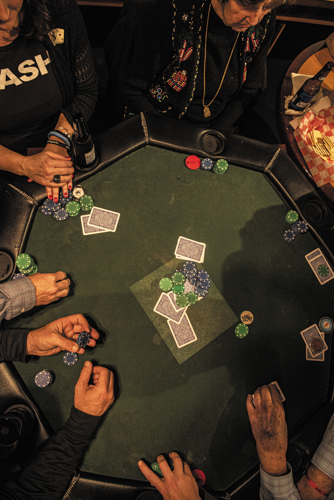
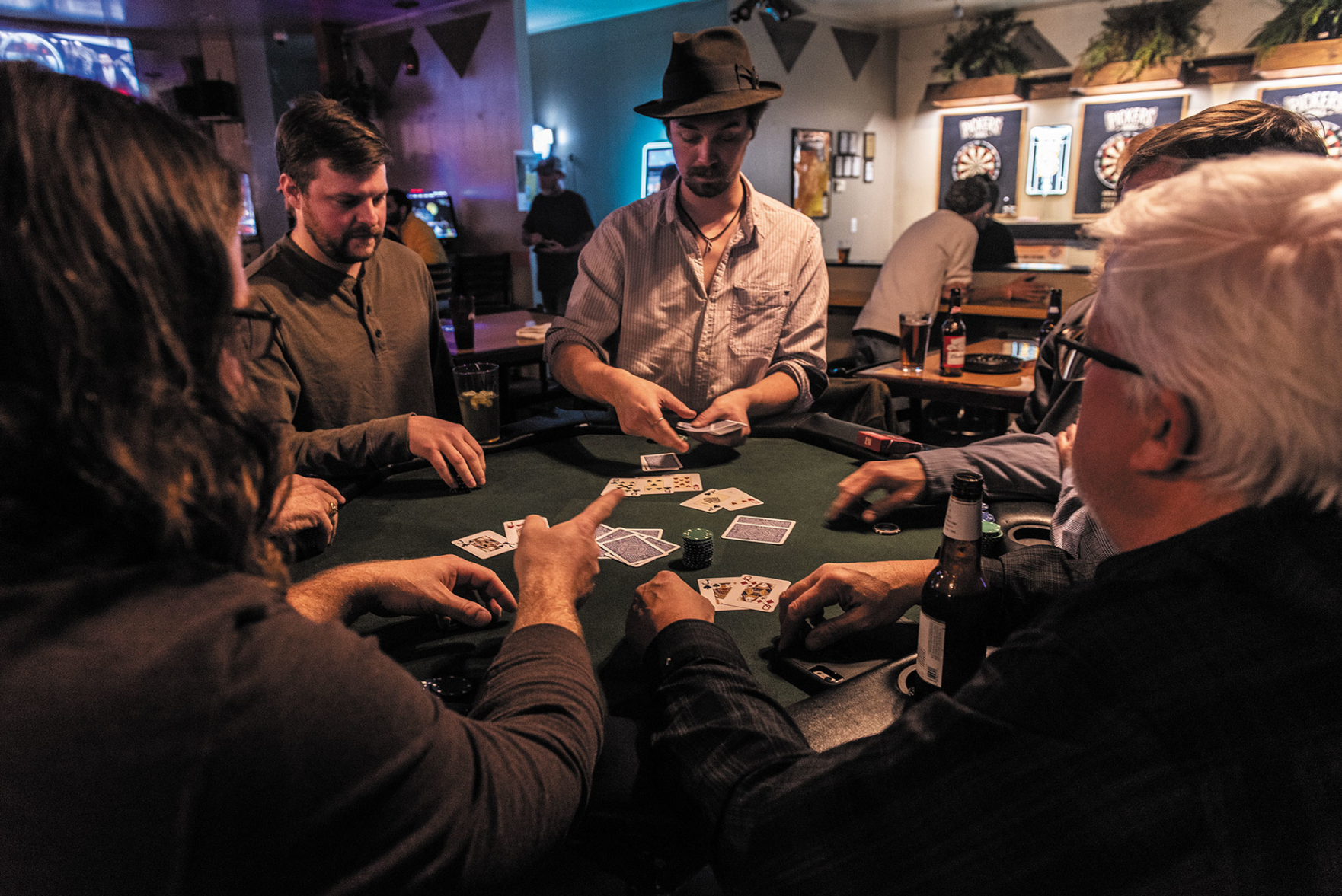
Left to right: Matt Loftus and Benjamin Winrock
Nicole Lashley-Wynn enters the bar looking like the Queen of Hearts. She’s clad in a crimson tartan shawl and her usual crystal bangles and rings. Cigarette smoke swirls around her head, looking like a crown in the low light.
It’s Friday night at Redline Bar & Grill in Bellevue, and at 7 p.m., five poker tables are full, each surrounded by six people waiting patiently for the host’s cue. As Lashley-Wynn makes her way toward the bar, she greets each of the players she passes with a wide smile and a familiar touch on the shoulder. When she addresses me, her voice is gravelly, low and warm. She comes out to play the league’s game, Texas Hold ’Em, about three times a week, and typically only for the second game — she’ll leave the house only after her three boys, ages 14 to 20, have had dinner and done their homework.
Lashley-Wynn learned to play “regular poker” — five-card stud — from her dad and grandfather as a 6-year-old in Chicago. She would play their elderly neighbors frequently, betting for pennies and green olives. “My mom thought green olives were too expensive and would never buy them,” she laughs. For Lashley-Wynn’s 21st birthday, her grandparents took her to Las Vegas, and in 2009, she joined Nashville’s Elite Poker League. In 2013, at age 42, Lashley-Wynn teamed up with her father Victor Mitchell to buy the league. Since then, the EPL has been her realm and sanctum.
The league, which has about 1,200 active players per quarter, hosts two games a night — each completely free and legal — at a different Nashville bar each day of the week. Gambling for money is illegal in Tennessee, so players bet for points, which are logged by the trained host on an app that ranks each person based on their cumulative scores. These ranks are used to qualify players for special tournaments and for the league’s annual trip to the Horseshoe Casino in Tunica, Miss., where they compete (for cash, legally) against the Memphis team, the River Rat Rounders.
Marvin Bateman and Paul Buttrey, Nashville natives in their late 60s, sit to my left at the table where I’ve taken my place. (I’ve played in the league since January.) Bateman and Buttrey are neighbors, and they gamble together at the casino in Tunica every two or three months, as well as annually with the team. “That’s where we got these T-shirts,” Buttrey says, he and Bateman pinching their black shirts where the league’s initials are printed. They also proudly show me their EPL bracelets.
As enthusiastic as they are about the league, they aren’t wearing the accessories out of EPL pride alone. The host hands out extra chips at the beginning of the game for each piece of league merchandise a player presents, as well as any merch sporting the name of the current league sponsor. (Last quarter, the sponsor was Four Roses Bourbon. Starting Jan. 1, the dual sponsors will be Bev, a woman-owned wine company, and Ajax Turner, which is based in La Vergne.) Another element players get extra chips for: each drink they buy at the bar.
Tonight, thirst will be quenched by beer alone. Richie King, a proud fifth-generation Nashvillian, took over ownership of Redline in November, and he says there are some paperwork obstacles delaying his liquor license. Still, it’s a full house, with each dart board in use and high stacks of empty beer glasses next to the usual tequila drinkers, who trust King’s word that the liquor will be flowing again come next Wednesday.
Not partaking in any drink is tonight’s host, Chris Zimmer, a former Air Force EMT who wears cologne and a white seashell necklace his parents got him on their vacation to Hawaii. He sits in the corner with his iPad at the ready to start the countdown for the blinds, which go up every 10 or 15 minutes. He addresses the tables in his booming voice — “Poker players!” He gives the signal to start dealing, and the cards fly, as do the insults — only some of which are in jest. I’m big blind on the first hand, and I take a look at my cards: three-six suited (diamonds). Buttrey, under the gun, raises the blind, and everyone else folds — except Wes Villers to my right, who reraises. I fold as well, leaving Buttrey and Villers head to head. Three rounds of betting later and Villers is the chip leader, beating Buttrey’s pocket sixes with a straight-flush draw. Villers rakes in his pile of points. I notice he’s also sporting a bracelet, except this one is turquoise and says “Autism Speaks.” “The league hosts a lot of community benefit games where you buy in for cash, but it all goes to a charity,” Villers tells me.
Matt Loftus is a three-year veteran of the EPL and co-chair of Nashville’s Autism Speaks, a nonprofit devoted to funding research and raising awareness for autism. When he told Lashley-Wynn of his idea of doing a fundraising event with the poker league, she quickly bought into the idea.
“We get together every year and have a buy-in of $20 or $30,” says Loftus. “The tournament encourages rebuys and add-ons, like if you donate $5 more you get extra chips. Lashley-Wynn does all of the leg work, promoting on Facebook and getting people out. She gives the chips, tables, time, and she doesn’t make a dime from it.”
Across the table, a player named Todd interrupts Loftus’ humility by informing me that Loftus’ league nickname is “The Champ.” Loftus shakes his head and folds his hand.
It’s December, and the EPL’s current fundraising project is its annual Christmas toy drive, also run by a player — Ron Sapino of Kids Cafe in Nashville. Players can bring an unwrapped toy to the game and get extra chips. The league also does fundraising tournaments with Maggiano’s Little Italy for the Make-A-Wish Foundation and Nashville firefighters’ Operation Warm fundraiser.
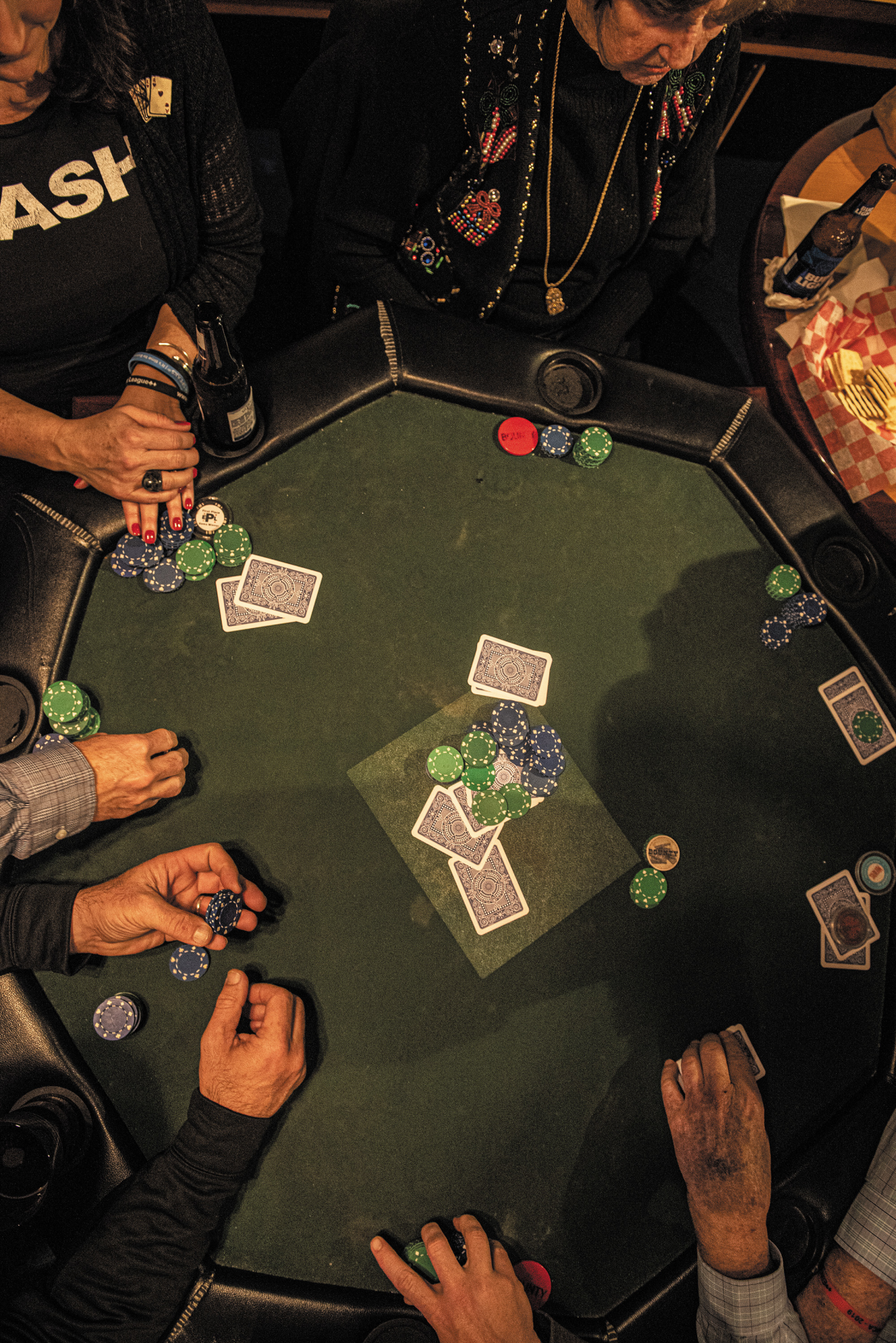
But the camaraderie of the EPL is a house of cards. The aggression factor runs high in poker, even when cash isn’t involved, and friendly jabs have turned to outdoor showdowns more than a few times, says Bo Bomar, who has played in the league for 11 years. “Usually other players will step in to defuse the situation before it’s taken outside,” she says. “People will get upset because they’ll lose against someone who plays a hand that, in their mind, the opponent shouldn’t have even played. But that’s the thing about poker: You can play everything right and still lose.”
Take the most notorious hand: pocket aces. Play them right and you could rake in a hefty pot. Play them wrong, and, well, you might see your name go down a few ranks on the EPL app. “I just had pocket aces not but a few hands ago,” says Robert Hraba. He bet three times the blind, but they were cracked. And that’s how it goes, he says.
“Most of the time, though, I say we’re like a dysfunctional family,” says Bomar. “And Ms. Jewel is the matriarch.”
Even many who have played against Ms. Jewel for years now still don’t know her full name, but she tells me it’s Jewel C. Crandall. She’s 93 years old, and she sits at the same seat at Redline every Friday — “down low,” as the Redline players call it, at the one table that isn’t four feet off the ground. Ms. Jewel learned to play poker at 9 years old. When I ask how long she’s been playing in the league, she can’t quite recall. “Oh, longer than 10 years,” she says.
Behind me, Brandi Kemp pipes in. “Fourteen or 15 years at least.” “Twenty years,” says someone else at the table next to us. “I go about six times a week to four different places,” says Ms. Jewel. “Do you want me to list them? Corner Pub in the Woods, Corner Bar at Elliston Place, Redline and Players.”
“She has a pretty set schedule,” says Kemp. Ms. Jewel has a car, but she chooses to take Uber or be driven by a fellow player back to her senior home — a wise decision, given the empty glasses she’s stacked almost as high as her usual chip stack.
There’s Bryce Bennett, a U.S. Army veteran who served two tours in Iraq. There’s the younger crowd of players, usually seen as the fish — that is, new and inexperienced players. And there’s the younger longtime league crowd, such as 30-year-old Cory Konz from Franklin, who discovered poker nine years ago while the EPL was playing at Corner Pub on Monday nights. “I learned the game because I would see them playing in the bar every week and thought, ‘I want to learn that,’ ” says Konz.
“You’ll meet everyone from blue-collar workers to doctors and lawyers and everyone in between,” says Bomar. “We’ve had people in the league with cancer, and people came together for them. We had a father and daughter who played and the daughter overdosed, and we had a benefit for the dad. Antonio died in his mid-30s from a heart attack, and the league paid for his funeral. We have had people meet and get married, meet and get married and have babies, and meet and not get married and have babies.”
The appeal of bar poker is that it gives everyone, even “socially awkward m-fers,” something to do when they go out, says Lashley-Wynn. “I’m an introvert. I was a stay-at-home mom for 14 years. The league brought me out of my shell. Some places you go to and can’t wait to leave, but not with poker. This feels like home.”
Tonight, the lack of hard liquor doesn’t seem to be affecting the energy. When everyone is sufficiently boozed up, the cook, affectionately known as “Feezy,” closes the kitchen and sets up his karaoke station. First to act is John Oliphant, who chooses Sinatra’s “Luck Be a Lady” — heads would certainly be turning at his talent if everyone hadn’t already heard him sing it dozens of times before. An hour later, eight men are crowded onstage, leaning on each other with beers sloshing and cigarette ash falling, belting “Sweet Caroline.” At the tables, their cards are folded for them for the three minutes and 25 seconds it takes to sing the Neil Diamond song. But as the group stumbles off the stage, Zimmer hands them each extra chips for singing.
“This is my bread-and-butter,” says King. “My main draw. It’s the best people, the best environment, loyal customers. I love it. Friday night poker is what it’s all about.”



