
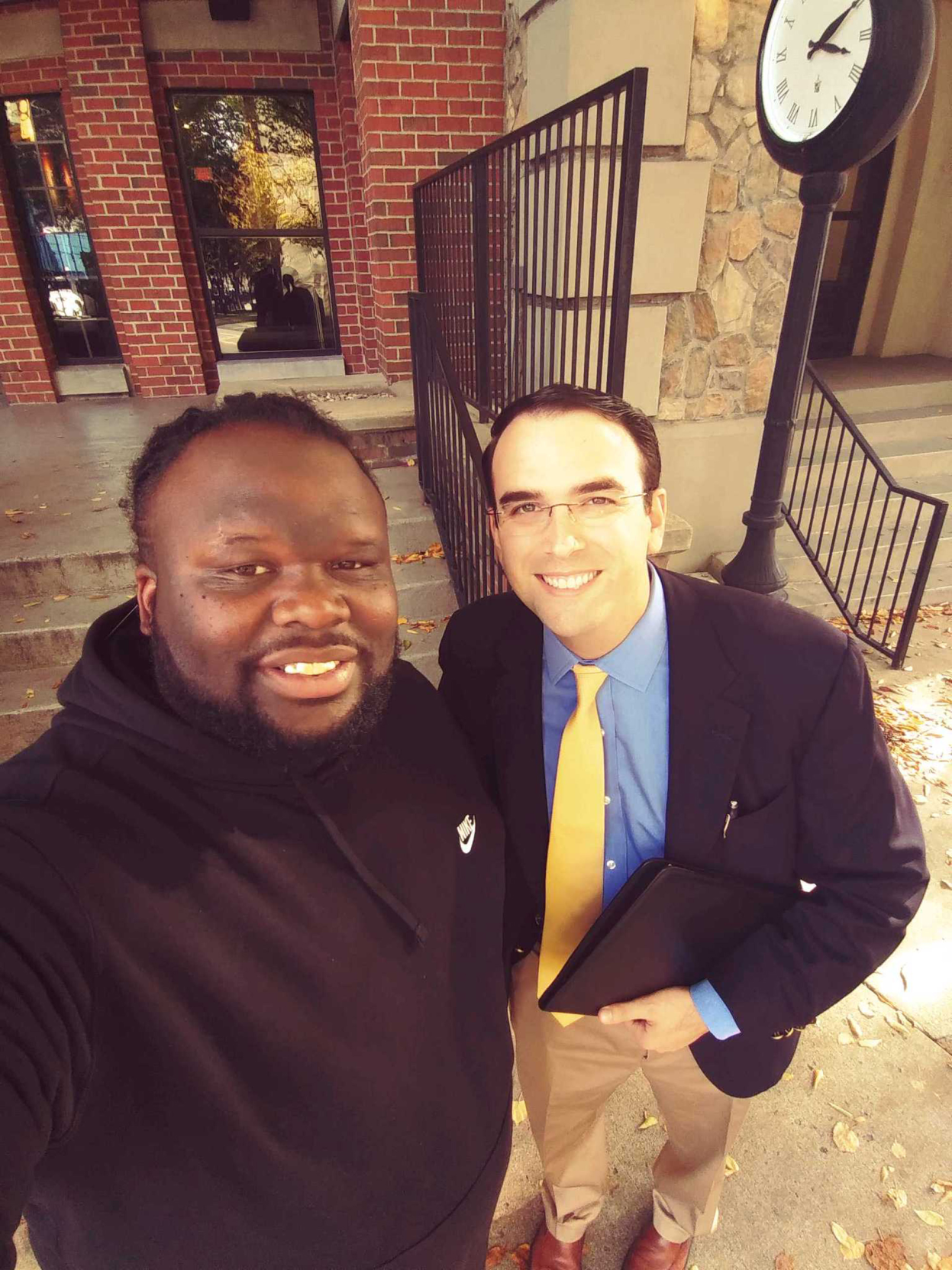
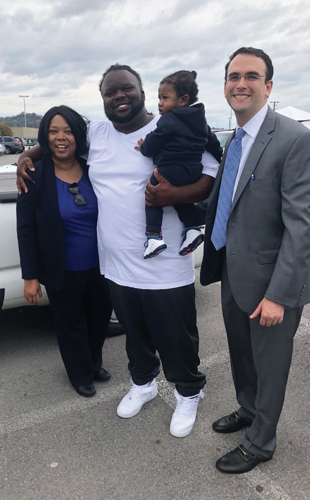


From Left: Attorney Joy Kimbrough, Calvin Bryant, Bryant’s nephew and attorney Daniel Horwitz
If you want to see the relief and joy of newfound freedom, go knock on Calvin Bryant Jr.’s door. The 32-year-old beams as he greets a reporter he’s never met. He’s a big guy — it’s obvious why his nickname has long been “Fridge” — but on this day, a little more than two months after his early release from prison, it looks like 1,000 pounds have been lifted from his shoulders.
Bryant was just 22, a former Hillsboro High School football star who had moved on to play for Tennessee State University and had no criminal record, when he sold 320 pills, mostly ecstasy, to a longtime family friend. What he didn’t know was that his friend was working for the Metro Nashville Police Department as an informant in exchange for a good deal on a recent arrest. The pill sale took place in Bryant’s home, but because the Edgehill housing project where he lived at the time was within 1,000 feet of a school, he was convicted under Tennessee’s drug-free-school-zone law. He received a 17-year sentence, with a mandatory minimum of 15 years before he’d be eligible for parole. It was a sentence harsher than the one he would have received for rape or second-degree murder.
In recent years, Bryant’s case had prompted increased scrutiny of drug-free-school-zone laws. Such laws were ostensibly created to punish people who sell drugs to kids, but they’ve resulted in harsh mandatory sentences in cases where no children were present, or in which the defendant is a nonviolent first-time offender. Both of these circumstances apply to Bryant’s case.
But Davidson County District Attorney Glenn Funk, who took office in 2014, has refused to prosecute such cases unless a child is actually endangered. And in October, he agreed to a deal that allowed Bryant to be released.
A couple months later, Bryant closes his eyes and shakes his head as he recalls the feeling of getting in a car with his attorney, Daniel Horwitz, and his mother before driving away from Riverbend Maximum Security Institution.
“I still live off of it,” he says. “Every day I wake up, I wake up with a purpose to be great. Because I know I could be in a cell right now.”
That’s not to say the transition has been easy. Bryant says that for days after he moved back to his mother’s house, he struggled to break out of his prison sleep pattern.
“I was used to being locked down at a certain time every night, and waking up at a certain time and being counted,” he says.
Still, within days of his release he was visiting churches and school groups to talk about his experience. In a short time he has become a regular speaker for high schools and groups working with at-risk youth. And he’s back in school at TSU.
“My main purpose when I was released was to change lives,” says Bryant. “I felt like it was kind of difficult to change lives and tell these kids to never give up if I wasn’t doing the same thing. So I felt like I had an obligation to go back to school and show kids that regardless of what you go through, or how long you go through it, you still can accomplish your goals and your dreams.”
But Bryant and his relentless attorney have another goal — a pardon from Gov. Bill Haslam.
“That would be everything for me,” Bryant says. “I respect [Haslam] to the utmost, you know, he has a job to do either way he makes the decision. [But] that’s my final goal when it comes to this case and what I’ve been through, for him to get rid of it all. That’s a way that I can really start over and have a second chance. But if he don’t do it, I’ve still gotta push forward regardless. I feel like that would be an amazing thing, I feel like that would be a gift from God if it does happen. It is very important to me. Very important. I’m just thankful that I got the opportunity to get out before the decision was made. But that would cap it off right there. I’d be able to do a lot of things that I won’t be able to do right now.”
Beyond the psychological effect of a pardon, a criminal record can be a serious obstacle to job opportunities and housing. Horwitz thinks a pardon would also send a powerful message.
“In addition to giving him his life back, giving Mr. Bryant a full chance for redemption will immediately inspire others to take responsibility for their mistakes, learn from them, and use their second chances to become productive citizens that everyone can be proud of,” Horwitz says. “If [Haslam] cares about justice and grace at all, why wouldn’t he pardon him?”



Post a comment as anonymous
Report
Watch this discussion.
(0) comments
Welcome to the discussion.
Log In
Welcome to the discussion.
Keep it clean. Please avoid obscene, vulgar, lewd, racist or otherwise abusive language. Comments featuring hate speech or threatening or violent content will not be tolerated.
PLEASE TURN OFF YOUR CAPS LOCK.
Be truthful. Don't knowingly lie or mislead.
Be proactive. Use the “report” link on any comment that violates our comment policy.
Share with us. We'd love to hear your feedback.