


The Department of the Interior has done a bang-up job promoting public lands during the pandemic, emphasizing that there’s no better way to get out of the house and stay safely away from people than exploring some of the 640 million acres that belong to every American.
Recreation, after all, is essential activity.
But with so many options — 62 national parks, 128 national monuments and umpteen other designations — why pick the one that draws the most people? Great Smoky Mountains National Park is far and away the most visited national park, with 12.5 million people stopping by in 2019 — more than twice as many as the runner-up Grand Canyon.

It’s easy to see why. The stunning and verdant vistas are awe-inspiring. The park is riddled with creeks and streams tumbling over dozens of waterfalls. Bears and, now, elk are a frequent site. Unlike most of the 61 other parks, it’s free. But it’s also wildly convenient. It’s a breezy four hours from Nashville to the Sugarlands Visitors Center on the west side of the park, and it’s just as accessible from other cities in the South and along the Eastern Seaboard. That’s a far less daunting haul than, say, 20 hours to Petrified Forest National Park (trust me, I know). And with a little planning and ingenuity, crowds are avoidable. You just have to go to the other side of the mountain to see what you can see.
Most visitors spend the vast majority of their time on the western, Tennessee side of the park, accessible through either Townsend or Gatlinburg. The park’s superstar attractions — Cades Cove, Laurel Falls and Clingmans Dome — are all on that end of the park, and even with a pandemic on, they stay plenty packed. And with good reason: All are worth seeing.
The more rugged eastern side of the park in North Carolina is no less beautiful and has plenty to see on its own — and being less dense with tourists, it has certain advantages in these times.
There are also plenty of other places to explore and experience outside the park boundary for those willing to drive on past the Rockefeller Monument.
Stay

Cherokee, N.C., is just outside the park boundary, a short drive to the Oconaluftee Visitor Center and a center point of sorts in the cluster of charming mountain towns near the park — Maggie Valley, Sylva, Bryson City and Waynesville — thus making it a great base camp. Like many towns forced to survive crowded against the Appalachians, its geography is a bit disjointed. There are, as one might expect, lots of lodging options at various price points, levels of corporatism and age near the Harrah’s Cherokee Casino Resort. But the middle of town, split by the Oconaluftee River, is less beset by national chains, catering to those looking for a more charming (or kitschy) experience.
The River’s Edge Motel offers riverside balconies with every room, complete with rocking chairs for resting weary feet after exploring some of the more than 800 miles of hiking trails in the national park. After the sun sets over the Smokies, the stars shine bright, and it’s mighty relaxing to lean back in the rocker, gaze up at the sky and listen to the bubbling river below while sipping on a cold one from one of North Carolina’s myriad craft breweries. (One caveat: almost no retail stores inside the Qualla Boundary, the lands of the Eastern Band of Cherokee Indians, sell booze; grab a sixer in Tennessee or in one of the towns outside tribal lands.) Similar to its western neighbor, the North Carolina side offers lots of cabin rentals as well, though they are often remote. With population centers, such as they are, already far-flung, the more rustic option puts the traveler even farther away from things to do and places to eat — though of course social distancing is much easier.
Cherokee is a walkable town, and opting for a hotel within its city limits allows visiting its destinations to be a blessed respite from being behind the wheel. Note that the sidewalks are a bit narrow and up against the main highway, so maintaining six feet from other pedestrians requires a little effort.
Do
Sometimes, the best activity is the easiest: admiring the grandeur that surrounds you in the wilderness … but those with less transcendental desires will find plenty of things to do as well.
For hiking on the western edge of the park, a good jumping-off point is the Deep Creek entrance near Bryson City. Hikes of any difficulty or length can be put together with an official trail map, though letting intuition be one’s guide once on the trail is also an option. A simple two- to three-mile loop (depending on side trails and one’s propensity to get lost) from Deep Creek offers views of three waterfalls — Juney Whank, Indian Creek and Toms Branch. Overlooks — some with surprisingly comfortable benches — are good places to take a load off and watch the tubers float past (tubing is an extremely popular pastime on the North Carolina side and can be enjoyed while maintaining that critical distance) or admire the work of artists who use the relative quiet as inspiration for their painting or chalkwork. Mingo Falls, though not actually within the park, is easily accessible from Cherokee. It’s 120 feet tall, making it one of the highest waterfalls in Southern Appalachia.
The trails at Deep Creek are rarely crowded and extraordinarily wide as well, a welcome sight after dodging the maskless throng at Clingmans Dome.
After a morning’s hike, absorb some local culture. Qualla Arts and Crafts Mutual in Cherokee’s Cultural District offers traditional crafts from prize-winning Cherokee artisans (and modern takes on those crafts). There are handmade blankets and clothing, intricate basketry, highly detailed woodwork and stonework, and pottery of all shapes, sizes and uses. Bows, arrows and equipment for the Cherokee sport of stickball, all made the traditional way, are also available. The shop also includes a small museum featuring the work of the most renowned craftsmen. Qualla is the oldest Native American artists’ co-op in the United States, founded in 1946 to preserve traditional Cherokee artistry against the rise of mass-produced goods and ensuring Cherokee craftsmen are paid fairly for their work.
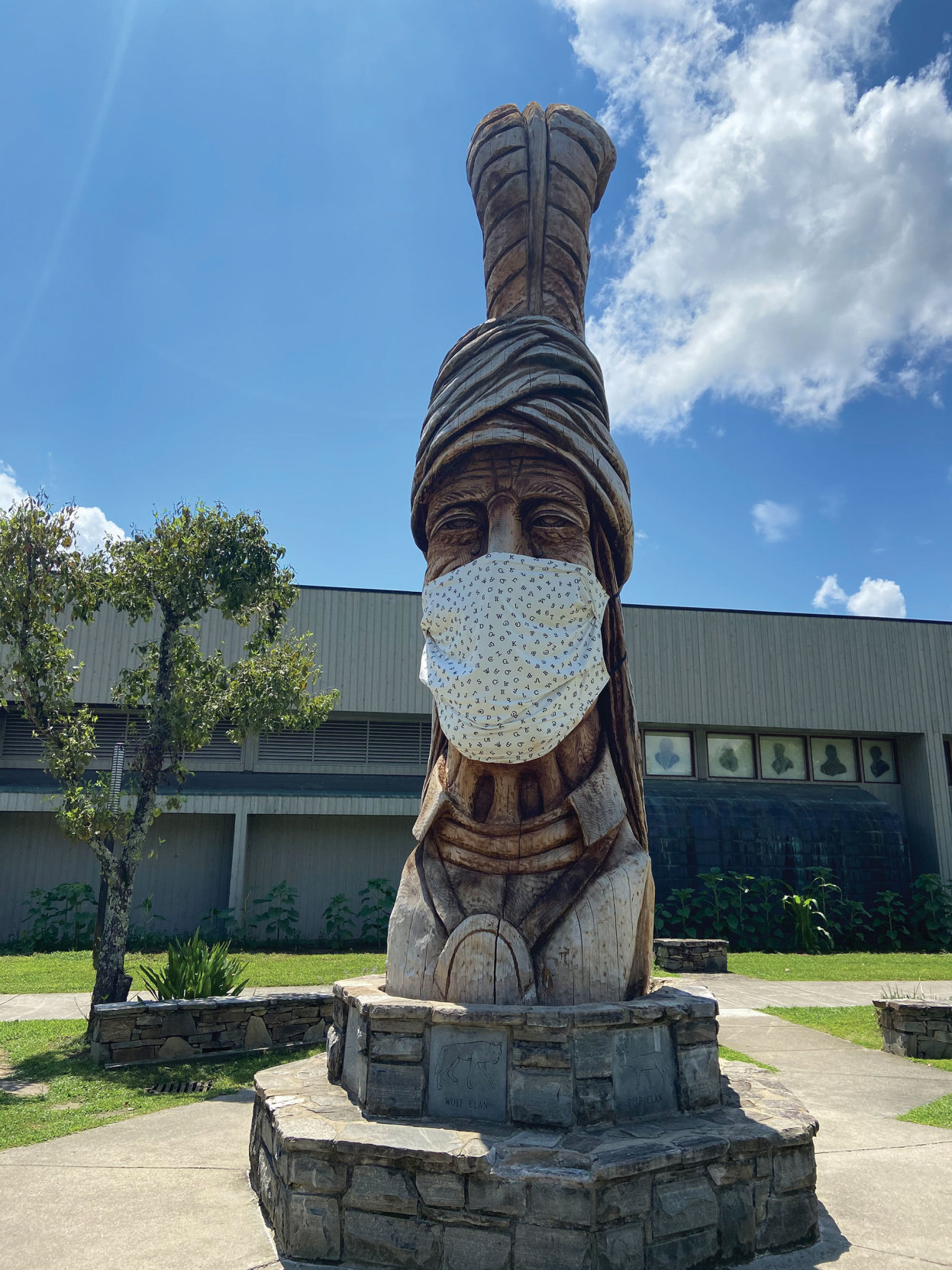
Museum of the Cherokee Indian
Across the street is the Museum of the Cherokee Indian, a look at 11,000 years of history of the tribe, with a particular focus on the Eastern Band, who remained in this corner of North Carolina even after removal sent 15,000 of their people west on the Trail of Tears. The museum showcases how the tribe was able to adapt, survive and thrive when faced with repeated challenges. Coincidentally (or serendipitously), the museum is currently hosting Many Faces, an exhibit featuring more than 150 masks from more than 50 Cherokee artists. Ceremonial mask-making is a centuries-old tradition among the Cherokee, though it nearly died in the mid-20th century. It was revived by a small clutch of artists and is thriving once again, with today’s carvers putting a modern spin on the old tradition.
Need to cool down and unwind after a long day? Oconaluftee Islands Park stretches along the banks of the eponymous river running through town. The shallow waters stay chilly even in the height of summer, and while there are stretches that are a bit rapid, the river is safe enough for toddlers to splash around. Note that the river bottom and much of the shore is quite rocky. Barefootedness isn’t the best idea.



Post a comment as anonymous
Report
Watch this discussion.
(0) comments
Welcome to the discussion.
Log In
Welcome to the discussion.
Keep it clean. Please avoid obscene, vulgar, lewd, racist or otherwise abusive language. Comments featuring hate speech or threatening or violent content will not be tolerated.
PLEASE TURN OFF YOUR CAPS LOCK.
Be truthful. Don't knowingly lie or mislead.
Be proactive. Use the “report” link on any comment that violates our comment policy.
Share with us. We'd love to hear your feedback.