






Four police officers, two people of the cloth, former drug addicts, activists, politicians, CEOs and do-gooders, slicing across every demographic. And that’s not counting the 620-some-odd-thousand people who won nine years ago. For three decades, the Scene has devoted an issue near year’s end to the people making Nashville a better place to live. Here’s a look back at what they’ve done since and where they are now.
1989: Suzanne Brown and Joyce Harris
Then: Joyce Harris had led the residents’ association at Preston Taylor Homes for 13 years and was instrumental in starting what we would now call pre-K at McKissack School. She was so well-known on Clifton Street that drug dealers sheepishly apologized to her if she ran into them. Suzanne Brown was a teacher at a similar pre-K-style program at Caldwell Early Learning Center.
Since: Harris’ honors didn’t stop with the Scene. She was ultimately feted by, among others, the Junior League and J.C. Penney for her community service.
Now: Harris died in 2018. The Scene was unable to track down Brown.
1990: Andy Shookhoff
Then: After four months on the bench, Juvenile Court Judge Andy Shookhoff took home the Nashvillian of the Year honors for his efforts at reforming and streamlining the long-neglected juvenile courts in Davidson County. Swept into office in the anti-cronyism-wave election of 1990, the nationally recognized juvenile justice expert was widely lauded for the overhaul.
Since: The reform-minded “tofu-eating” Shookhoff lasted eight years on the bench, defeated in 1998 by former prosecutor Betty Adams, who ran on the platform that Shookhoff had turned the juvenile courts soft. Shookhoff — who won a national award from the Court Appointed Special Advocates in 1996 and saw his court designated a national model court by the National Council of Juvenile and Family Court Judges — led Vanderbilt’s Child and Family Police Center from 1998 to 2009.
Now: He still practices family law in Nashville and is a consultant with the Washington, D.C.-based Center for the Study of Social Policy.
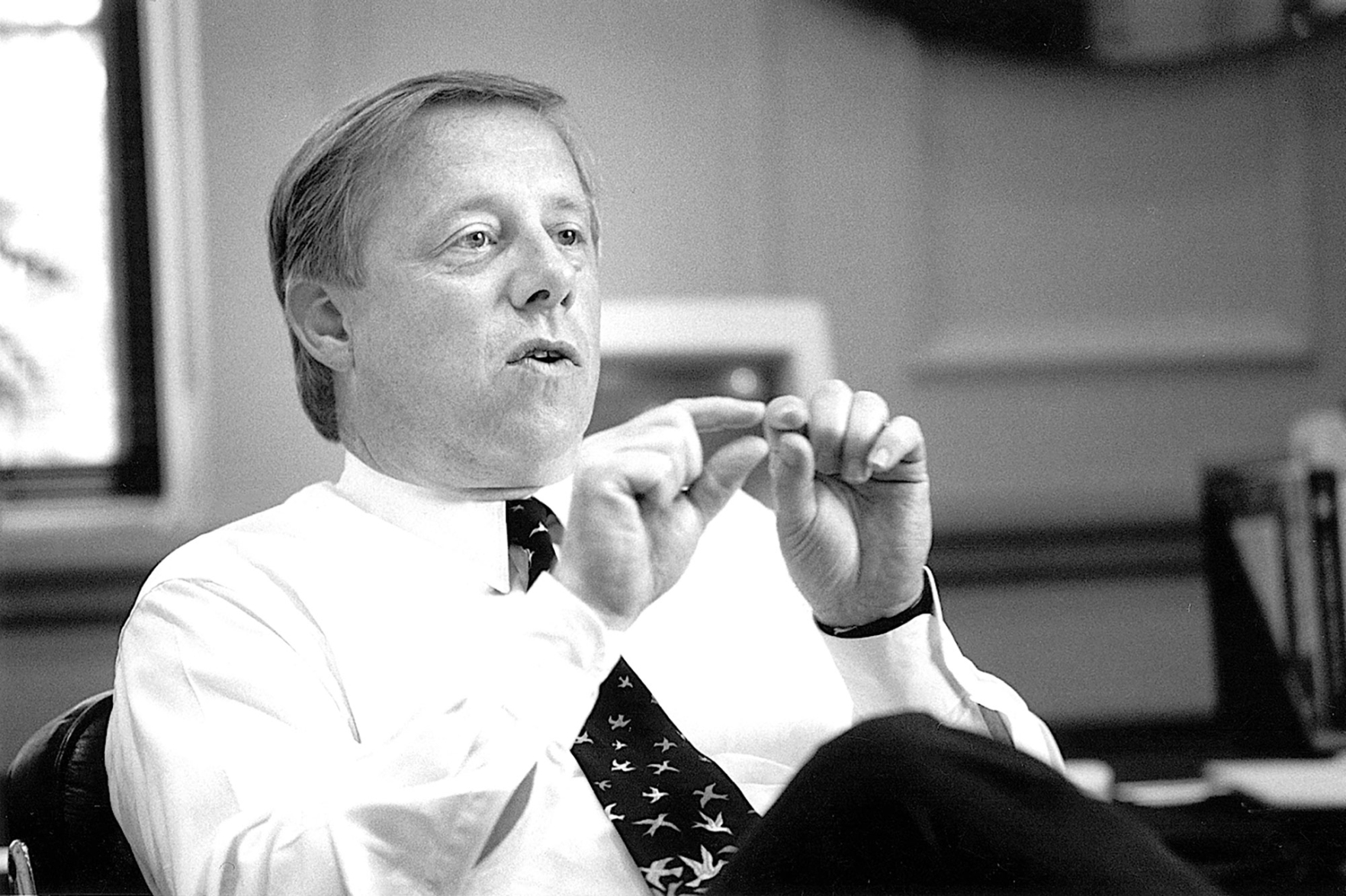
Phil Bredesen
1991: Phil Bredesen
Then: The upstate New York-raised health care entrepreneur had just been elected mayor.
Since: After two wildly successful terms leading Metro, during which he, among other things, turned Nashville into a big-league sports city, Bredesen spent two terms as Tennessee’s governor.
Now: Comfortably retired, one supposes, after his 2018 defeat by Marsha Blackburn in a bid to succeed Bob Corker in the Senate.
1992: David Satcher
Then: In his 10th year leading Meharry Medical College, Satcher was already well-known in medical and academic circles, with the journal he founded at Meharry in 1990, Journal of Health Care for the Poor and Underserved, regarded as a must-read.
Since: President Bill Clinton appointed Satcher to lead the Centers for Disease Control and Prevention in 1993, and six years later named him the country’s 16th surgeon general. He remained America’s top doc until 2001. He served as interim president of Morehouse School of Medicine between 2004 and 2006, then established the Satcher Health Leadership Institute.
Now: Satcher remains on the faculty at Morehouse and is a respected mind in public health and on the issue of health disparities among minorities.
1993: Gordon Bonnyman
Then: In 1983, Bonnyman secured a win in the Grubbs case that put Tennessee’s prison system under federal monitoring for a decade. By the time the feds released the state from the order, Gov. Ned McWherter announced the launch of TennCare in 1993. That gave Bonnyman — for 20 years an advocate for the legal rights of the poor at Legal Services of Middle Tennessee — a new set of challenges.
Since: Bonnyman remained a tenacious defender of TennCare and continued fighting the good fight for its recipients in court. In 1996, Congress passed a law hamstringing the ability of organizations like LSMT to file class-action lawsuits, so along with Michele Johnson, he founded the Tennessee Justice Center.
Now: Bonnyman served as the center’s executive director until 2014. He stepped down not to retire, but to work full time as a staff attorney once again. He’s now nearing 50 years practicing poverty law.
1994: Barry Scott
Then: Scott was already Nashville’s most well-regarded actor and a formidable playwright, whose depiction of the Rev. Dr. Martin Luther King Jr. in Ain’t Got Long to Stay Here, the one-man show he wrote, garnered praise from an expert critic: Coretta Scott King. He earned his Nashvillian of the Year honor particularly for his work with children, introducing them to the arts and motivating their better angels.
Since: Scott never slowed down, continuing to act in Nashville and elsewhere. He’s done loads of voice work for ESPN; his velvety baritone is familiar to sports fans.
Now: He remains active and is still Nashville’s Voice, famously narrating the patriotic accompaniment to the symphony’s Independence Day performance.
1995: Henry Foster
Then: Dean of the School of Medicine and previously acting president of Meharry Medical College, Foster — one of George H.W. Bush’s “Thousand Points of Light” for his I Have a Future program, which educated teens about responsible sexual health and positive self-image — was nominated by Bill Clinton to be surgeon general in 1995. Foster, an OB/GYN, ran into controversy from the right after saying he’d performed “a few” abortions, and later saying the number was substanially higher than “a few.” He faced opposition from members of the left curious as to his involvement in the infamous Tuskegee syphilis experiment. (Foster denied he was involved.) Clinton withdrew his nomination.
Since: Interestingly, Satcher became surgeon general as a result of Foster’s withdrawal. Clinton named Foster senior adviser on teen pregnancy reduction and youth issues in 1996, a post Foster held until 2001. He contributed to more than 250 textbooks and helped reestablish the obstetrics and gynecology residency at Meharry.
Now: A professor emeritus, Foster remains active in academics, focusing on the intersection of public health and social justice.
1996: Emmett Turner
Then: Turner was appointed Nashville’s first African American police chief by then-Mayor Bredesen. He introduced the new concept of “community policing” and helped calm racial tensions within the department, which had reached a flashpoint in 1992 when three white officers assaulted an undercover black officer during a traffic stop.
Since: Turner led MNPD for seven years, leaving the department in 2003 after 34 years. He became Tennessee’s Assistant Commissioner for Fire Prevention. In his last year leading MNPD, the crime rate dropped 9 percent and Nashville had its fewest murders in 33 years.
Now: Turner is one of the inaugural members of Metro’s Community Oversight Board.
1997: Andrea Conte and Cal Turner Jr.
Then: Conte, Nashville’s first lady (she was and is married to Bredesen) and president of You Have The Power, and Turner, the CEO of Dollar General, led the push to rebuild a Dollar General in Nashville’s Sam Levy Homes. It was torched, apparently in response to the shooting of a fleeing black suspect by Metro police. The store served not just as a marketplace, but as a meeting place and community center in the housing project.
Since: Conte went on to become Tennessee’s first lady, focusing on child and victim advocacy and keeping Canadian hands off her favorite hockey team. Turner stayed on as Dollar General’s chairman and CEO until 2003. Through his foundation, he has endowed numerous academic programs and charitable initiatives.
Now: Conte continues her advocacy initiatives. Turner serves on numerous boards — including Vanderbilt’s Board of Trust — and continues his work with his foundation.
1998: Mark Wynn
Then: A lieutenant with the MNPD, Wynn was already a recognized expert on domestic violence when he was tapped to lead the department’s new domestic violence unit. In five years, that unit grew from one detective to 22.
Since: Wynn was transferred out of the unit in 2000, not because of his performance — in fact, he’d received letters of commendation from all over the world for his tireless work — but because he failed to return voicemails quickly or shuffle paperwork with the alacrity his supervisors demanded.
Now: Wynn is still in Nashville, running a well-regarded consultancy that focuses on domestic and sexual violence prevention.
1999: Don McGehee
Then: McGehee, then 75, had been volunteering in Nashville schools for more than 50 years. The former pro wrestler and retired state employee (though that’s just a snippet of his Pepys-ian biography, which includes stints as LBJ’s bodyguard and as The Everly Brothers’ image consultant) started — and largely self-funded — the I Am Somebody program at two North Nashville elementary schools. The program emphasized self-esteem and doing one’s best. In addition to Scene honors, McGehee was named a Point of Light.
Since: McGehee continued his work with the schools well into his 80s.
Now: McGehee died in 2013. He was 89.

Becca Stevens
2000: Becca Stevens
Then: Stevens, the chaplain at St. Augustine’s Chapel at Vanderbilt, started the Magdalene Project, which helped get sex workers off the street and into intensive rehab to stop the jail-to-street cycle. By 2000, there were three Magdalene Houses for former sex workers.
Since: The Magdalene Houses became the residential portion of the larger Thistle Farms project, which employs survivors of sex work, addiction and trafficking in two enterprises: Home & Body, which produces soaps, lotions and the like, and The Café at Thistle Farms on Charlotte Avenue.
Now: Stevens continues her work with Thistle Farms (and as the chaplain at St. Augustine). She published a book in 2017 and is now a sought-after speaker.
2001: Margaret Ann Robinson
Then: Having chaired the library board for 15 years, the scion of the Craig family (which founded National Life and WSM) was widely credited with getting the downtown library branch funded and built.
Since: Robinson continued to serve the library system, sitting on its foundation board.
Now: Robinson died in 2017. She was 92.
2002: Pedro Garcia
Then: Cuban refugee, USC superfan and film fanatic Garcia was appointed superintendent of a struggling Metro school system in 2001. By 2002, he’d already earned a reputation for his oft-combative relationship with the teachers union and general brutal frankness. An overhaul of MNPS’ curriculum was underway.
Since: Honors rolled in for Garcia in the short-term. President George W. Bush appointed him to the Presidential Commission on Service and Community Participation in 2003. He launched MNPS’ “customer service centers” in 2005. After a contentious redistricting fight with the board, Garcia was ousted in 2008.
Now: Garcia is a professor of clinical education at USC, his alma mater.
2003: Colleen Conway-Welch
Then: Having served as the dean of Vanderbilt’s School of Nursing since 1984, Conway-Welch had put the school on steady financial ground, which led to a rise in prominence. She launched a clinic run by the school in Nashville’s Vine Hill neighborhood and became a leading advocate for access to OB/GYN services in underserved areas. By 2003, she was part of a national initiative to ensure that first responders and E.R. nurses could communicate in the wake of a terrorist attack.
Since: Welch was inducted into the Tennessee Health Care Hall of Fame and Modern Health Care Hall of Fame and named a Living Legend by the American Academy of Nursing. Conway-Welch left Vanderbilt in 2013.
Now: Conway-Welch died in 2018. She was 74. The atrium at the new building at the VU School of Nursing was dedicated to her in June.
2004: Charlie Strobel
Then: A lifelong advocate for social justice (and one of the city’s grandest baseball fans), Father Charlie Strobel was honored for his work with the homeless through Loaves and Fishes and Room In The Inn, among other organizations.
Now: Strobel is still dedicated to his work, and baseball has returned to Sulphur Dell, where he first fell in love with the game.
2005: Students of KIPP
Then: In its first year, the “unassuming little school of 60 students on Douglas Avenue” on the forefront of charter schools in Metro was lauded thus: “KIPP has achieved what most of us may have once thought impossible: It has 10- and 11-year-olds buying into the notion that learning is fun — and a privilege.”
Since: The bloom fell off the rose not just for KIPP, but for charters in general, as the growth of the independently governed schools became the hottest topic in education and led to an extremely contentious atmosphere on the school board. The board rejected KIPP’s plan to add two more schools in the district, while renewing the original charter for 10 years in 2015.
Now: Ultimately, the state overruled the MNPS board. KIPP now enrolls more than 1,500 students at six schools, serving kindergarten through 12th grade.
2006: Pat Postiglione, Tom Thurman and Bill Pridemore
Then: Sgt. Postiglione, Det. Pridemore and Deputy DA Thurman arrested and prosecuted Perry March for the murder of his wife Janet, one of the most bizarre mysteries in the city’s history. (More on that here.)
Since: The trio wasn’t done. In 2008, the policemen solved the 1975 murder of Marcia Trimble, perhaps the only mystery more notorious than the March case. Postiglione retired in 2013, having closed 55 cold cases (Thurman urged MNPD to launch a Cold Case Unit in 2002), including the arrest of three serial killers.
Now: Since his retirement, Postigilione has gone to work for the DA as an investigator and stars in a show about his career on A&E. Pridemore is now a Metro councilmember. Thurman retired in 2016 after successfully prosecuting a group of Vanderbilt football players who raped a fellow student.
2007: Clemmie Greenlee
Then: A recovering crack addict, former sex worker and Magdalene alum, Miss Clemmie was a recognized speaker on addiction and trafficking who started a nonprofit focused on recovery from drug addiction. She also started Nashville Peacemakers, a nonprofit that began as an HIV advocacy group but morphed into a group focused on ending violence among young black men.
Now: She hasn’t slowed down. The Peacemakers now partner with Moms Over Murder, a support group for mothers of murder victims. Greenlee traveled with the Rev. Becca Stevens to New Orleans to establish Eden House, a program similar to Magdalene. She underwent a heart transplant in 2018, but stays busy as one of the city’s best-known and longest-serving activists.
2008: Gregg Ramos
Then: Local attorney and second-generation American Ramos was the public face in the fight against the divisive English Only charter amendment — which, thankfully, Nashville easily rejected in a referendum held less than a month after the issue appeared.
Now: Ramos continues to practice law and remains an advocate for immigrant communities, attacking initiatives from the Trump Administration in op-eds that combine his legal and activist expertise.
2009: Hal Cato and Roger Dinwiddie
Then: Cato, then CEO of Oasis Center, and Rodger Dinwiddie, CEO of STARS, joined forces to create the Youth Opportunities Center at 17th Avenue and Charlotte, a one-stop shop for teens and young adults, including a temporary transitional housing center for 18- to 21-year-olds. In its first year, the center served more than 60,000 people.
Now: Dinwiddie remains CEO at STARS. Cato left Oasis in 2011 after a decade at the helm. He then ran a start-up called Zeumo before taking the CEO job at Thistle Farms in 2015, where he remains.
2010: The People of Nashville
Then: In the wake of the flood that devastated the city in May, the Scene named every resident as Nashvillian of the Year for their resilience.
Now: There are now roughly 66,000 more people of Nashville than there were in 2010.
2011: Thomas Nelson
Then: Night Court Magistrate Nelson won praise for not just rejecting arrest warrants for Occupy Nashville protesters (and a handful of journalists, including one from the Scene), but also for questioning the basis on which the protesters were arrested at all, noting that state law did not give anyone the ability to establish a curfew on Legislative Plaza.
Now: The Scene was lambasted for its decision to honor Nelson almost immediately, as people who’d appeared before him in the past noted in 2007 he had allowed for protestors (including at least two former Nashvillians of the Year, Becca Stevens and Clemmie Greenlee) to be issued warrants. He’d also been rebuked by judges for setting excessive bail. Nelson retired in 2017.
2012: Christina McDonald and Adam Taylor
Then: In an effort to refocus the interminable debate about charter schools versus traditional schools, the Scene chose McDonald, a teacher at charter Nashville Prep, and Taylor, a teacher at Overton High.
Now: McDonald is now the principal at Nashville Prep. Taylor remains at Overton.

Renata Soto
2013: Renata Soto
Then: The founder and leading force behind immigrant advocacy group Conexión Américas and community center Casa Azafrán, Soto won for her new project as well as for her years as a leading voice for immigrant communities.
Now: Soto served as chairman of the National Council of La Raza in 2015. She left Conexión Américas in May of this year, sparking widespread speculation — a hefty amount of which came from Scene reporters — that she would seek political office. She didn’t, but she is an Advanced Leadership Initiative Fellow at Harvard University.

2014: Studio A Saviors
Then: As Nashville’s construction boom leveled many of the city’s most famous former recording studios (and other cultural landmarks), Ben Folds, Mike Kopp, Sharon Corbitt-House, Trey Bruce, Aubrey Preston, Mike Curb and Chuck Elcan stepped up to preserve iconic Studio A from demolition by a Brentwood-based developer. Elcan, who helped save The Loveless Cafe in 2003, ponied up $5.6 million of his own money at the last-minute. (More on that here.)
Now: Restored to its 1960s glory days, the studio at 30 Music Square West is still churning out the hits, with Grammy-winning albums from Chris Stapleton and Jason Isbell and the 400 Unit recorded there.
2015: Abby Rubenfeld & Bill Harbison
Then: Longtime civil rights attorney Rubenfeld and white-shoe lawyer Harbison — who previously had success in the case of Juliana Villegas — filed Tanco v. Haslam, challenging Tennessee’s ban on recognizing same-sex marriages performed in other states. Eventually, Tanco and similar cases were rolled into Obergefell v. Hodges, the case that ultimately overturned same-sex marriage bans in the U.S.
Now: Both continue to practice law, taking civil rights cases and fighting the good fights.
2016: Stephanie Silverman
Then: After a decade as the Belcourt Theatre’s executive director, Stephanie Silverman oversaw the expansion and revitalization of the beloved arthouse.
Now: Silverman remains at the Belcourt’s helm.
2017: The Community Foundation of Middle Tennessee
Then: “The nonprofit behind your favorite nonprofit” won for its quarter-century of work handling myriad charitable funds in the Nashville area.
Now: In 2017 — the last year for which records are available — TCFMT took in $55 million and handed out $47 million in grants.

James Shaw Jr.
2018: James Shaw Jr.
Then: The man credited with stopping the Waffle House shooter by grabbing the hot end of his rifle — ending the mass shooting that took four lives — became a beloved civic hero.
Now: The honors haven’t stopped. Chadwick Bozeman gave Shaw his MTV Movie Award for “Best Superhero.” Shaw appeared in the NBA’s 2019 Celebrity All-Star Game (he had 8 points and five assists and led all players in plus-minus at plus-15).



