

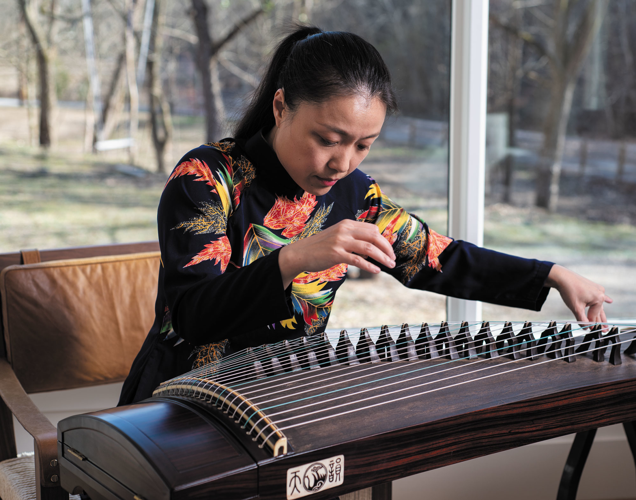


Wu Fei photographed at her home
Seated at the kitchen table in her warm, bright West Side home, Wu Fei explains that she goes by Fei in the U.S., but that her full name has an important meaning. Roughly translated from Chinese, “Wu Fei” means “the opposite of nothingness,” and it’s hard to imagine a more appropriate name for the master musician.
Born in Beijing in the early years of China’s one-child policy, Fei began studying music as a toddler. Her parents started her on a rigorous program that she compares to Olympic training, which led her to the China Conservatory of Music and later the University of North Texas. By 2002, when she began graduate school at Mills College in Oakland, Calif., she’d absorbed Chinese traditional music and Western art music. She became an outstanding performer on both piano and guzheng, an ancient Chinese instrument with 21 strings that resembles a harp on its side. But one of her professors at Mills, avant-garde guitar legend Fred Frith, noticed something about the pieces Fei was writing.
“He said, ‘I hear a lot of wonderful craft, but I don’t hear Fei,’ ” she recalls. “That shocked me. I didn’t go back to class for about a week. I just stayed home to think through my life. I was in a master’s program in music composition, and I had no clue why I wrote music!”
Following Frith’s advice, Fei began to explore ways to get away from traditional ideas about the structure of music by learning how to improvise. After graduation and between tours in Europe and elsewhere, she worked with electronic musicians in California and experimental jazz players like John Zorn in New York. She spent a few years in Boulder, Colo., where she fell in love with Appalachian music and was introduced to Abigail Washburn. The banjo wizard has a keen ear for the connections between American string-band music and Chinese traditional music, and invited Fei to play on her 2011 album City of Refuge.

Wu Fei photographed at her home
The experience of working with Washburn and other Nashville musicians made an impression on Fei. A few years later, she and her husband were raising their two young children in Beijing, and the stress of getting by in a major metropolis — one where, she says, you have to self-censor to avoid getting in trouble with the government — was taking a toll.
“The culture of Tennessee, especially the folk music, was a big piece that I was missing,” Fei says. “You want to be a healthy person, you’ve got to eat all sorts of things, right? I crave different nutrients every now and then. I draw those in, and I cook up a new dish.”
In early 2015, Fei and her family moved to Music City, and she dove into new projects. She joined the contemporary classical ensemble chatterbird as composer-in-residence. In 2019, they premiered a piece for chamber orchestra called Hello Gold Mountain. It tells a less-remembered story of the Holocaust, about a group of more than 20,000 Jews who fled Germany and took refuge in Shanghai. Fei has also collaborated with Washburn on a new album, out April 3 via Smithsonian Folkways and aptly titled Wu Fei & Abigail Washburn, which further explores connections between Chinese and American folk music.
Fei is constantly composing for piano, percussion, voices and other instruments — more ideas than she has time to write in her lifetime, she says. Whatever shape her next major piece takes, she knows what she wants to address: the anxiety that’s come from watching the deteriorating relationship between her home country and her adopted country.
“As a composer, I can’t do anything to calm the politicians. They’re gonna do whatever they want. But these emotions have been buried deep in my head, my heart, my cells, my blood.”



Post a comment as anonymous
Report
Watch this discussion.
(0) comments
Welcome to the discussion.
Log In
Welcome to the discussion.
Keep it clean. Please avoid obscene, vulgar, lewd, racist or otherwise abusive language. Comments featuring hate speech or threatening or violent content will not be tolerated.
PLEASE TURN OFF YOUR CAPS LOCK.
Be truthful. Don't knowingly lie or mislead.
Be proactive. Use the “report” link on any comment that violates our comment policy.
Share with us. We'd love to hear your feedback.