
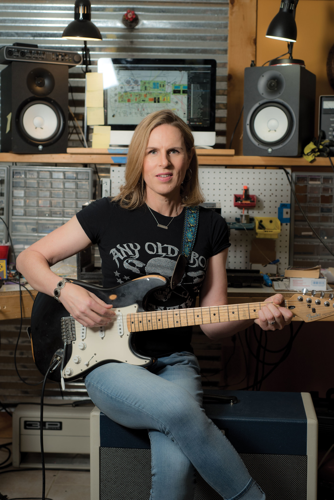
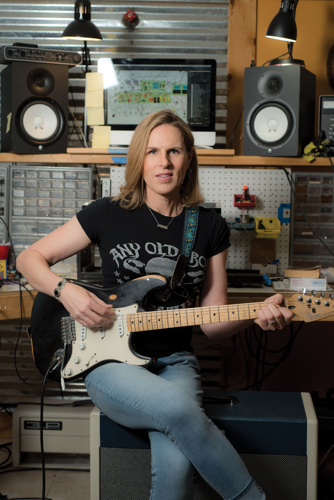

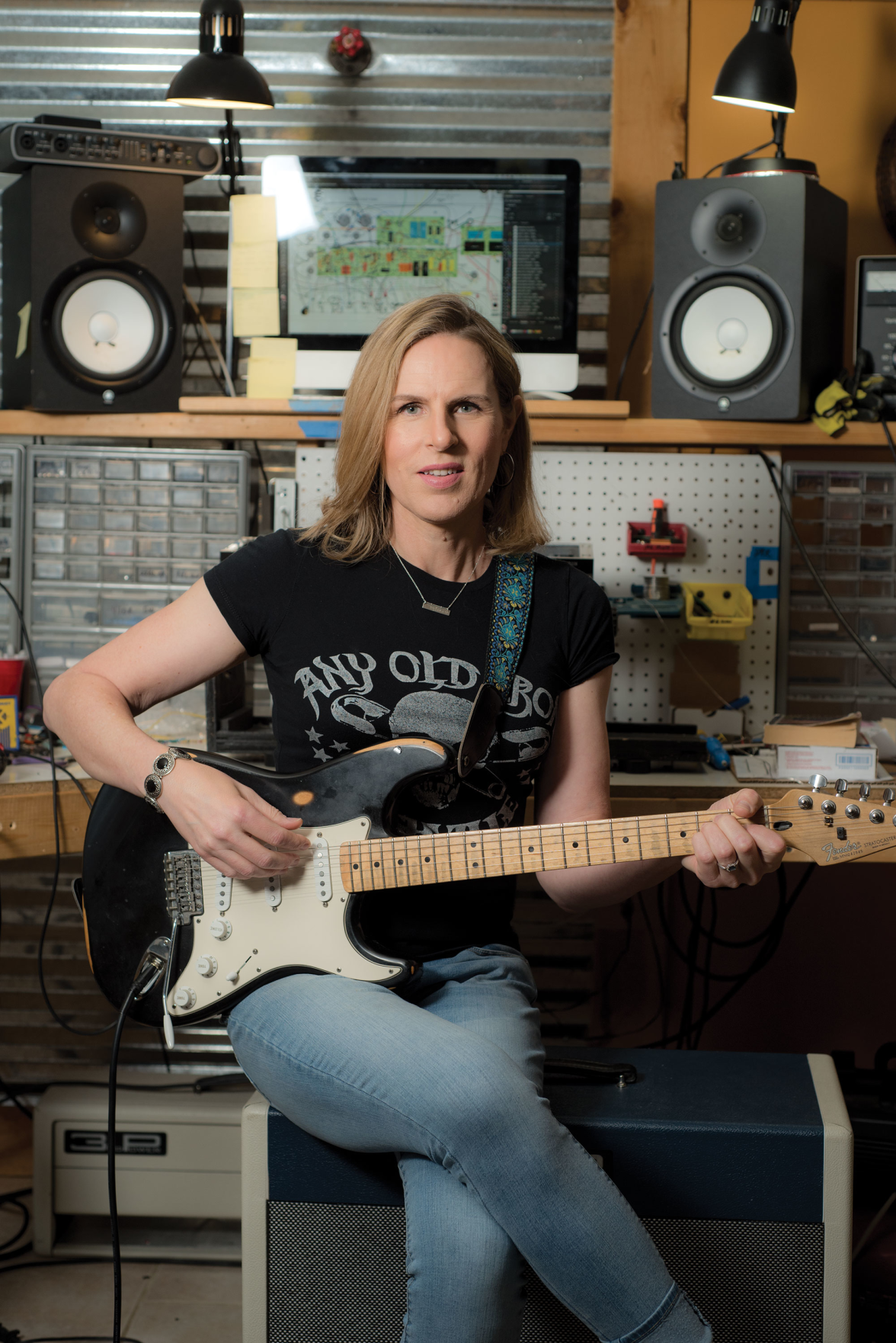
Dylana Nova Scott
Sitting at the kitchen bar in her large Brentwood home, Dylana Nova Scott sounds almost giddy as she recalls the rigorous process that preceded 3rd Power, the boutique guitar amp company she founded in 2008.
Fascinated by the disparity between how a guitar sounds on record versus live, Scott — who has played guitar in the San Francisco-bred metal band Vain since the ’80s — wanted to create an amplifier that offered musicians the same control onstage that they had in the studio.
Scott had already spent years studying amps’ innards — she collects ’68 Marshall Plexis, specifically — so the next step was to dissect guitar riffs. She uploaded licks from Van Halen, Fleetwood Mac and Tom Petty into ProTools and stripped the soundwaves down to their rawest form.
“I can tell when the track has a lot of transient activity that there’s not a lot of compression,” she says. “If it’s pretty gooey and not a lot of transient and lots of sustain, you can tell that, obviously, there’s some compression there. So I start unraveling the mystery now at the recorded level, where I had unraveled what was going on in the amp at the electronics level.”
To hear her describe it is wild — like hearing a magician revealing the secrets behind her illusions.
“I refined the way I hear sound to the point where — now this is going to sound foreign — I smell sound,” says Scott. “Like a chef can take in ingredients and bring you a dish and drop it on you, and you go, ‘Wow!’ Well, I do that in the sound realm.”
I balk.
“Yes! I know when a design is right when I can play [guitar] and throw harmonics like I’m throwing glitter or confetti, or a rock if I need to throw a rock. I create the tools that allow you to conjure and move what it is you need to move.
“And a lot of times it’s that emotion, that energy inside of us,” Scott continues. “Us musicians have this thing, that chunk of coal that never stops burning. It’s our own little chunk of coal that has our joys, our triumphs, our wounds, our fears. Sometimes our guilt and shame. Sometimes our pain. Sometimes our secrets. Sometimes our mysteries that even we don’t know. And that drives us. I have that lump of coal. And right next to it I created the way to manifest the outlet for it through the gear.”
Scott’s journey to quite literally reinvent the guitar amp — she holds three U.S. patents with a fourth pending — didn’t result only in a new way to create music. It also helped her unravel a tangled burden that she had long struggled with quietly.
“I was on this journey of making things that don’t go together on paper come together, and then it hit me,” Scott says. “I was transitioning. I was finding myself. The masculinity that was apparent on the outside to others, it wasn’t my natural state. … It turns out that I’m a woman, and I didn’t know it.”
It was important to Scott that she transition from male to female publicly — she didn’t want anyone to see her step out of the public eye and misinterpret that as shame. She posted her first photo on Instagram on June 10, 2017 — “The journey to self actualization is underway,” she wrote.
Many of Scott’s colleagues have continued to support her — Emmy-winning producer Kenny Royster, for example, “has stayed an absolute best bud through my transition,” she says. Vince Gill remains loyal as well. But others have disappeared.
“I heard that artists that I had endorsed were ashamed of my transition and actually started putting duct tape over the logos on the amp because they didn’t want anybody to think they were affiliated with my freak show,” she says.
“When I say that, I hold no grudges. There isn’t a bone in my body that holds a grudge. It’s nothing but love. Really, what we see when somebody goes to that extreme to separate from a company that they work with, well, we just got a peek inside their soul. Unfortunately for them, they’re in pain and hurting. If they were to read that I’m aware that they did that, I just want them to know that they’re loved, and they’re welcome back any time. We don’t even have to talk about this.”



Post a comment as anonymous
Report
Watch this discussion.
(0) comments
Welcome to the discussion.
Log In
Welcome to the discussion.
Keep it clean. Please avoid obscene, vulgar, lewd, racist or otherwise abusive language. Comments featuring hate speech or threatening or violent content will not be tolerated.
PLEASE TURN OFF YOUR CAPS LOCK.
Be truthful. Don't knowingly lie or mislead.
Be proactive. Use the “report” link on any comment that violates our comment policy.
Share with us. We'd love to hear your feedback.