



When Raekwon the Chef and Ghostface Killah performed at Marathon Music Works in the summer of 2015, Dylan Brown couldn’t see much from the cramped wheelchair section.
Separated from the main crowd by temporary barriers, Brown found the enclosure “a little awkward,” in part because a larger attendee in the tight space — like Brown, in a wheelchair — was “drunk and all over the place.”
“It was a cluster up there,” he remembers.
As someone who attended a lot of shows at the time, Brown was used to navigating Nashville’s music venues on wheels. He was happy to hang in the back, but as the former Wu Tang Clan MCs took the stage, he instead ended up in the pen wedged against the stage.
But Ghostface spotted his fans in wheelchairs with obstructed views. Get the people in wheelchairs up on the stage, Ghostface ordered security.
“Listen, those are my friends,” Ghostface said, according to a contemporaneous concert review in the Nashville Scene.
He was adamant. Brown, who has worked as an accessibility consultant and organizer for multiple business groups and nonprofits around town, watched the rest of the show not in front of the stage or from backstage, but onstage.
It was an extraordinary solution to an ordinary problem.
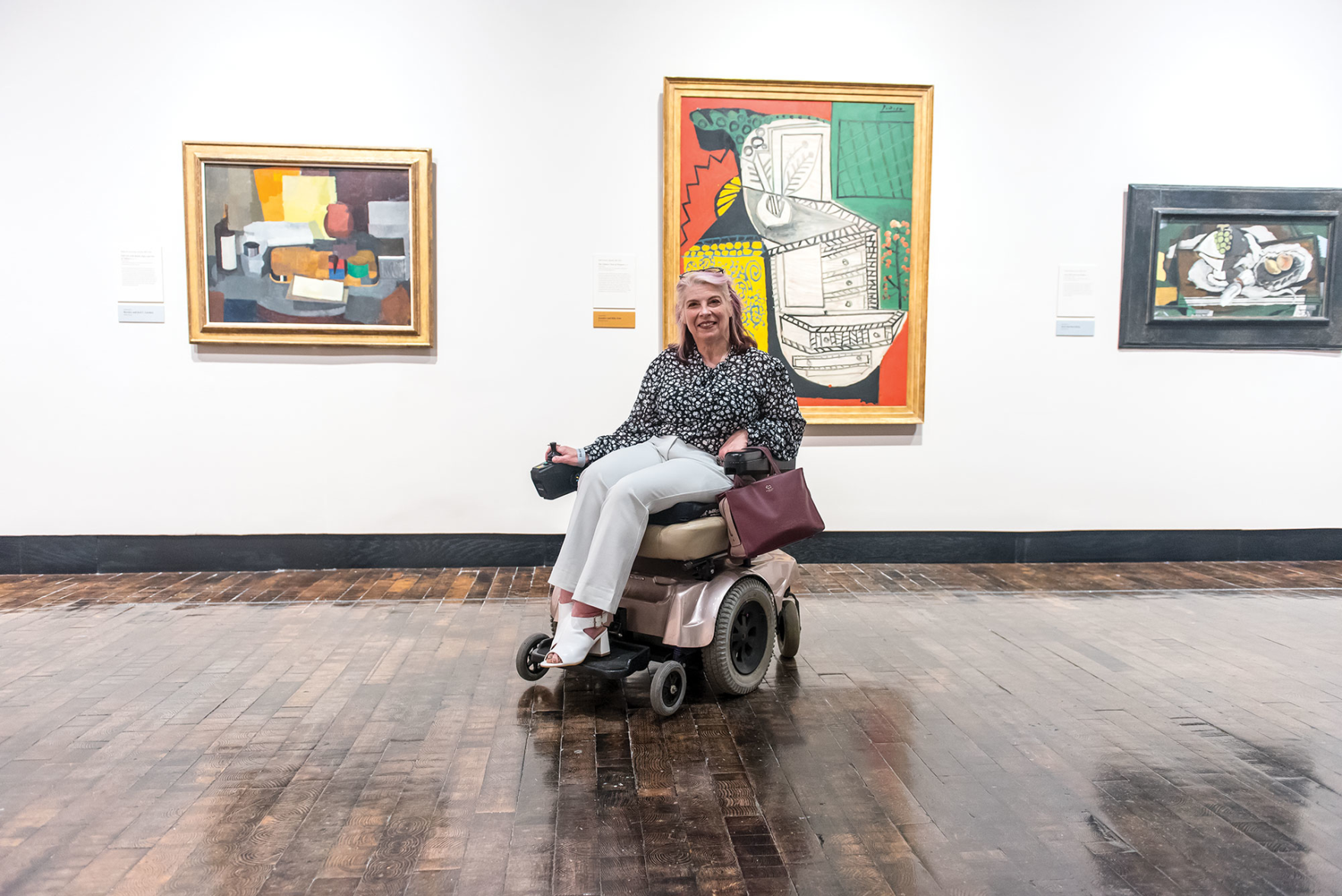
Alicia Searcy at the Frist Art Museum
Perhaps more commonplace is the experience of Alicia Searcy, a fashion blogger and nonprofit director. She recalls a recent Alice in Chains acoustic set at the Ryman Auditorium. Her wheelchair-accessible seat was directly behind an able-bodied person who opted to stand for the duration of the show, almost completely blocking Searcy’s view. She couldn’t move to the aisle, lest she be deemed a fire hazard.
It’s an experience repeated so often that Searcy has a running joke about concerts at the historic theater: “It’s at the Ryman, but we’re going to go anyway.”
Brown, however, notes that Ryman staff members have always been exceedingly nice to him. “Some seats are better than others, but you can’t replace how awesome people treat you,” he says.
Lindsey Becker, a freelance entertainment journalist and live music enthusiast, attends as many concerts as she can — at the Ryman, at Bridgestone Arena, at honky-tonks on Lower Broadway. She too is in a wheelchair, as is her husband Wesley, a retired Marine. Two chairs can mean a new round of hurdles.
Becker estimates that she has been to hundreds of shows at the Grand Ole Opry House, for example. There, like other venues with fixed seating, many accessible seats fall on the end of a row. Since there’s only one such seat on each row, the Beckers are asked to split up and sit in different rows — alternatively, one of them could give up his or her wheelchair and be seated within the row, next to the accessible spot. In the latter instance, Becker says, she would be unable to go to the bathroom, get a drink or exit the venue during an emergency. Like Searcy, Becker recalls being told she was a fire hazard if she tried to sit next to or directly behind her husband while in her wheelchair.
At one of the new Lower Broad bars emblazoned with a country star’s name, Becker has tried and failed to attend a friend’s weekly set. That’s because the upstairs stage where he performs is just that — up some stairs, with no elevator or ramp. Even when there is elevator access at country-star-branded establishments and other honky-tonks, the elevator is often hard to find or is blocked by untidily scattered boxes and other storage items, as it was on a recent trip with Becker to the elevator shared by two singers’ bars.
Stories like these from Nashville’s music scene paint a picture of a city built to entice visitors and residents with disposable income and no physical limitations. The lack of accessibility in many parts of Nashville sprawls well beyond nightlife spots, and the problem is older than the challenges created by the recent building boom, though those too are plentiful.
Norma Bracey moved to Hermitage from Sumner County for two reasons: to be closer to her many doctors in Nashville, and to have access to Davidson County’s on-demand transit service for people with disabilities.
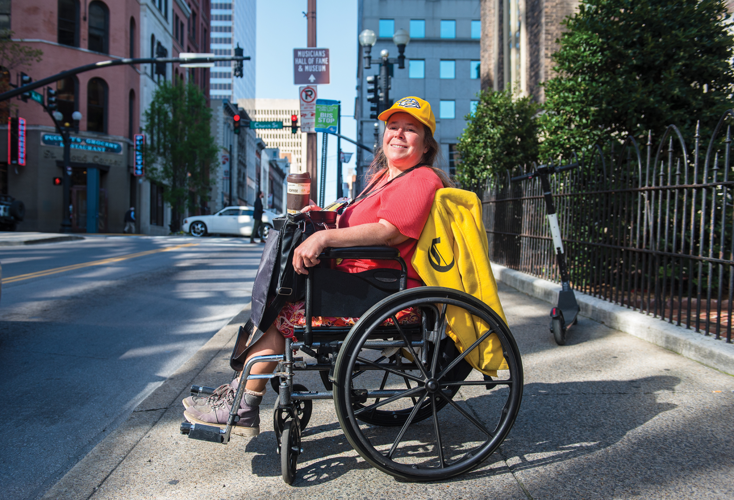
As Bracey puts it, she “ran out of housing options,” so she moved into an extended-stay hotel. Bracey uses a wheelchair because of complications from cerebral palsy, though she retains limited walking ability (“waddling,” she calls it).
Bracey lost a series of jobs because, she says, “people want to focus on what you can’t do — they don’t want to see all the things you can do.” She eventually decided to “eat some crow” and start selling The Contributor, Nashville’s street paper. She staked out a spot within sight of both TriStar Summit Medical Center, where many of her doctors work, and the bus stop where her granddaughter, of whom she has full custody, returns from school every afternoon.
Bracey spent four years, six months and one day in the extended-stay hotel before finding a long-term housing unit that was wheelchair-accessible at the end of last year. Much of the subsidized housing stock that is accessible is reserved for seniors and doesn’t allow kids. That meant securing affordable, accessible housing with a 10-year-old in tow was a “virtual impossibility.”
Bracey’s first trip to the apartment complex that she now calls home was dispiriting. The woman taking her application told her that the 100-unit complex had only four accessible units.
“I really wanted to break down and cry right there,” she says.
Instead, she turned to her characteristic wit.
“I guess it’s a good thing I only need one of them,” she told the clerk.
Country, as he likes to be called, is a 54-year-old man who’s spent the past eight years using a wheelchair. His move was in the opposite direction from Norma’s — he went from Nashville to Gallatin, where he has been living, at least temporarily, in a group home. He tries to avoid downtown Nashville, in part because of construction closures and broken sidewalks that make it difficult for him to navigate. But that’s where he lived until landing the spot in the group home a few months ago.
“There aren’t a lot of apartments that are handicap-accessible,” he says.
Country stayed some nights at a nearby shelter with a wheelchair ramp, but he spent much of his time on the street, near Main Street on the east side of the Cumberland River. When he says he was on the street, he means it literally: Country couldn’t access the homeless camp beneath Ellington Parkway, the same encampment demolished by Metro earlier this year.
“I never went down there in a wheelchair,” he says, adding that he stayed there sometimes when he could still walk. “If it rained that night, I’d be stuck down there for two or three days.”

Norma Bracey
Bracey’s and Country’s challenges are not the same as those seeking equal accommodations at concert venues and restaurants, but they are part of an interconnected web.
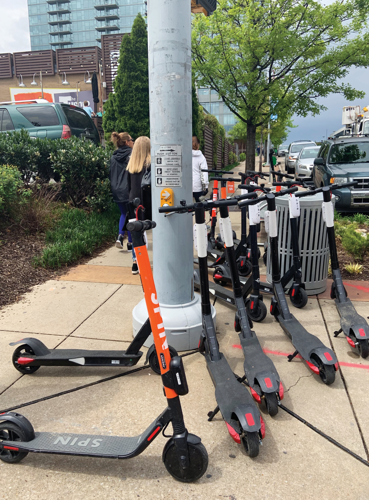
The side effects of the New Nashville boomlet may generate eye-rolls from some but cause serious quality-of-life problems for others. The electric scooters that have littered local sidewalks for the past year are the butt of jokes, but a dumped scooter can seriously impede a wheelchair user’s path. Likewise, temporary construction closures that aren’t properly marked or sidewalks that abruptly end can leave someone in a wheelchair stranded or forced to backtrack. State Rep. Darren Jernigan (D-Nashville) uses a wheelchair, and he has found himself in that situation multiple times — including once in sub-freezing temperatures.
“For me, it wasn’t an emergency,” says Jernigan. “It was irritating, and it defeats the purpose of all the money we’ve spent on sidewalks.”
Another trend: a wave of upscale bars and restaurants that share an aesthetic and a general lack of accessibility. High-top bar tables and booths are the new norm, and both Brown and Becker recall immediately departing newer restaurants whose only seating options were incompatible with their wheelchairs. (“Eff this place, I’m not coming back,” Brown recalls saying of one popular Gulch eatery.)
As the new builds frequently referred to as tall-and-skinnies have popped up, often in the place of affordable or semi-affordable single-family homes, some residents and amateur architecture critics have lambasted them for their out-of-character designs. But the phenomenon has had more tangibly deleterious effects in the disabled community. Tall-and-skinnies are proverbially tall and skinny, neither of which is conducive to wheelchair access. Many of the units feature stairs leading to the front door, and some include not a single bedroom on the ground floor.
“They’re reducing the housing stock that’s available to people who have mobility impairments,” says Kathy Trawick, executive director of the Tennessee Fair Housing Council.
Trawick suggests that instead of putting up three or four townhouses, developers could stack the same number of units on top of each other so at least the ground floor would be accessible. Both Trawick and Brown note that not only are wheelchair users typically precluded from living in a tall-and-skinny, they also can’t visit friends or family who live in them.

Scooters blocking a sidewalk in The Gulch
“For someone like me, it’s almost like a sign saying, ‘You’re not coming here,’ ” Brown says.
Advocates argue that the construction of such inaccessible housing stock is as short-sighted as it is a slap in the face to the disabled community. A family with a child in a stroller would have a hard time navigating the homes, as would someone who purchases the unit at a young age but hopes to age in place.
Brandon Brown (no relation to Dylan) is executive director of the advocacy group Empower Tennessee. “Disability is the one demographic that any person can join at any time,” he says. Complications from aging, illness or an accident can take a person from full mobility — and ease of movement in a tall-and-skinny — to a wheelchair.
The reduction in housing stock for disabled people with the means to purchase a brand-new townhouse isn’t occurring in a vacuum. It also means a compounding reduction in the existing affordable housing stock in neighborhoods often home to low-income, minority or otherwise marginalized populations.
“Not everything that’s unfair is illegal,” laments Trawick.
Nashville has become a city where both the most visible high-end housing option (tall-and-skinnies) and the most visible last-chance housing option (the homeless encampment near the Ellington Parkway overpass) aren’t open to an entire segment of the population.
“There’s a lot of things I took for granted when I was walking,” Country says.
Wheelchair users have a common refrain when telling businesses and other entities that they aren’t accessible: This is bad for business.
Searcy once encountered a retail store in Nashville with an inaccessible entrance. She told the owner that a $200 portable ramp could fix the problem, but the business owner declined to act on the advice. Searcy decided never to return, and she told her friends with similar mobility issues to avoid the place too.
“This place is not accessible, and they don’t want to be,” she says.
When businesses, cultural institutions and other public spaces ensure they are accessible to people with mobility restrictions or vision impairments or other disabilities, they maximize their potential patron base, the argument goes. And, yes, advocates and people with disabilities admit that some modifications could come at a cost for business owners.
“Civil rights should never be at the mercy of someone’s profit margin,” argues Brandon Brown, the Empower Tennessee director. “An impediment to us being able to patronize a place or live in a city like anybody else would does not speak well of any community.”
The aggravating circumstances simply reinforce themselves. Businesses are not accessible, so people with disabilities don’t go there, so business owners never see or are never forced to consider the needs of those with disabilities. Out of sight, out of mind.
Searcy calls it a “hamster wheel.”
She has made it something of a personal mission to disrupt that insidious cycle. Searcy showed up every night of Nashville Fashion Week. She shows up an hour or two early to events to make sure she can get in. It can be a pain in the ass, but she loves fashion and music and fine art, so she makes it work (sometimes with the help of her husband and others).
Becker is the same way. She goes to honky-tonks on Lower Broad, often posting up at Legends Corner, which she applauds for its accessible bathrooms and friendly staff. Becker even braves the crowds of CMA Fest, where she, like Searcy, shows up hours early to ensure a spot on the accessible platform.
“People already want to give us participation trophies just for existing in the same area that everyone else is,” Becker says. “You find your place and you stick to it. In an ideal world, it would be awesome if everywhere was clean and friendly and open enough to get around, but it’s just hard.”
Despite the constant barriers to entry across the city, some places make it a point to be open to all. Multiple wheelchair users praise the Frist Art Museum for its accessibility. The Frist, like other historic cultural centers, has been renovated since the passage of the Americans with Disabilities Act nearly 30 years ago. Unlike some of those other venues, the Frist made a point of ensuring all parts of the building were accessible, frequent visitors say.
Searcy says that when historic buildings don’t make a point of adapting their space for all visitors, it’s a personal affront.
“So a building has more value than I do, which I don’t accept,” she says. “There are ways to modify a building to make it more accessible and not ruin its historical impact.”
On a recent afternoon visit to the downtown art museum, Searcy notes the use of accessible ramps that skirt an ongoing construction project in front of the building. And that’s not the case everywhere?
“That’s not the case anywhere,” she corrects.
Searcy believes businesses, other institutions and the general public should try to employ more “informed empathy.” An expansion of access, she says, will open the community to more people — and in turn, expose more people to those in their community who can be left in the shadows, or in the back corner of a restaurant.
“If we made this city more accessible, I think more people with disabilities would be encouraged to go out and become consumers in their city and not buy from Amazon,” says Searcy. “We are people too. We are not just some inconvenience. We have value. And the more people can connect with our value, the easier we can solve these problems.”




