

Many drove from Houston, the weight of uncertainty far greater than the belongings they had jammed into their vehicles.
Members of the NFL team formerly known as the Houston Oilers arrived on the Tennessee State University campus on July 18, 1997. For them, it was — in a lot of ways — the start of just another training camp, six weeks with a lot of sweat, little time to themselves, and the idea that they would emerge amply prepared for the rigors of a 16-game National Football League season.
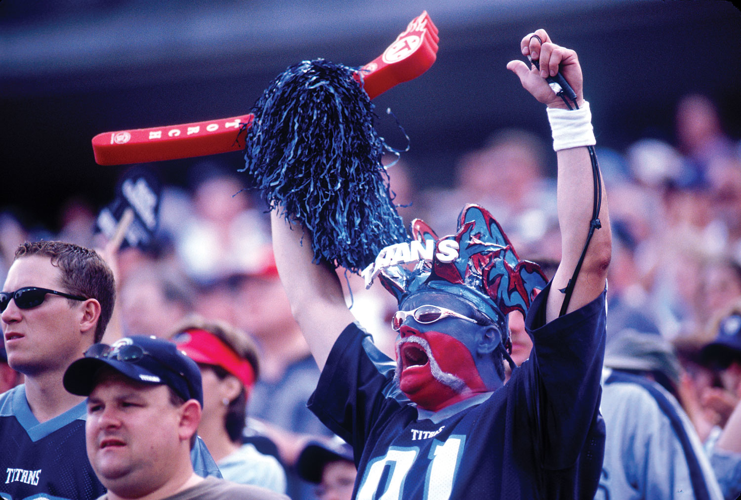
For the city in which they now found themselves, their presence meant something far greater. Nashville’s evolution as a pro-sports town began in earnest at that moment. It was the Big Bang that came from the ideological gases of NFL Yes!, the grassroots organization that endorsed a stadium referendum in 1996. Household names or soon-to-be household names like Bruce Matthews, Steve McNair, Eddie George and Blaine Bishop brought life to those notions.
These days it is no longer news when players, now members of the Tennessee Titans, report for the start of training camp, as they will do this weekend. It is just another marker in the passage of time.
With 20 seasons of professional football now underfoot, let’s dig through the layers and study one memorable day from each. As a whole, they reveal much of what makes pro sports unique — it’s not always savory, it’s often difficult to ignore (for good or bad) and it provides a means for those who cheer to question what matters to them.
1997-98
Aug. 31, 1997: The first regular-season game in franchise history also served as an important civics lesson for franchise leadership — only 30,171 people showed up at the Liberty Bowl in Memphis.
Founded as the Houston Oilers in 1960, the team was rechristened the Tennessee Oilers with the idea that the name would appeal to the entire state. One small problem: Memphis (all of West Tennessee, in fact) was not about to revel in the fact that Nashville got an NFL team, and certainly was not willing to babysit that team for two years while a stadium was built along the Cumberland River.
The Oilers’ average attendance for eight home games was 28,095, and the next year they played at Vanderbilt Stadium in Nashville.

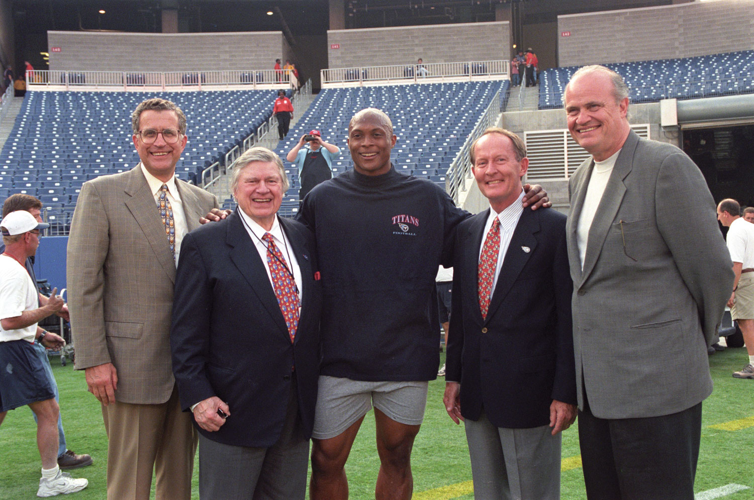
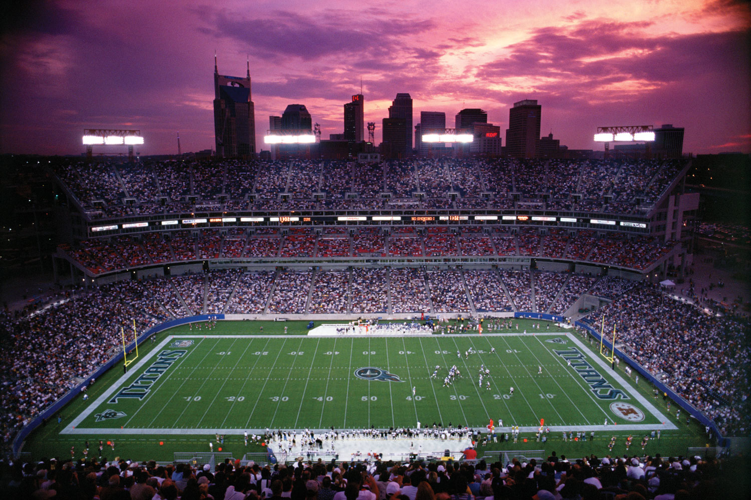
1999: First game in “Adelphia Coliseum”
1998-99
Sept. 13, 1998: There is no delicate way to say this — the Titans lost to a team that had Ryan Leaf as its starting quarterback.
It was no surprise to people in Nashville that Peyton Manning was the first overall pick, just ahead of Leaf, in the 1998 draft. The fact that Leaf turned out to be a colossal failure as an NFL quarterback, though, shocked many. He played just four years and went 4-17 as a starter.
The first of those victories was by a 13-7 score in Week 2 of his rookie season, as the San Diego Chargers faced the Tennessee Oilers in the Oilers’ first game at Vanderbilt Stadium, a result that left many wondering whether the venue had something to do with the extended misery in which Vanderbilt’s football program was mired at the time.
1999-2000
Jan. 8, 2000: There were many high points to the team’s first season as the Tennessee Titans, beginning with the decision to draft Jevon Kearse in the first round and finishing with the near miss in Super Bowl XXXIV against the St. Louis Rams.
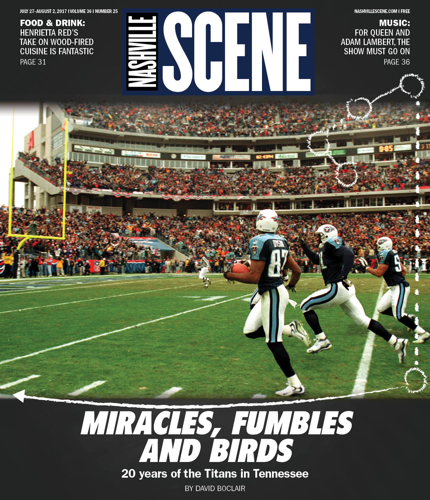
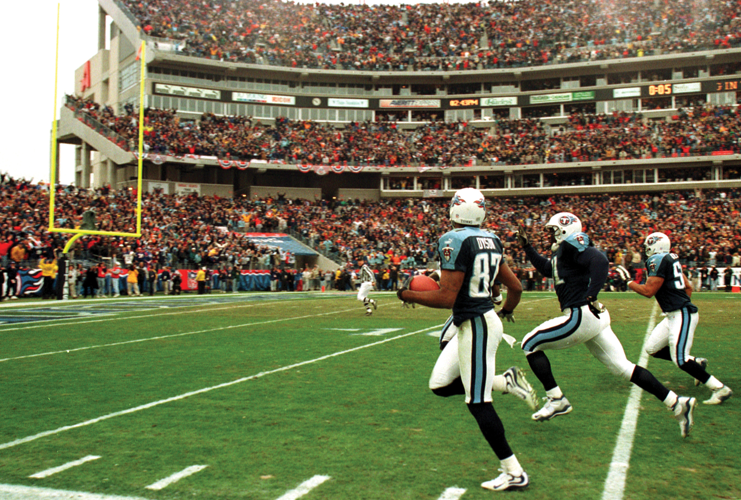
In the final two minutes of a wild-card game against the Buffalo Bills, the lead changed hands three times — the last when Tennessee pulled off an unlikely 75-yard kickoff return for a touchdown with three seconds to go. Lorenzo Neal’s handoff to Frank Wycheck. Wycheck’s lateral to Kevin Dyson. Dyson’s dash down the left sideline. They remain indelible images to this day.
The moment entered the national sports lexicon as the “Music City Miracle” and cemented the team’s place in the local consciousness. (Click here for a rundown of the famous play.)

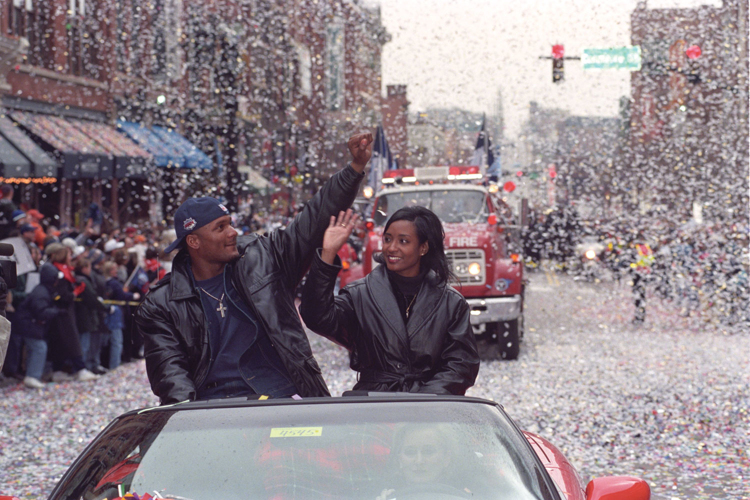
2000: Steve McNair and wife at at Super Bowl parade in Nashville
2000-01
Nov. 12, 2000: In most cases, a loss to a division opponent that snaps an eight-game winning streak is not the worst thing.
But this day’s 24-23 defeat at the hands of Baltimore (the Ravens scored the winning touchdown with 25 seconds to play) was the first time the Titans fell in their new stadium. They were 13-0 (12 regular season victories plus one in the playoffs) until that point.
With that result, a fan base raised on Tennessee-Alabama, Florida-Georgia and the like learned that rivalries also exist — and can spur just as much emotion — in pro sports. The intensity was dialed up when the Ravens came back two months later in the playoffs and won again.
2001-02
Jan. 6, 2002: NFL football is a man’s game. That does not mean the players can’t — and won’t — act like children.
Witness the final game of the regular season, a 23-21 loss at home with the temperature in the mid-30s. Late in the game, two Titans defensive backs, safety Perry Phenix and cornerback DeRon Jenkins, fought for a spot on the bench — literally. The players traded punches on the sideline over who was entitled to the final spot on the heated seat while the offense was the on the field.
The running joke after the game was that with the way the secondary played that year (Tennessee was last in the league in pass defense), both belonged on the bench.
2002-03
Jan. 11, 2003: One of the most unforgettable playoff games in franchise history proved that the third time is indeed the charm.
The Titans got the ball to start overtime and promptly drove into field goal range. Joe Nedney’s 31-yard attempt 2:08 into the extra period split the uprights and set off the stadium fireworks, but was waived off because officials ruled that the Pittsburgh Steelers had called timeout prior to the snap. Nedney missed the next one, but the officials called Pittsburgh for running into the kicker, a decision that Steelers players and coaches vehemently contested but which gave Nedney another chance. This time, from 26 yards, Nedney made it, and the Titans advanced to the AFC Championship.
Nobody wants officials to heavily influence the outcome of a game … unless it’s in favor of your team.
2003-04
June 17, 2003: Any question about the fact that the NFL is a business was answered on this day.
Middle linebacker Randall Godfrey, a fixture in the defense, was escorted off the field while the team went through an offseason workout. He was pulled from practice to ensure he would not be injured before the team had a chance to cut him, which it did the next day. An injury would have created contractual issues.
Here’s the thing, though: Three months earlier, Godfrey had agreed to a pay cut in order to help the team with its salary-cap issues. Ultimately, his sacrifice meant nothing to those in charge.
2004-05
Dec. 19, 2004: Drew Bennett capped one of the most remarkable three-week runs by any wide receiver in NFL history.
In losses to Indianapolis, Kansas City and Oakland, he caught 28 passes for 517 yards and eight touchdowns, which ranked right up there with the best three-game stretches of the era’s top wide receivers (Jerry Rice, Randy Moss, Terrell Owens and Marvin Harrison). And he did it with career backup Billy Volek at quarterback.
A college quarterback who made the roster in 2001 as an undrafted free agent, Bennett firmly cemented his place as a fan favorite in an otherwise miserable season. (The Titans finished 5-11.)

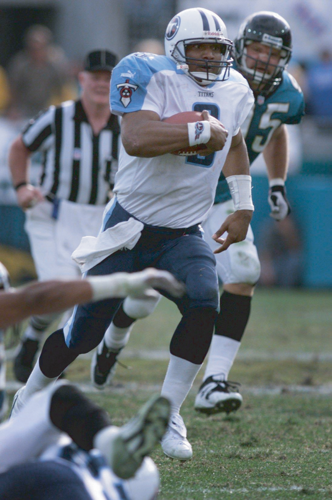
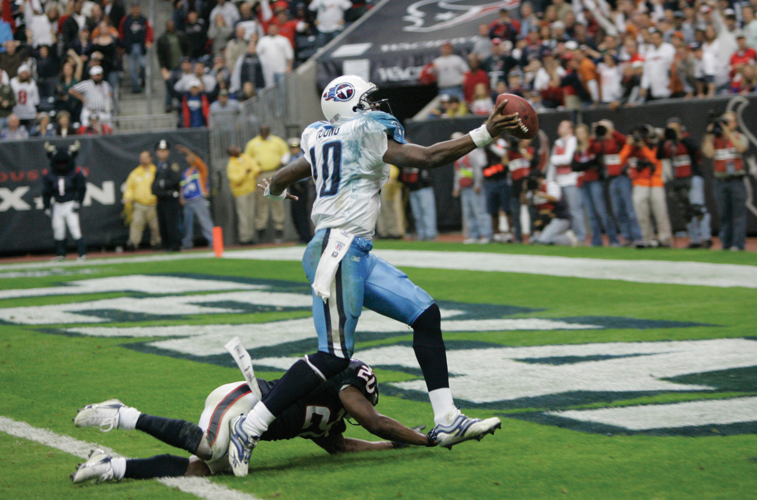
2006: Vince Young scores an overtime touchdown
2005-06
July 13, 2005: Two weeks before the start of training camp, Pacman Jones is arrested at the Titans’ training facility and charged with assault and felony vandalism following an altercation at a nightclub.
And so it began.
Tennessee’s first-round pick (sixth overall) in that year’s draft soon became a case study about how much character questions can — or should — affect draft decisions. He was arrested twice more in 2006 and was involved in a series of other off-the-field incidents, which led the NFL to suspend him for the entire 2007 season and prompted the Titans to trade him to Dallas in 2008.
He could play. But having him around was anything but fun and games.
2006-07
Nov. 18, 2006: The team departed for a game at Philadelphia the next day — without rookie quarterback Vince Young, who had called to say he was late because he was stuck in traffic.
Coach Jeff Fisher gave the order for wheels up, which forced Young to charter a plane to get there on his own. The Titans won 31-13 the next day, but Fisher scored the first major victory in what turned out to be a five-year power struggle with Young.
It is now widely known that Fisher never wanted the team to draft the University of Texas quarterback third overall that year — it was the owner’s call. It became pretty clear back then too, thanks to this incident.
2007-08
Sept. 24, 2007: Most of the team’s local history has been defined by humble stars, most notably McNair, running back Eddie George, cornerback Samari Rolle and the like.
So it was a bit shocking when, in the days leading up to a Monday Night Football matchup with the New Orleans Saints, linebacker Keith Bulluck dubbed himself “Mr. Monday Night” thanks to some notable performances he’d already had in the weekly showcase contest. But he backed it up with three interceptions and a big hit that knocked a Saints running back from the contest, as the Titans cruised to a 31-14 victory.
In terms of league-wide acclaim, Bulluck likely is the most under-appreciated Titans player of all time. But that’s not his fault.
2008-09
Sept. 7, 2008: Sometimes a man just wants to be with his boys and eat chicken wings.
A season-opening victory over Jacksonville was marred by a knee injury to quarterback Vince Young, who was booed when he left the field. Later that night, Titans officials called the police because they could not reach Young, who they said had a gun and had made comments about suicide. That touched off a frantic search that ended when he was found at a friend’s apartment eating chicken wings.
Young did not start another game that season. Behind Kerry Collins, the Titans finished 13-3 and earned what is currently their most recent playoff berth.
2009-10
Nov. 15, 2009: Franchise owner and founder Bud Adams got caught up in the moment and celebrated a 41-17 rout of the Buffalo Bills in novel fashion. From his suite, he flipped the bird to a group of visiting Buffalo fans — double barrel.
Adams was, to say the least, quirky, and his early reluctance to change the team’s name and logo after the relocation from Houston got him off on the wrong foot with the local fan base. Two middle fingers changed the way a lot people looked at him — for the better.
From the outset, Nashville did not endeavor to be a traditional pro sports town, and an owner — even a carpetbagging one — willing to show his true feelings in such a crass manner instantly turned him into a much more lovable eccentric.
2010-11
Nov. 28, 2010: Cornerback Cortland Finnegan proved that it if you’re going to go down, go down swinging.
The undersized cornerback always played with a chip on his shoulder, and on this day he antagonized Houston wide receiver Andre Johnson to the point that the two eventually came to blows. Each ripped off the other’s helmet and delivered what is regarded as one of the most entertaining fights in NFL history.
Sure, Johnson got the best of the exchange. And sure, the Titans lost to the Houston Texans 20-0 (the midpoint of a five-game losing streak). Sometimes all you can do is fight back.
2011-12
Dec. 18, 2011: In their first year under coach Mike Munchak, the Titans were 7-6 and in the thick of the AFC playoff chase. Good thing their opponent on this day was the Indianapolis Colts, who were 0-13 without injured quarterback Peyton Manning. Or was it?
Somehow the Titans lost 27-13. They got within a touchdown late in the fourth quarter, only to give up an 80-yard touchdown run on Indianapolis’ next offensive snap. Ultimately they missed out on a postseason berth because of a tiebreaker.
Sadly, it was the start of what has become something of a tradition for this franchise, which nearly every year since has lost to the worst team in the league (typically the Jacksonville Jaguars).

2012: Jake Locker’s first game as starting quarterback
2012-13
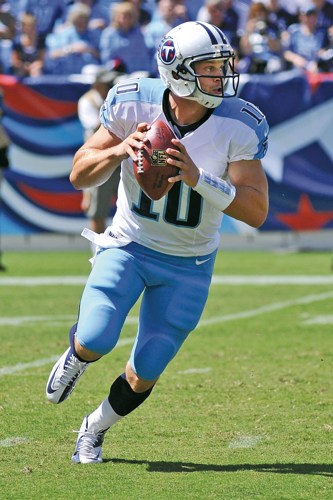
Sept. 9, 2012: Jake Locker’s first game as Tennessee’s starting quarterback was an otherwise forgettable affair, except that the 2011 first-round pick served up reminders throughout the rest of his abbreviated career.
He looked brilliant on the opening possession, a 12-play drive that staked the Titans to a 3-0 lead. Later, he was sacked and lost a fumble, which the New England Patriots returned for a touchdown. His day ended early when he threw an interception and hurt his shoulder making a tackle on the play.
Locker had some bright spots in his four seasons, but he never could stay healthy or productive.
2013-14
Nov. 3, 2013: The Titans defeated the St. Louis Rams 28-21 in a game between two mediocre teams that no one would have paid any attention if not for one minor detail. It was the first — and thus far only — time the Titans played against a team led by Jeff Fisher, the winningest coach in franchise history and the face of the organization for the majority of its time in Tennessee.
The record of Fisher’s performance as Titans coach is one of the most easily manipulated topics in the game. With five 8-8 seasons in 16-plus years, you can say he finished with a losing record just five times, or you can say he finished with a winning record just six times. Either way, you’d be right.
What’s undeniable is that the Titans are 1-0 against Fisher.

2014: Ken Whisenhunt
2014-15
Sept. 28, 2014: Nothing sums up this dreadful season (a league-worst 2-14 record) than the fact that QB Charlie Whitehurst made the first of his five starts on this day, a 41-17 loss to Indianapolis.
Whitehurst earned the nickname Clipboard Jesus by virtue of his easily identifiable long hair and the fact that most of his pro career had been spent holding a clipboard on the sideline. Drafted in 2006, he had started just four games in seven seasons and went a stretch of three full years without playing a down.
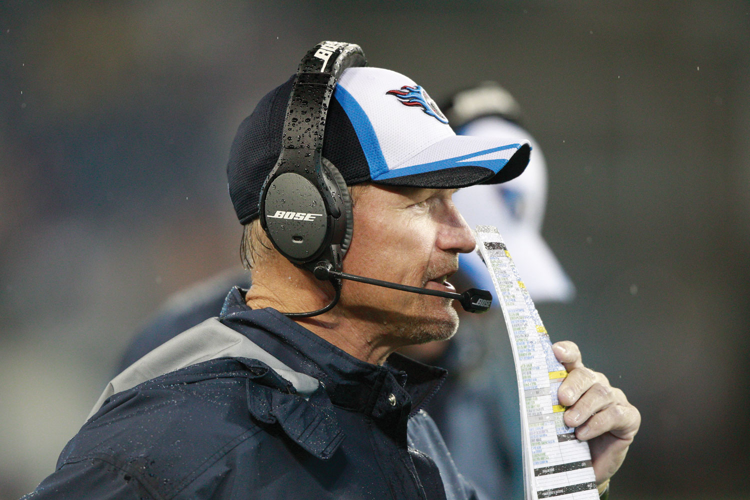
A free agent addition hand-picked by new coach Ken Whisenhunt, he started five times for the Titans. But the fact that he actually won one ought not be ignored.
2015-16
Nov. 1, 2015: A 20-6 loss at Houston ended a feeble chapter in franchise history. The defeat left the Titans at 1-5 and prompted ownership to fire coach Ken Whisenhunt, who was 3-19 in fewer than two seasons on the job.
Whisenhunt’s hiring was considered a coup when it happened. He had led the Arizona Cardinals to their only Super Bowl appearance in his six seasons in charge of that franchise, and after one successful season as an offensive coordinator with San Diego, several teams wanted him.
His tenure in Tennessee stands as a testament to the idea that you have to be careful what you wish for, because you just might get it.
2016-17
Jan. 14, 2016: Jon Robinson is named general manager. It is a watershed moment for the franchise, in that the 39-year-old (he turned 40 four days later) is a Tennessee native, the first franchise executive who came up watching and rooting for the Tennessee Titans.
He witnessed, exalted in and endured all the same things his team’s fans have, and he did so in Union City, in the northwest corner of the state, closer to Memphis — which once collectively turned its back on the franchise’s arrival — than to Nashville.
Robinson’s first season was a step in the right direction — a 9-7 record and meaningful games right to the end. It has created optimism for what is to come and hope that the Titans can revisit some of the highest points of their first 20 seasons.



