

Photo: Daniel Meigs
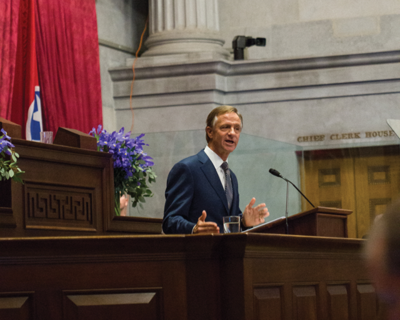
A year from now, Gov. Bill Haslam will be handing over his duties as head of the state to a newly elected governor, bright-eyed and bullish on advancing her or his agenda through the 111th Tennessee General Assembly. But starting this month, as the second year of the 110th session gets underway, Haslam has one last chance to push his own agenda and ostensibly cement his legacy, such as it is.
Relations between the governor and the Republican supermajority are not as friendly as they once were, and resentment lingers over last year’s battle to increase the gas tax. Almost two dozen members of the legislature are retiring or running for other office, which means Haslam is losing a lot of arms that he could have previously twisted.
The governor has yet to release either his legislative agenda or budget, and his office is staying mum on whether he has big plans or smaller ones.
“Gov. Haslam plans to finish strong in his final year in office, continuing his focus on creating high-quality jobs, investing in education, and implementing conservative fiscal policies,” says spokesperson Jennifer Donnals in an email. “This legislative session the governor will work together with the General Assembly to find solutions to end the opioid crisis in our state. And while more Tennesseans are attending college than ever before through Tennessee Promise and Reconnect, the governor is committed to helping those students complete college and be prepared to enter the workforce with degrees or certificates.”
Almost all of Haslam’s much-touted higher-education initiatives have passed both chambers without too many battles. Free community college? Free college for four years for veterans who aren’t eligible for the G.I. Bill? It’s hard to oppose taxpayer money being spent on that — at least, not in these flush budgetary times. And as far as signature achievements to highlight during a hypothetical future campaign, they all have bipartisan appeal.
But Haslam has had less success with his attempts at education reform in public primary and secondary schools. Although he pushed through sweeping changes in teacher evaluations and retention shortly after taking office, a lot of of the changes have backfired — and devoutly conservative members of the legislature have moved to repeal some of the reforms. Standardized testing changes have led to one disaster after another. Education committees in both chambers this year are likely to continue taking Department of Education Commissioner Candice McQueen to task for the failures. And Haslam’s attempt to implement a limited voucher program for students in low-performing schools — which has never made it out of committee, year after year — is almost certainly dead, as sponsor and voucher advocate Sen. Brian Kelsey (R-Germantown) has said he won’t pursue the bill this year.
Haslam had the benefit of taking office right as the economy finally began bouncing back in the wake of last decade’s recession, and he takes as much credit for it as he can every time he speaks. It’s true that other states like Mississippi and Kansas are still in dire fiscal straits all these years later — although in Kansas’ case, it’s significantly due to massive tax cuts backed by Reagan economist Art Laffer that did the opposite of stimulating the economy. (Laffer, who lives just outside of Nashville, has endorsed U.S. Rep. Diane Black for governor.) But despite Tennessee’s record low unemployment, more of the economic gains appear to be accruing to the state’s cities. The unemployment rate doesn’t reflect the people who have long since stopped searching for jobs or the people whose full-time minimum wage jobs don’t cover the cost of living — both circumstances are possibly a cause of and a result of the opioid epidemic.
Tennessee has the highest opioid prescription rate in the country (although of course not everyone prescribed opioids is an addict). The legislature has taken baby steps in recent years to deal with the problem, but far too many legislators still don’t understand the basic facts of addiction and treatment, many seeing the condition as a moral failing and thinking the best solutions for treatment are found in faith-based organizations.
Last year, legislation died that would have provided immunity from arrest for people who suffer drug overdose, despite support by the Tennessee Medical Association, the Tennessee Bureau of Investigation and the Tennessee Association of Chiefs of Police. Even medical doctors who should know better, like state Sen. Mark Green (R-Ashland City), currently running for Congress, said the legislation would encourage addicts to “fake” overdoses when they had run-ins with law enforcement.
No matter how low unemployment drops, no matter how many companies have expanded or relocated in the state, this too is Haslam’s legacy. And even if his proposed legislation to handle the opioid crisis is as progressive as possible, there aren’t enough treatment centers to handle patients — and that’s even if they had the insurance to cover treatment, which many do not.
House Deputy Speaker Steve McDaniel (R-Parker’s Crossroads) made waves last week when he said he would have voted for Insure Tennessee, Haslam’s 2015 plan to expand Medicaid to cover the uninsured in accordance with the Affordable Care Act. Insure Tennessee never made it out of committee — thanks in part to House Speaker Beth Harwell (R-Oak Hill), who’s now running for governor. It’s worth noting that McDaniel did vote in support of a 2014 bill that prevented Haslam from negotiating a deal to expand Medicaid without legislative approval, which also helped kill expansion.
Around the Capitol, Haslam’s inability to get even his own speaker on board to pass Insure Tennessee — with a GOP supermajority in both chambers — is seen as his biggest failure. Whatever his legacy on higher education, many say it is offset by the almost 200,000 people who could have had health insurance during his tenure but have not, as well as the 10 rural hospitals that have closed their doors (or will be doing so in the next two months) since 2012.
Could Haslam salvage part of his legacy — and people’s lives — this session, even without his preferred non-structured federal block grants? It’s possible, especially if enough outgoing legislators like McDaniel are willing to stop playing politics and deal with policy nuance. But if last year’s battle over the gas tax and IMPROVE Act proved anything, it’s that the Haslam administration has trouble whipping up votes before the very last minute. Yes, a stripped-down version of the bill with huge tax breaks for corporations finally passed, but it almost didn’t. And a small gas tax increase to pay for roads we all drive on is far less of a hot potato than subsidized health insurance.
Haslam has his new state museum building under construction. Construction for the new state archives building should be fully funded this year; ground has already been broken. It’s likely that some other construction projects at universities and elsewhere will also be funded in the budget. And legislators are positively luxuriating in their window views from their fresh digs in the newly renovated Cordell Hull Building. Of course, if Haslam had gotten his way several years ago, Cordell Hull would have been torn down, per the recommendations of Jones Lang LaSalle, which took on a contract to assess building efficiency and costs in the governor’s first term. Thanks to JLL, many state offices outside of Nashville are no longer in one building in a central location but rather scattered throughout assorted suburban strip malls and office parks. And despite Haslam’s promise to create jobs, a different contract with JLL outsourcing custodial and maintenance work in state buildings in Nashville resulted in dozens of state employees losing their jobs.
Last year, after a secretive and lengthy process, the state signed yet another contract with JLL to outsource custodial, landscaping and maintenance jobs at state colleges and universities. Employees were told they’d be able to keep their jobs, but they’d lose their state benefits — which would mean for all practical purposes, many longtime employees would opt to retire early, meaning JLL could hire new workers and pay them far less. But to date, only one school, Austin Peay State University, has signed on, and that’s only because its leaders were already outsourcing custodial work and the school’s contract with the other company was up.
Even fans of Haslam have been puzzled with his seeming obsession to outsource some of the lowest-paid state jobs for comparably minimal savings (especially compared to the salaries the people leading the outsourcing are getting paid). An unlikely group of bipartisan legislators has become united in fury over the secrecy, including contracts with JLL’s subcontractors that lawmakers have been told they can’t see. There is pending legislation to give the General Assembly the authority to approve contracts of this size — legislation vocally opposed by Haslam and his staff.
Meanwhile, Haslam has floated the idea of reducing the size of the University of Tennessee Board of Regents, which outsourcing opponents fear is a backdoor way to reverse campus decisions not to outsource. UT system President Joe DiPietro, in an email to board member (and Haslam pal) Raja Jubran, wrote that an article celebrating the failure of outsourcing at UT was “HORSE SHIT” — capitalization his. Jubran replied, “Indeed.”
Will this, too, be a key part of Haslam’s legacy? More students in higher education and fewer employees (making less money) serving them? Or will he let the legislature win this battle and save his resources for something more meaningful?
It might be a short session in 2018 so legislators can leave town to go raise money and run campaigns. But if one thing is certain, it’s that Haslam won’t be given a pass on anything in his last year in office.



Post a comment as anonymous
Report
Watch this discussion.
(0) comments
Welcome to the discussion.
Log In
Welcome to the discussion.
Keep it clean. Please avoid obscene, vulgar, lewd, racist or otherwise abusive language. Comments featuring hate speech or threatening or violent content will not be tolerated.
PLEASE TURN OFF YOUR CAPS LOCK.
Be truthful. Don't knowingly lie or mislead.
Be proactive. Use the “report” link on any comment that violates our comment policy.
Share with us. We'd love to hear your feedback.