
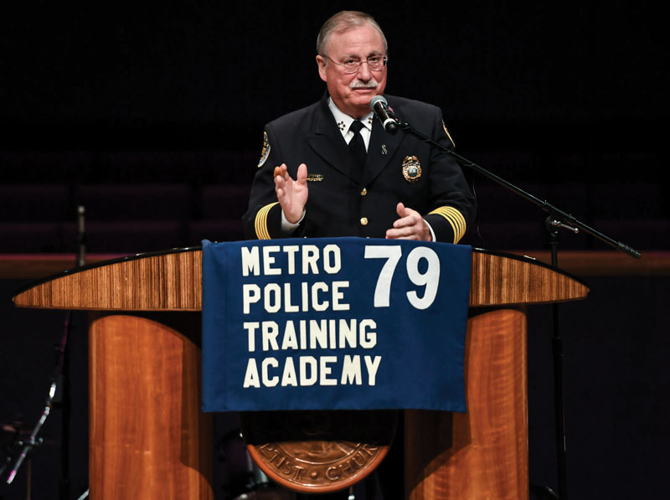


Metro Nashville Police Chief Steve Anderson stood with Mayor Megan Barry before 62 police officer trainees who were seated at classroom desks behind stacks of reading material. It was the morning of Jan. 4, 2017. The trainees were at the beginning of a five-and-a-half month process meant to equip them for hitting the streets with a badge and a gun. The chief was just days into what has turned out to be a long few months for the MNPD.
Anderson impressed upon the trainees that they were the cream of the new crop.
“I want you to know that the seat you’re sitting in, there were two other people qualified to sit there,” he said, quoted in a report from WPLN. “But we picked you.”
“It’s going to be really, really hard — maybe the most difficult thing you’ve ever done. But you can do it.”
Anderson, who is in his seventh year leading the department, was a trainee once too, more than 40 years ago. He started working as a Metro cop in January 1975, the month before one of the most notorious crimes in modern Nashville history — the murder of 9-year-old Marcia Trimble. Although he’d initially turned to police work as a side job to help him pay for college and law school, he soon made it a career, and he has described it as an addiction. He rose through the department for 35 years until he was named chief in 2010, in the middle of that year’s devastating flood. Following her election in 2015, Barry kept him on, after years spent sitting just feet from him at biweekly Metro Council meetings where he is a fixture.
In conversations with Metro officials and insiders in the city’s political and criminal justice spheres, as well as activists and other close observers, a picture emerges: Anderson is a hardworking, veteran law enforcement official who is also a savvy operator, a man whose skill at managing the department’s public image has helped him weather changing cultural and political winds, but whose old-school approach in some areas has caused tension and strained some relationships within Metro government. Behind the scenes there can be an edge to the mild-mannered chief who has said he sees Andy Griffith as a model.
If you know him for one thing, it’s probably the time in 2014 when he ordered his officers to greet street protesters — demonstrating in solidarity with people protesting police brutality around the country — with hot chocolate. The move brought Anderson low-level internet fame and nearly unanimous praise from Metro officials, a sphere in which he seemed to enjoy singular goodwill. He was presiding over the MNPD at a time when the city’s murder rate had hit record lows for two years in a row and his officers had not appeared on the national news.
But 2017 has been different. In the first three months of the year, a Metro officer died in the line of duty, another shot and killed a black man fleeing a traffic stop, and festering wounds have ruptured in communities where relations with police have long been fraught. Seemingly every issue we talk about when we talk about policing has been thrust to the forefront of Nashville politics, and thus so has Anderson. A recent Vanderbilt University poll found that the MNPD is the most popular institution in Nashville, but the first few months of this year have complicated an understanding of its chief.
On a recent weekday morning, Anderson sits in a small meeting room at the MNPD’s North Precinct, where he’s agreed to talk about the year so far.
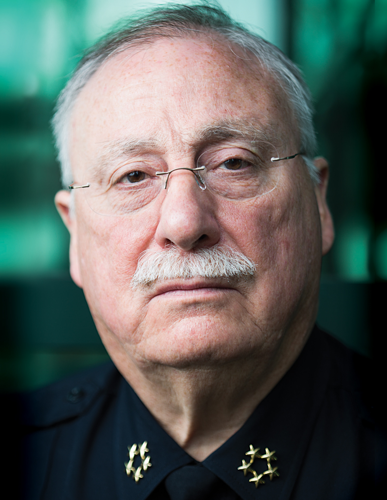
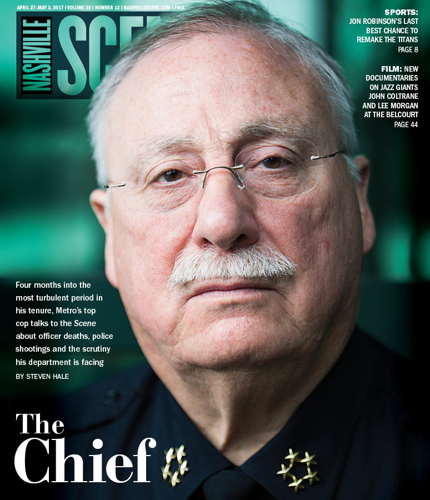
In person, the 69-year-old chief gives off an almost preternatural calm. He has wire glasses, a neatly trimmed mustache and thinning gray hair. He speaks at an easy pace, a tinge of Tennessee in his voice. In nearly half a century of police work he has presumably shouted a time or two, but it’s hard to imagine it.
When I tell him it seems there’s been a lot going on at the police department this year, he leans back in his chair and doesn’t miss a beat.
“Really?” he says, before letting out a knowing chuckle.

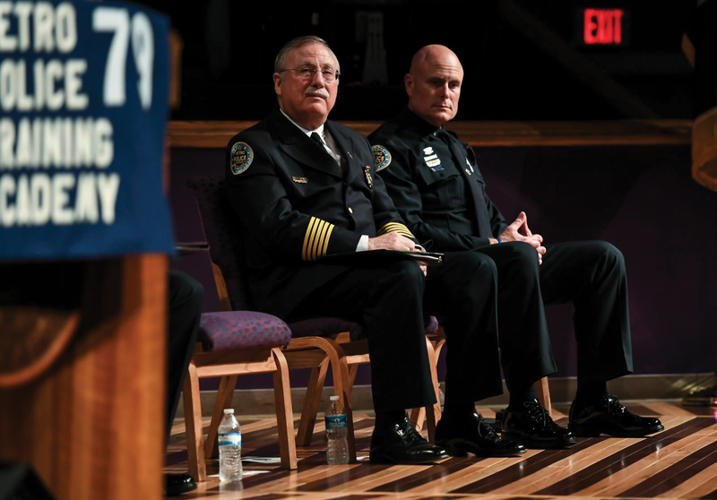
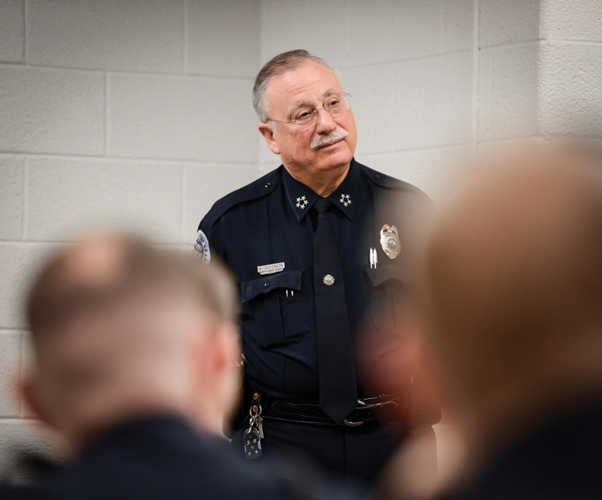
Metro police chief Steve Anderson at graduation for new officers
In recent years, as debates about policing have dominated TV screens and Twitter timelines, two inescapable facts, while not mutually exclusive, have battled for attention: the risks that officers face when they leave home every morning, and the fact that black Americans are disproportionately at risk of being shot and killed by police officers.
In the span of eight days in February, Nashville saw both.
Anderson was still at his home in Joelton — the rural area where he lives with his wife and six classic cars he rarely finds time to work on — when police spokesperson Don Aaron called him with bad news. One of his officers, an 18-year veteran named Eric Mumaw, was missing.
When the chief heard that, he says, it “pretty much told me that he was gone.”
Shortly after 4 a.m. that morning, Mumaw and two other officers had responded to a report of a suicidal woman sitting in her car on a boat ramp at the edge of the Cumberland River. As they tried to talk her down, the car began to move into the river. (Police allege she put the car into gear.) Mumaw was pulled into the frigid water and drowned. While the woman, Juli Glisson, was still in the hospital, the MNPD announced the controversial decision to charge her with aggravated vehicular homicide. A judge last month sent the case to a grand jury.
Anderson’s face looks heavy when he talks about that day.
“Until recently I thought these thoughts were mine, but they’re not,” Anderson says, recalling conversations he’s had with other police chiefs. “Intellectually, you know that you didn’t send them on the call, you didn’t make the assignments, you’re not involved. Emotionally, as a supervisor and especially as a chief of police, you know that people and especially families are looking to you. … It’s difficult talking to the families, and it’s difficult for the families to talk with me. A lot of communication I have to keep in touch, I do through other people, because it’s more comfortable for the family.”
When an officer dies, Anderson says, it’s his job to put aside his personal feelings and make sure the family and other officers are taken care of. But when time allows, I ask, what does he do with those feelings?
“I don’t know the answer to that,” he says. “I can still see every officer that I’ve been involved with. I can see where they were last laying. Those images do come to mind.”
The chief was leaving Mumaw’s gravesite after a small private ceremony in Ohio when he received word that, back in Nashville, a white officer named Josh Lippert had shot and killed a black man named Jocques Clemmons.
Clemmons had run a stop sign and pulled into a parking lot at the James A. Cayce Homes — Nashville’s largest public housing development, which has been ground zero for the complicated relationship between police and black Nashvillians in the past year. Lippert pulled in behind him in an unmarked car, and Clemmons tried to run away. Police say a gun Clemmons was carrying had dropped to the ground and that he’d picked it up again before turning his back to Lippert and running in between two parked cars. Lippert fired on him, striking him once in the left hip and twice in the back. The whole incident, captured by a surveillance camera across the street, lasted less than a minute.
For years, Metro officials had watched unrest in other cities, brought on by the killing of black men by police officers, and expressed cautious gratitude that such an incident had not occurred here — a false sentiment, historically speaking, but a comforting one nonetheless, particularly for the white citizens of an ostensibly progressive city. Now, though, a dead black man’s name was trending on Twitter in their town.
Anderson says he did not see it in the context of that national narrative, though.
“My thinking on this incident or any other incident, whatever it might be, is, ‘Are we doing everything that we’re supposed to be doing?’ ” he says.
The department would be criticized for including some details of Clemmons’ criminal record in their initial release about the shooting — with even more outcry when it was revealed that they’d sought warrants to dig through his social media accounts. At the same time, though, the MNPD promptly released the officer’s name and footage of the shooting.
A few days later, Anderson held a press conference to announce that he’d asked the Federal Bureau of Investigation to monitor the department’s investigation into the shooting. But later, when Davidson County District Attorney Glenn Funk announced that the Tennessee Bureau of Investigation would be “taking over” the investigation, neither Anderson nor anyone from the MNPD was present.
He was present, though, for an unprecedented event at the Metro Council almost two weeks after the shooting.
Sitting in his normal spot at the head of the chambers, Anderson sat stone-faced as an impromptu airing of grievances played out in front of him and the council. Under the banner of “Justice for Jocques,” some two dozen demonstrators filed into the meeting and shut it down, refusing to yield the floor until they were granted a hearing. Clemmons’ sister spoke, telling the council members sitting in stunned silence how she cried herself to sleep at night, if she slept at all. She called her brother’s death “cold-blooded murder,” and other speakers would call out Anderson by name.
After the meeting, Anderson told reporters simply that he’d listened to everything the group had to say and taken it to heart. Months later, though, he seems largely unmoved.
“I understand that there’s always going to be people on both sides, on either end of the spectrum, that’s going to be critical of what I do, what the department does,” he says. “You have to take that into account. There are people who think that I have absolute power as the chief of police, that I can do anything that I figure ought to be done at any given time, that there are not rules and regulations that I have to operate under. I take that into account. It doesn’t get personal, and you just have to put that into the compartment that you consider, but you can’t give everybody everything that they want.”

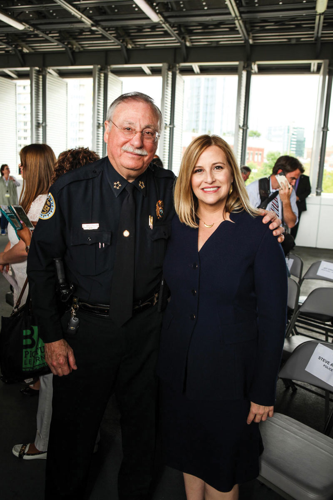
Chief Anderson with Mayor Megan Barry at the State of Metro Address
As February turned into March, Metro started the process of determining what policies and procedures would govern the MNPD’s use of body cameras, which the mayor has committed to funding in her forthcoming budget. Later in the month, Anderson would present a $50 million plan to outfit every officer with a camera and equip Metro police vehicles with dashcams, which nearly all of them lack*.
But if the month previous had seen Anderson publicly representing the department under the most dramatic of circumstances, March offered a window into how he operates behind the scenes.
In October 2016, a group called Gideon’s Army released an extensive report, called “Driving While Black,” showing racial disparities in traffic stops and vehicle searches in Nashville. It appeared to provide statistical backing for anecdotal evidence of bias that black Nashvillians had been talking about for years, and it rocked the city’s political and criminal justice establishment.
On March 8, months after At-Large Councilman Bob Mendes filed a resolution — co-sponsored by more than half the council — that requested an official MNPD response to the Gideon’s Army report, Anderson sent a letter to the council slamming the report and questioning its methodology. He “categorically” denied that “racial profiling is an element of any MNPD policing strategies” and reiterated the department’s argument that it simply deployed more officers where crime was higher. He listed statistics showing that African-Americans were disproportionately the victims of a number of crimes, including murders and assaults.
“Ignoring these real disparities of victimization in our African American communities by seeking to divide or drive a wedge into police community relations by attempting to draw attention to a false narrative of racial profiling, without clear evidence, is morally disingenuous,” he wrote.
Anderson’s use of the term “morally disingenuous” stunned many around the courthouse who still reference it to this day. But it turned out that his open letter was actually the culmination of a months-long back-and-forth between him and Mendes, which occasionally got personal. In emails obtained by the Scene, Anderson questioned the councilman’s motives in filing the aforementioned resolution, as well as another requesting that traffic stop reports be submitted to the council annually. The chief wrote that Mendes’ effort seemed “to be more about self-promotion than providing pertinent information” and “more about a need to perpetuate an agenda than to provide a public service.”
In a response at the time, Mendes had written to the chief that he was “taken aback by the anger in your email.”
In an email to Anderson on March 9, the day after the chief’s scathing response to the Gideon’s Army report, Mendes wrote:
“When you have previously questioned (in emails to the full Council) whether my intentions were ‘legitimate’ and suggested that I was simply pursuing an agenda of self-promotion, I have not gotten upset about it. In my day job as a lawyer, I have been involved in contentious business disputes for 25 years and I am used to people questioning another person’s motives as a tactic. However, I really don’t think that doing that with a private group — i.e., calling private citizens ‘morally disingenuous’ — is advisable. I’m sure you must sincerely hold that belief, otherwise you would not have said it. But I don’t think it helps the public conversation move forward.”
If it seems like Anderson is unnecessarily sparring with a council member, consider a police chief’s role as servant of multiple masters. Anderson reports to the mayor, but works with the council on issues from budget to constituent services. He’s the public face of the department, and also responsible for roughly 1,500 sworn officers. He doesn’t shy away from the realities of operating in multiple worlds.
“I’m not an elected official, I’m not a politician. But you have to take into account the politics of everything. There’s internal politics, external politics, so all of that has to measure into everything you do. There’s three tests I apply to almost everything — it’s a balancing act every day. You have to keep in mind the troops, the department, the personnel of the department — their wants, their needs, their considerations. The public — their wants, their needs and their considerations. And then the administration — the mayor and the council. So while we all want a good city and a safe place to live, there’s competing interests.”
Also on March 9, Gideon’s Army released a response of its own, rebutting the chief’s criticisms of the report’s methodology and questioning what they saw as Anderson’s self-servingly narrow definition of racial bias.
“Gideon’s Army works to dismantle institutional injustices that are deeply ingrained in the criminal justice system,” they wrote. “Chief Anderson just told us that he does not see discrimination as an institutional problem but a problem of single individuals acting on bias. This outdated and inaccurate understanding of racial discrimination undermines his credibility on issues of race and policing. Nashville deserves more.”
Whatever credibility Anderson and the MNPD did have on race and policing took a hit several days later, when WPLN reported on one of the books distributed to every one of the new recruits Anderson had welcomed in January. The book, published in 1986, was called Tactical Edge, and among its contents were blaring warnings about the threats that every officer faced on the street. Among them: minorities and children who’d grown up in daycare. WPLN reported the book warned “officers to be wary of an increasing population of minorities, which it says are ‘disproportionately associated with criminal violence.’ ”
Later in the week, at the MNPD’s budget hearing with the mayor, Barry prompted Anderson to clear things up. The chief described the book’s inclusion in the academy’s training materials as “an extreme oversight” and assured her that it had been removed. There were those in Metro circles who were shocked at how quickly the mayor moved on from the matter. But in his interview with the Scene, Anderson says the controversy over the book — which he says he had read in the past — was “sort of much ado about nothing.”
“We should not have had that book in there,” he says. “There were portions of the book that are taught and are utilized and valuable today. The book was written some time back, there should have been closer scrutiny of the materials that we’re handing out. The offensive portions of the book, we actually have a whole broad array of training that contradicts that. So, in fact, as I’ve said before, I expect there will be much closer scrutiny of materials that go to our people.”
If the revelation of a decades-old racist and alarmist police department textbook put the mayor and the chief in an uncomfortable public position, another behind-the-scenes drama was threatening to further complicate their relationship.
A month-and-a-half after the district attorney had announced that the TBI would be “taking over” the Clemmons investigation, the MNPD had not stopped its own investigation, and Anderson was refusing to bow out. Emails obtained by the Scene showed TBI officials describing the standoff as unprecedented and raising the possibility that they would walk off the Clemmons case and refuse to participate in future investigations. Throughout, Anderson maintained that the two agencies could conduct parallel but independent investigations.
The mayor, the DA and the TBI all signaled a desire for the MNPD to agree to an arrangement that would make the TBI the sole investigators of incidents in which an officer shot and killed someone. Publicly, the mayor expressed her “complete confidence in the ability of Chief Anderson to lead” MNPD. Some people close to the process were all but convinced that Anderson would never sign such a memorandum of understanding with the TBI. Ultimately, though, he did, agreeing to an arrangement for future investigations that was less than the “parallel but independent” arrangement he desired but more to his liking than a more restrictive MOU used in Memphis, which the TBI had proposed. The department seems to view this as a victory.
In response to a comment pointing out that the MOU wasn’t quite what Anderson had wanted, Aaron, who was sitting in on the interview, chimed in to note that “it’s not Memphis.”
Anderson makes it clear that he had some issues with the way the story was framed by the Scene and other outlets, whom he suggests were sensationalizing the conflict.
“Let’s be frank here: If the story were that police and TBI are discussing and expect to reach an agreement, the public wouldn’t be too much interested,” he says. “But that’s what we were doing, we were discussing.”
Anderson says his concerns arose from the fact that the MNPD has more resources to devote to an investigation of this kind and can do it in a more timely manner. His proximity to the investigation would also allow him to keep the public informed. At the same time, he says he recognizes that “from the public standpoint there could be some perception that we might be biased.”
As far as the Clemmons investigation goes, Funk is now in possession of two files — one from the MNPD and one from the TBI. As of this writing, his office had not yet decided whether to seek an indictment in the case.

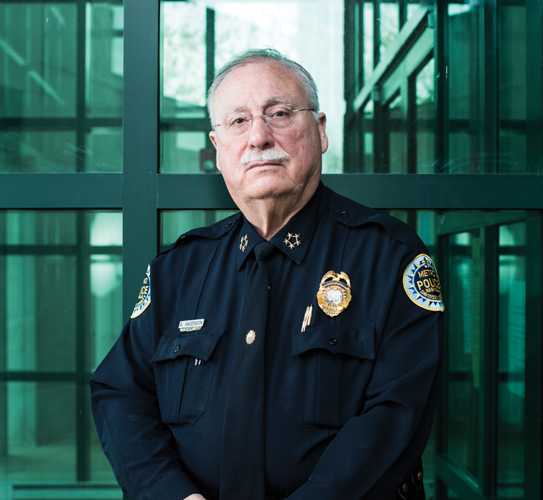
Chief Anderson at MNPD’s South Precinct
As Anderson sits at the North Precinct, calmly and confidently talking past the 30 minutes his press office had originally offered, it’s clear he doesn’t think there’s much at all wrong with the MNPD or how its officers patrol the streets of Nashville.
He’s also confident that it’s best for the department to police itself, in spite of recent calls for a civilian review board.
“I’ve not seen one work in another city,” he says. “They wind up being on one extreme or another,” either coming down too harshly on officers or deciding that someone with a badge can do no wrong.
“A lot of what people might think about us is not really us — it’s the news clip they saw from some other city,” Anderson says. “If someone sees a school teacher, a doctor, a plumber or whatever, and however horrendous it may be in Texas or California or Washington state, they don’t automatically think, ‘Well my plumber must be bad’ or ‘My doctor must be engaging in this practice.’ But what they see in some other place gets imputed to us.”
Anderson says there is a joke in the department that “police officers on the first day have to be perfect and then get better after that.”
In some ways, his comments echo those of U.S. Attorney General Jeff Sessions, who wrote in a recent USA Today editorial that “too much focus has been placed on a small number of police who are bad actors rather than on criminals.”
To be fair, there are planes that land, so to speak. In late March, a 19-year-old black man fired a gun at two white officers in the J.C. Napier Homes. But because of the risk to bystanders, neither of the officers fired back. Instead they chased the man down and arrested him. He would later tell investigators that he’d mistaken the officers for a man with whom he’d been arguing.
“I often say, and I’ve said this testifying in court, in lawsuits,” Anderson says, “as we speak, one of our officers before this conversation ends will have made a million-dollar decision. In other words, a decision [that] had it gone wrong was going to cost the city a million dollars. We do that every day, all day. And you can see the public satisfaction of the police department is pretty high. Because our people do make good decisions and do exercise great discretion all day long.”
In the department’s critics, Anderson seems to see a vocal minority clinging to isolated incidents of bad behavior — or perceived bias — to service a preconceived narrative about policing. At the same time, he acknowledges that for all the good he believes his department does, a few bad actions can spoil the public perception of the department and undermine trust between officers and the community.
“We had an assistant chief here at one time that had a saying that I still take into account today,” he says. “And I have to clean it up for public use. He points out that it only takes a couple of drops of the waste product of a domesticated fowl to mess up a whole bunch of vanilla ice cream.”
With that, the chief was due at a retirement ceremony down the hall for Paul Flournoy, an African-American officer who’d been with the department for 28 years. The building in which it was held is named for William David Bodenhamer, one of Nashville’s first black cops. The North Precinct sits surrounded by black metal fencing, the parking lot full of MNPD patrol cars, the newest models carrying a recently added tagline: “Nashville’s Guardians.”
Just across the street are the brick buildings of the Cumberland View public housing development.
The true distance between them, though, is harder to measure.
* After this story went to press, the mayor released her budget proposal including $15 million for body cameras and dash cameras — a fraction of what Anderson had proposed.




