
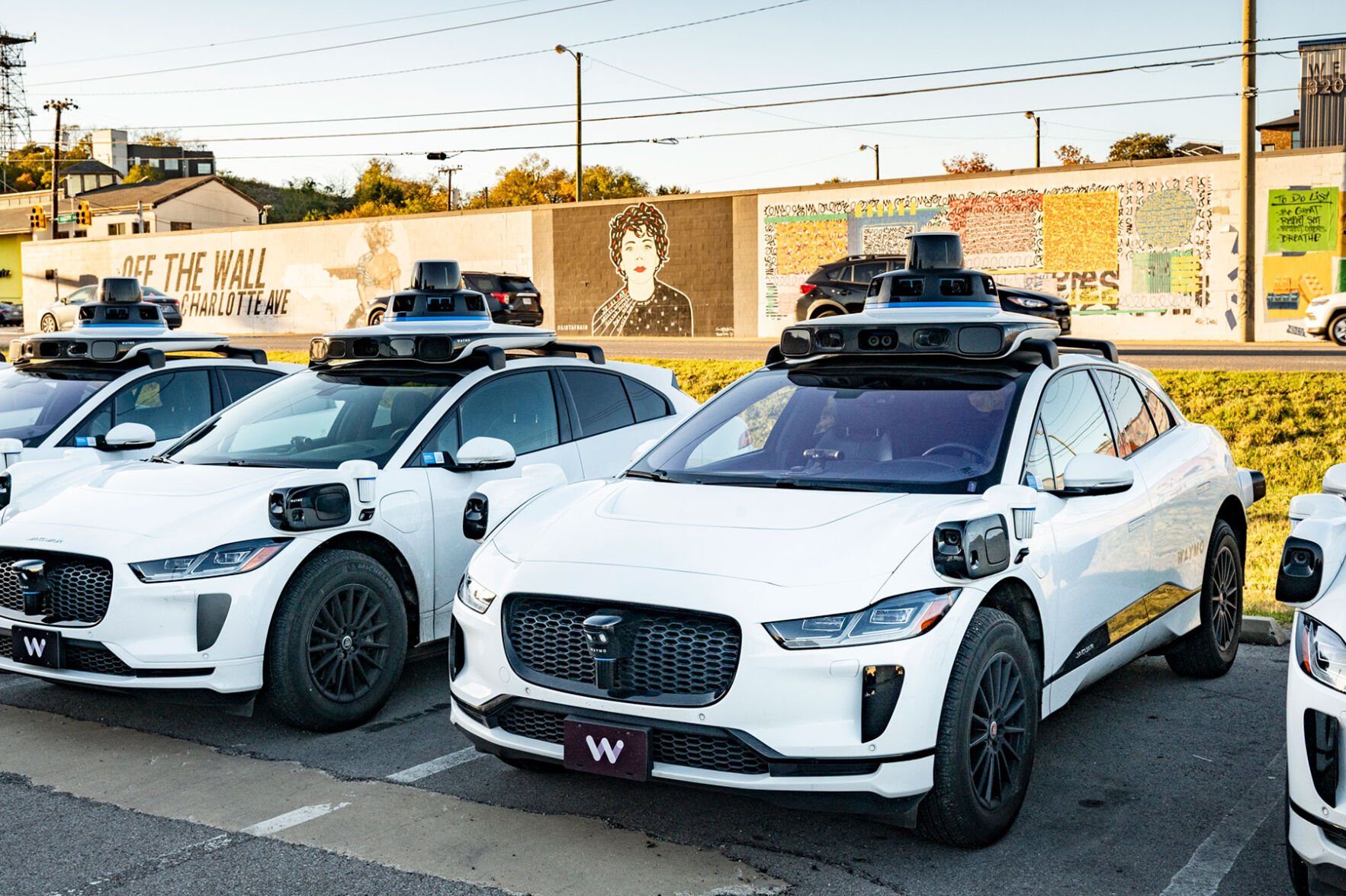
Waymo will partner with Lyft to roll out autonomous ride-hailing in Nashville next year, starting with trips booked in the Waymo app before expanding into Lyft’s platform. If the rollout goes as planned, the sight of Waymo’s white Jaguar I-Pace SUVs could go from a novelty to an everyday feature of Nashville life.
Waymo — owned by Alphabet, Google’s parent company — already offers robotaxis in Phoenix, San Francisco, Austin, Los Angeles and Atlanta. The company is testing or planning to launch soon in several other U.S. cities, including Detroit, Dallas, New Orleans, Las Vegas and San Diego. Chattanooga Mayor Tim Kelly recently said he pitched Waymo to come to his city as well.
Meanwhile, similar autonomous vehicle companies — such as Amazon’s Zoox and Beep’s self-driving electric shuttle buses — are also testing and launching in various U.S. cities. It seems like every day, a new announcement about autonomous vehicles puts robotaxis closer to swarming the streets of every major American city.
Several questions swirl around this shift in urban mobility, including passenger trust and safety. Equally pressing, though less often discussed, is the labor impact: Nashville rideshare drivers will soon face competition from robotaxis.
Although exact figures are elusive, rideshare driving is estimated to provide income for thousands of Nashville residents, from full- to part-time drivers. The city’s booming tourism industry has fueled demand for rideshare services, but it has also flooded the market with drivers, thinning out earnings for many. Uber and Lyft drivers nationwide have seen their earnings decline in recent years. A Gridwise analysis found that hourly earnings for Uber drivers fell 3.3 percent between 2023 and 2024, while those for Lyft drivers declined 5.5 percent in the same period.
Nashville resident Monique McClain has driven for Uber and Lyft for nine years, and she says earnings have fallen even faster for her and other local drivers. She serves as co-president of the Tennessee Drivers’ Union, a grassroots organization of local rideshare drivers that formed last year. The union has grown to roughly 400 members and aims to secure a fairer share of platform revenue, improved working conditions and stronger regulatory protections for drivers.
McClain once drove about 60 hours a week, reliably earning around $1,500. But between October and November of last year, she and other drivers saw their weekly earnings fall sharply. Despite keeping the same schedule, her take-home pay dropped to between $600 and $800. McClain says neither Uber nor Lyft offered clear explanations for why so many drivers were abruptly earning so much less.
McClain has since taken a job as an administrative assistant and now drives for Uber and Lyft only 15 to 20 hours a week. But she and others in the union are concerned about what Waymo’s arrival could mean for drivers who depend on rideshare work as their primary source of income.
“This is a way to phase us out,” McClain says. “More of us are forming unions nationwide, and this is a way to replace drivers.”
Waymo may not replace all rideshare drivers anytime soon, but data shows it will likely further affect their earnings. Hourly pay for Uber and Lyft drivers between July 2024 and July 2025 fell across regions where robotaxis operated, according to a Gridwise report. The sharpest declines were in San Francisco (down 6.9 percent) and Austin (5.3 percent). Researchers at George Washington University also analyzed the labor impacts of the transition to robotaxis in a study published last year. Their findings suggest one silver lining: Operating an autonomous vehicle company like Waymo will require entirely new categories of work that didn’t exist before.
“You see an autonomous vehicle on the road, and you’re just amazed,” says Leah Kaplan, a systems engineer who led the study while earning her Ph.D. at GWU. “But it’s easy to forget about all the other pieces that the driver was providing before.”
Kaplan explains that removing the driver doesn’t eliminate all labor, but rather splits it into new roles — those include remote operators, customer support, fleet maintenance and incident coordinators. A “remote monitor,” for instance, is someone who oversees rides on screen and steps in if problems arise. The challenge is that the new jobs created by Waymo and other robotaxi operators will be fewer and more technical. Driving has long served as an entry-level job for people who need it, such as immigrants and workers without advanced training.
While Waymo’s arrival may create some local jobs, many roles will likely be remote and therefore wouldn’t need to be based in Nashville.
“Waymo often avoids the elephant in the room,” says Harry Campbell, who covers the autonomous vehicle industry for his Substack and podcast, The Driverless Digest. “They promise new jobs, but the core purpose of automation inevitably means fewer jobs.”
Analysts like Campbell foresee an extended transition phase in which human rideshare drivers and robotaxis share the road. In April of this year, Waymo reported more than 250,000 paid trips per week in the U.S, a major milestone. By contrast, Uber completed, on average, around 30 million trips per day globally in the second quarter of last year. Lyft logged 188 million rides in the first quarter of 2024.
Waymo’s expansion will also hinge on several factors, including public perception. Americans may eventually warm to robotaxis, but AAA’s latest survey on autonomous vehicles found that just 13 percent of U.S. drivers would trust a self-driving car.
Regulation could also stifle growth, though Tennessee’s Automated Vehicles Act bars cities like Nashville from passing their own requirements on autonomous vehicles. Senate Bill 310, sponsored by state Sen. Becky Massey (R-Knoxville), proposes updates to Tennessee’s autonomous vehicle laws for commercial use. The measure would require that any autonomous vehicle transporting goods or carrying passengers have a human driver behind the wheel, actively monitoring the system, able to take control at any moment, and holding the appropriate class of driver’s license. The bill passed on second consideration in the state Senate in February, but was ultimately deferred to next year’s legislative session.
The Nashville Department of Transportation and Multimodal Infrastructure has spoken with Waymo regarding its road testing. Brendan Scully, an NDOT spokesperson, says the agency will incorporate autonomous vehicle updates in its Connect Downtown Plan. NDOT has also provided a place for AV complaints on hubNashville, the city’s non-emergency service portal.
McClain of the Tennessee Drivers’ Union says companies like Waymo may benefit from lower labor costs with driverless technology, but customers are likely to feel the trade-offs. She says service quality will decline, citing elderly riders who struggle with technology and travelers who need help with luggage at the airport.
“A lot of my passengers talk about Waymo, and many seem uncomfortable with it,” McClain says. “There are still a lot of unanswered questions.”



Post a comment as anonymous
Report
Watch this discussion.
(0) comments
Welcome to the discussion.
Log In
Welcome to the discussion.
Keep it clean. Please avoid obscene, vulgar, lewd, racist or otherwise abusive language. Comments featuring hate speech or threatening or violent content will not be tolerated.
PLEASE TURN OFF YOUR CAPS LOCK.
Be truthful. Don't knowingly lie or mislead.
Be proactive. Use the “report” link on any comment that violates our comment policy.
Share with us. We'd love to hear your feedback.