
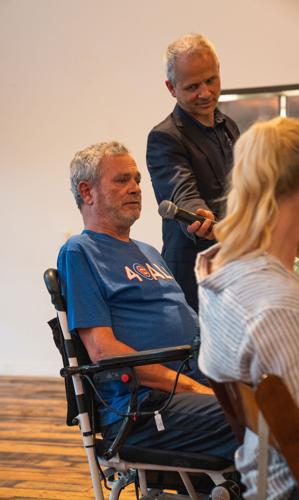


Dave Warnock
Dave Warnock says that when he was diagnosed six years ago, there wasn’t as much conversation around ALS (amyotrophic lateral sclerosis, sometimes known as Lou Gehrig’s disease) as there is today. Earlier this year, researchers began lab work in the Vanderbilt University Medical Center ALS Research Center — the only such research center in the state, and it’s in Warnock’s hometown.
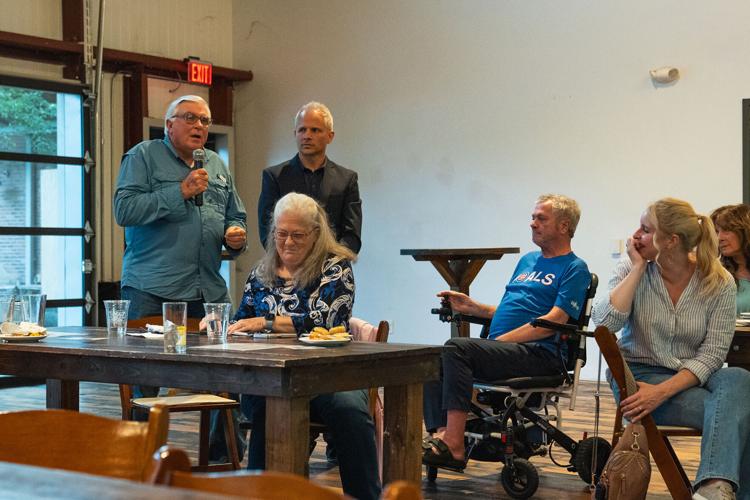
As part of ALS Awareness Month in May, eight of the center’s 10 staff members were on hand at Fat Bottom Brewery last week to share the work of the center and its goals.
“To see this kind of increased awareness is impactful, even though this is going to be too late for me,” Warnock tells the Scene. “Whenever they do find the cause — and then from the cause, find a cure — it’s going to help the people coming behind me that get this hideous disease.”
Warnock is somewhat of an anomaly — it typically takes one year to be diagnosed, and patients often die within two to five years following diagnosis. ALS affects nerve cells in the brain and spinal cord that eventually affect the muscles needed to move, speak, eat and breathe.
The public event was an effort to raise money for the research center, and also put center director Veronique Belzil and her team’s open-science philosophy to work. She wants to be sure patients know the latest findings, and that researchers and clinicians meet the people they are seeking to help. They also plan to share the findings online.
“We want to make sure that we give the right information to patients, that we are transparent, and they understand really what’s happening right now in research and can ask their questions,” Belzil tells the Scene. “Because right now, when you have questions, they Google, right? We want to make sure that they have a voice in the center, and we are inspired every day by their voice, but also that it can contribute to our work. Sometimes a question that is asked can lead us to a new idea.”
Belzil suspects that one of the biggest misconceptions about ALS is that the disease is familial, but only 5 to 10 percent of cases have some type of family history. The rest are sporadic.
The center’s big task is finding biomarkers for ALS — ways the disease shows up in a blood, spinal fluid or urine test. In the past two decades or so, researchers have found 40 genes associated with the disease, but there is no test to confirm diagnosis before symptoms start. At the event, staff shared that a student from Vanderbilt’s Department of Engineering has used artificial intelligence to compare DNA and health records in an effort to find the patterns more quickly.
ALS has only one treatment, and that treatment helps only a small percentage of patients. Clinical trials are often not successful, but the researchers point out that a particular treatment could be successful on a subset or subsets of the ALS population — though they do not yet know what those subsets are.
Part of the center is focused on recruiting people with ALS and their family members to donate fluids so they can build up what’s known as a biorepository to aid in research. Families serve as a control variable, as they have experienced similar environments. The staff is also working to introduce remote sampling.
Belzil says the biggest needs for ALS are funds for research and collaboration between institutions.
“I was tired of seeing people working in silos and not getting anywhere,” Belzil says. “People mostly, unfortunately, focus on having success and their career. And this is not what this is about. This is about patients.”

ALS Awareness Month event at Fat Bottom Brewery
Alexander Parker is the ALS Research Center’s branch leader of cellular and organoid modeling. He adds that it’s common for researchers to publish a big paper every five or six years, compiling the most meaningful data to report.
“We don’t have a luxury of time, particularly for our own labs to do all the work to publish,” Parker told the group last week. “If we can collaborate with other groups, split up the work, rely on other experts — we can publish that same kind of work, disseminate the same kind of findings, and make the same kind of progress in a year or two, instead of five or six.”
While the center recently lost some federal funding, it gained additional state funding this year, Belzil says. The center also benefits from nonprofits including the Live Like Lou Foundation, and will offer an ALS license plate in Tennessee later this year for another stream of income. During the event at Fat Bottom, listeners were asked to consider donating on a monthly basis to support operational costs for the research center.
Belzil notes that research has grown exponentially over the past few years.
“We’re not talking about decades anymore — we’re talking about years to find a treatment for ALS,” she tells the Scene.
During the event’s Q&A portion, Warnock asked to donate his body to research after death.
“I feel like that’s something I can do to make a difference,” he tells the Scene. “Most people don’t get involved in it unless it affects someone they know. Then it gets personal. The more people that get involved with it before it gets personal, the better.”
“You don’t connect the dots until it impacts you personally, but I guess that’s human nature,” he says with a smile.



Post a comment as anonymous
Report
Watch this discussion.
(0) comments
Welcome to the discussion.
Log In
Welcome to the discussion.
Keep it clean. Please avoid obscene, vulgar, lewd, racist or otherwise abusive language. Comments featuring hate speech or threatening or violent content will not be tolerated.
PLEASE TURN OFF YOUR CAPS LOCK.
Be truthful. Don't knowingly lie or mislead.
Be proactive. Use the “report” link on any comment that violates our comment policy.
Share with us. We'd love to hear your feedback.