
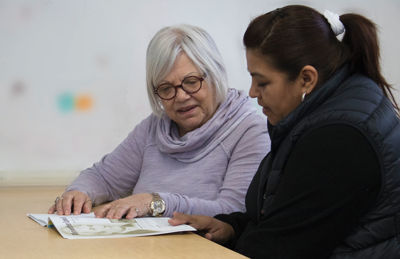

Nashville Adult Literacy Council’s Sheila Jacobs with learner Sandra, pre-pandemic
Speaking and writing well in your community’s dominant language is a privilege that’s easy to take for granted when you’ve been doing it most of your life. But for some, language is an everyday struggle. Marceline Sibomana, a refugee from Burundi, is all too familiar with the difficulties language barriers bring. When she came to Nashville 14 years ago, she was only able to attend one month of school.
“I had to know how to write my name in English, how to greet people in English,” Sibomana says. “I didn’t have a chance to continue because the life was so hard. I had to pay bills, I had a baby to take care of, so I dropped.”
Sibomana’s story echoes those of many other Nashvillians, both immigrants and nonimmigrants, who have had to prioritize survival over education. According to the National Center for Education Statistics, one in eight adult Nashvillians lacks basic literacy skills; meanwhile, the population of residents who have immigrated to Nashville has grown from 2 percent to more than 12 percent over the past two decades.
Though many non-native English speakers can converse well, they may still need assistance with advanced language topics or specialized instruction related to their professions. The Nashville Public Library estimates that 250,000 adult Nashvillians need educational assistance with English language learning, high school equivalency testing and basic literacy skills. According to the NPL, not only could increased literacy help more adults progress, it could also lower unemployment, poverty and crime rates.
Though increased state funding has been allocated to boost literacy in young learners, there is little emphasis on adult education. A multigenerational approach would better serve families, as — according to the Nashville Adult Literacy Council — children with illiterate parents have a 72 percent chance of falling behind. “The kids they come with homework,” says Sibomana, “you don’t know nothing. You cannot help them. They bring forms to fill out, you don’t know how to fill the form. You feel ashamed.”
Tired of struggling with language, Sibomana decided to return to school. “I think, ‘No, I cannot continue for this life. I have to change my life myself.’ That’s why I decided to go to school. Sometimes I feel ashamed when people don’t understand me.”
Sibomana discovered the Nashville Adult Literacy Council, which tutors adults to improve reading, writing and English-speaking skills. NALC works alongside a cluster of other local organizations united under the Adult Education Collective Impact to help adults access educational resources. The coalition has a collective objective to “triple the number of adults achieving their educational goals by 2025.”
Full disclosure: I volunteered as an English tutor for NALC until the pandemic paused in-person interactions. When those sessions were halted in early March, NALC shifted its organizational focus from education to crisis response as it helped provide resources for students. “The thing that stood out to me the most was how difficult it must have been for our learners to be taking in information because it was happening so quickly,” says NALC CEO Kim Karesh. “It was so complex, and I needed all of my literacy skills to be able to comprehend and interpret it into action. I was using reading and writing and speaking English to be able to make decisions for myself and then for the agency as well.”
These decisions included shutting down in-person learning, providing financial assistance to students who lost their jobs and launching a new online learning platform. Being a part of the AECI collective gave NALC its own network of resources to utilize. “Even in those early decisions, we were able to check in with each other, and it provided community,” says Karesh. “It provided reassurance, but it also just shared resources that made us faster. It made all of us move faster, because we were able to share what we were learning.”
What started off as a huge adjustment has since become normal for both NALC and its students, and it’s creating new opportunities. Before, barriers like traffic and child care prevented people from committing to classes, but the online platform removes those obstacles and provides greater access. In a typical year, NALC serves nearly 600 students across Nashville, with a wait list nearing 300. Because they’ve suspended volunteer tutoring during the pandemic, they only reached half their normal enrollment in 2020. Once volunteers return, however, NALC will likely work with more learners than ever.
These classes give people like Sibomana opportunities to continue learning and progressing. Taking classes at NALC has motivated her to work on getting a GED, a step toward her ultimate goal of becoming a pharmacist. She’ll likely connect with another organization in the AECI to move to the next level of her education, GED classes.
“I have an appreciation for Nashville Adult [Literacy Council],” says Sibomana. “They are here, they volunteer for free. I want to say thank you for everything that they’ve done for us.”



Post a comment as anonymous
Report
Watch this discussion.
(0) comments
Welcome to the discussion.
Log In
Welcome to the discussion.
Keep it clean. Please avoid obscene, vulgar, lewd, racist or otherwise abusive language. Comments featuring hate speech or threatening or violent content will not be tolerated.
PLEASE TURN OFF YOUR CAPS LOCK.
Be truthful. Don't knowingly lie or mislead.
Be proactive. Use the “report” link on any comment that violates our comment policy.
Share with us. We'd love to hear your feedback.