
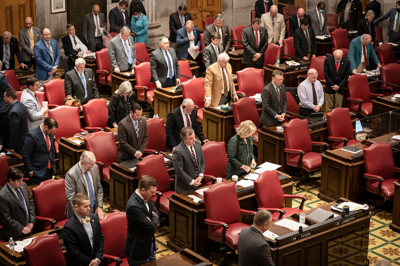

Odd-year autumn is supposed to be a sleepy time for the state legislature.
There’s no campaign to run, no laws to make. This year, though, that typical peace was interrupted by a call from Gov. Bill Lee.
He needed the legislature to approve nearly $900 million in new spending so the state could convince Ford Motor Co. to build its new electric pickup trucks at a long-vacant state-owned site in West Tennessee.
Though the price tag is high — the most for an economic development deal in Tennessee to date — the typically conservative legislature was eager to back the idea, and did so in just three days last week, which is the quickest such a deal can be approved. The state is paying for the Ford incentives and related infrastructure with spare change, more or less. Lee’s top aides told lawmakers the money would come exclusively from over-collections from the past year — money the state brought in but did not expect to.
Despite one minor and ultimately unproductive diversion into debate about COVID-19 mandates, lawmakers remained focused on the purpose of the special session: giving Ford hundreds of millions of dollars. That was in part because special-session legislation is supposed to be limited to the topics described in the official call. But Republicans were clearly frothing at the mouth to take a crack at what they consider to be the tyrannical overreach of government bodies both above and below them, namely Joe Biden and local school boards.
They’ll get their shot to do that in the coming days after lawmakers called a special session of their own — the second of the month and the third for the year. It was set to begin Wednesday and could last as long as a few weeks with its agenda more open-ended than the Ford meetings. Lawmakers took the extraordinary step of calling a special session themselves rather than waiting for the governor to do so, for several reasons. Their official call, signed by more than two-thirds of members from both chambers, opens up the possibility for legislation related to COVID-19 vaccine and mask requirements at both public and private entities, a response to a proposed federal vaccine requirement at certain businesses, making school board elections partisan, punishing local district attorneys (like Nashville’s Glenn Funk) who decline to enforce certain laws, and more.
As a preview of the tone that can be expected during the new special session, House Speaker Cameron Sexton promised a “nullification type of bill” in response to federal rules.
Passing the Ford legislation created some strange allegiances, as Republicans found themselves cheerleading a move that could help spur a full-scale transition to electric vehicles while also creating what might end up being the home of one of the largest union shops in the state. And the strangeness could continue in the next special session, as the Republicans who control both chambers find themselves at odds with business groups with whom they are typically aligned.
Some Republicans in the legislature want to add regulations to businesses, preventing them from requiring employees or customers to do anything related to COVID-19. In a normal year, the same Republicans fight tooth and nail to prevent new regulations on businesses, or to end existing regulations, and the business groups respond by generously funding their campaigns. Some business groups are now taking the rare step of openly criticizing Tennessee Republican lawmakers. Is that the sound of trouble in paradise?
“We do not believe government, at any level, should unnecessarily interfere with health, safety and operational decisions of private businesses,” the Tennessee Chamber of Commerce said in a release. “We look forward to discussing this with our elected leaders in the Tennessee General Assembly who have expressed their commitment to ensuring that Tennessee remains one of the best states in the country to do business.”



