
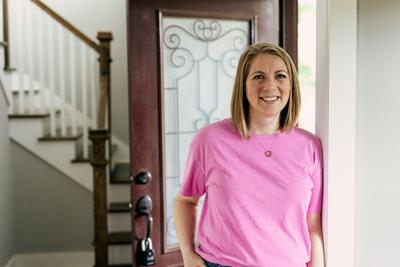

When a real estate agent left a postcard in Inglewood Elementary School’s mailbox offering to help sell the property, an employee jokingly asked her principal if she would get in trouble for selling the school — and how much she might get for it.
Principal Ashley Croft later shared her thoughts about it on Twitter: “While I AM intrigued about what kind of cash offers our precious school building and its 2.5+ acres of green space could [bring], you can kindly leave us the heck alone, Robby.” Croft also noted that she and her husband are being priced out of the area.
They moved into their East Nashville house, which is close to Inglewood Elementary, three years ago when Croft took the job as principal. Before that, she taught at Inglewood while she was an undergraduate student, and later worked at Isaac Litton Middle School nearby.
While Croft says some principals prefer not to live near their schools, she enjoys feeling connected to the community, being close to her campus and seeing students around the neighborhood.
She and her husband hoped to buy the home they were renting, but that opportunity came sooner than expected. “They hadn’t raised the rents on us at all in our three years here, so we were expecting a little bit of a rent increase,” Croft tells the Scene. “But they actually told us they were going to sell.”
At almost $800,000, the house was too expensive. They later discovered they could continue renting with a $1,200 monthly rent increase. Still too expensive. Instead, they bought a home in Hermitage.
“If you look at us on paper, we should be able to live in the community where I work,” says Croft, whose husband is a lawyer for the federal government. “We can’t, and so that means our teachers definitely can’t. When I think of the number of our teachers who live in our community, it’s very few.”
Nashville’s public school teachers are the highest paid in the state, yet many can’t afford to live in the communities where they work. And at Inglewood Elementary, some staff members literally risked their lives for their students — in May, they made headlines for restraining an intruder. One teacher broke her elbow tackling and restraining the man.
The families of Inglewood Elementary students are also being pushed out of the area. Croft notes that many families do not live within Inglewood’s designated school zone, but longtime connections keep them coming back. That means Croft must help families work out carpool arrangements, navigate enrollment options and fill out school option applications.
She also spends a lot of time marketing the school, recruiting new students and working to increase racial and socioeconomic diversity. Fifty-five percent of Inglewood Elementary’s students are economically disadvantaged; 72 percent are Black, 22 percent are white, and 5 percent are Hispanic.
“Our schools are very segregated on this side of town in particular, even though our neighborhoods are much more integrated,” says Croft.
Enrollment at the school has mostly declined over the past decade. As longtime families are priced out, connections to neighborhood schools diminish and affluent families move in — families who can afford to commute to other schools or pay for private education.
In 2017, Inglewood Elementary, alongside a few other Nashville schools, received a federal Magnet Schools Assistance Program grant to “reduce minority group isolation,” or desegregate schools. This means adding programming to attract more students — Inglewood became an Environmental Sciences STEAM magnet school.
While no single person can dismantle gentrification and years of school segregation, folks can educate themselves on the matter and consider their actions in relation to it. The Nashville Public Education Foundation’s recent documentary By Design, the Shaping of Nashville’s Public Schools and Ansley Erickson’s 2016 book Making the Unequal Metropolis can serve as starting points. From there, Croft has some advice.
“When you’re moving into a new neighborhood and you hear, ‘Oh, [this] school is the good school,’ or ‘[That] school is the school you don’t want to go to,’ or … ‘Oh, if you live over there, you really have to go to private [school],’ — you know, you see all these discussions on the East Nashville Facebook pages all the time,” says Croft. “As a parent or as a family or as a community member who has beliefs or interests in schools, you need to go to the school. You need to walk through the doors, you need to meet the people, you need to see the kids … to make an informed decision about what that school is.
“Think about what you’re saying when you say, ‘Oh, XYZ is a good school.’ ”



