
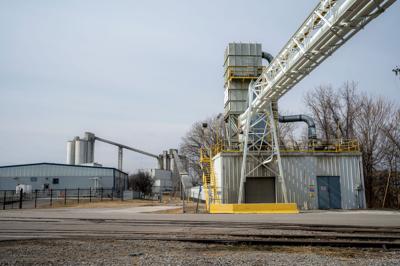


1916 Cement Plant Road
The sound is an E-flat, suspects Cleveland Park resident Adam Ollendorff.
It sounds like the world’s longest-running lawnmower, which verges into helicopter-sound territory at times. Sometimes it sounds like a crop plane circling the neighborhood for hours at a time, or someone’s loud old refrigerator. It changes volume, but not pitch, and doesn’t have a regular schedule. Quite simply, it’s at a frequency that’s “really annoying,” one area resident tells the Scene.
The needle-drops happen a few times per week — but there have been days when it’s nonstop for 12 hours. An opportunity for peaceful gardening, porch coffee or a rooftop hang is foiled.
And it seems to be getting worse, according to Ollendorff.
“It used to be that you’d have to step outside to hear it, and now I noticed that I can hear it in the living room with the doors and windows closed,” he tells the Scene.
It’s been bothering Derek Lisle and his neighbors in the Salemtown Neighborhood Association too. The sound, Lisle says, has even woken them up at night.
“We just know that before last spring, it was never an issue, and now it’s frequently an issue,” Lisle says.
Emily Hardesty went on a fact-finding mission to share with her neighborhood Facebook page in Cleveland Park. Every now and then a new resident poses the same question: “What’s that buzzing sound?” Following the sound, she ended up at 1916 Cement Plant Road, which serves as a gravel entry to the Cumberland River Greenway.
It’s also the site of an industrial machine operated by the aptly named Buzzi Unicem, a cement company that has been in operation there since the early 1900s. It originally functioned as a cement manufacturing plant and was converted to a cement distribution terminal in the 1980s, company spokesperson Sally Yundt tells the Scene in a statement.
Cement is the dry material that serves as the primary binder in concrete. The company receives dry bulk cement by railcar and Cumberland River barge, and distributes it by truck to local concrete producers, or puts it into bags.
The sound comes from exactly where Hardesty suspected: an enclosed water slide of sorts that shoots air to move dry cement through piping from barges and rail cars to the plant. Buzzi Unicem hasn’t changed operations in years, Yundt tells the Scene. But there have been some changes in the area over the past century — more people have moved into the area, and more recently, land clearing has taken place between the plant and its neighbors as part of ongoing development of the Cumberland River’s East Bank.
“Recent developments undertaken by the local municipality and private developers along the riverfront have altered the surrounding landscape, including the removal of trees and structures,” Buzzi Unicem says in a statement. “These features previously acted as natural sound buffers, and their removal may have made existing operational sounds more noticeable.”
But if a buzzing sound happens and no one is around to track how many decibels it is, did it happen at all? It might as well not have, at least from a Metro Codes perspective. A violation of Nashville’s commercial noise ordinance is defined as anything over 70 decibels that takes place between 9 p.m. and 6 a.m., measured from the wall of the nearest residential structure. There’s no limit during the day.
A pedestrian was killed and another injured at the same Germantown intersection this summer, raising concerns about response time
According to Metro Codes spokesperson Will Dodd, his department has not captured the sound, or any kind of violation.
“There had been a couple times we had sent people out after hours when we were getting complaints,” Dodd tells the Scene. “But it’s not happening every day. And so it seemed like every time our inspector was out there, there was none of that noise taking place.”
Another limitation, he says: It would be hard to distinguish one sound that’s violating the noise ordinance from every other highway and industrial sound that could interfere. Even if there was a violation and the company was cited, state law limits the fine to $50.
These types of issues are best talked out, says Councilmember Jacob Kupin, who has tried to get in touch with the company — which is located in his District 19. District 5 Councilmember Sean Parker can hear it from his district across the river too.
“To me, anything that’s disrupting the quality of life for neighbors on both sides of the river is some sort of a violation,” Kupin says. “The fact that both Salemtown and East Nashville are having issues tells me that it is a violation, and it’s something that should be just addressed, because it’s the right thing to do.”
Buzzi Unicem acknowledges that they received correspondence from councilmembers concerned about the sound, and no meetings have ever happened, the company says.
“They’ve been here a long time, so we don’t have a problem with them being there and operating, and they should be allowed to do that,” Lisle says. “But they should just try and be good neighbors while doing that.”



Post a comment as anonymous
Report
Watch this discussion.
(0) comments
Welcome to the discussion.
Log In
Welcome to the discussion.
Keep it clean. Please avoid obscene, vulgar, lewd, racist or otherwise abusive language. Comments featuring hate speech or threatening or violent content will not be tolerated.
PLEASE TURN OFF YOUR CAPS LOCK.
Be truthful. Don't knowingly lie or mislead.
Be proactive. Use the “report” link on any comment that violates our comment policy.
Share with us. We'd love to hear your feedback.