
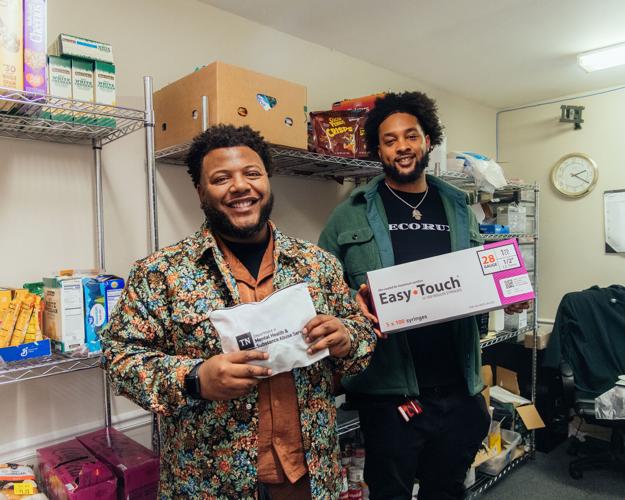



Kyle Oliver (Left) and Shamar Gunn head up the Syringe Service Provider program at Street Works
If people want to use drugs, they’re going to. And if they’re going to use drugs, they should have access to clean supplies to prevent the spread of hepatitis C and HIV, and naloxone to prevent overdose.
That is the ethos of harm reduction. Local organizations Street Works and Mainline Harm Reduction operate under the harm-reduction umbrella, and want to see drug users have clean supplies, preventing deaths and infection. But they have different methods of making that happen.
The concept of harm reduction got a local boost in 2018 when the state established its Syringe Service Programs, and Nashville’s Street Works — an HIV-outreach organization established in 1997 — was one of the first organizations to join in. But the uptake has been slow. The Tennessee Department of Health currently lists 19 Syringe Services Programs in the state.
Still, operating on a model in which clients are meant to turn in dirty syringes to receive clean ones, SSPs statewide distributed 2,591,076 syringes and saw 2,076,728 returned in 2021, and distributed 53,000 naloxone kits. According to the 2021 annual statewide report, the nine SSPs functioning in the state at the time had 54,008 total client visits, with 5,677 new enrollees.
Street Works, operating through a combination of state and private grants, distributes 9,000 to 10,000 syringes and roughly 200 doses of naloxone per week. The organization also plans to bring its mobile unit out of hiatus as soon as the state approves location stops.
Mainline Harm Reduction bucks against the SSP guidelines, operating as an unregistered mobile service to reach those who are unhoused and using drugs. Founder Miriam Field says the SSP program is more about optics than reaching those most in need.
“We’re upholding stigmas with SSPs, because clean and safe injection supplies should be available at any pharmacy,” Field says. “I feel that on a governmental level, the government has closed a door and opened a small window — and the SSP is the small window.”

Shamar Gunn(Left) and Kyle Oliver head up the Syringe Service Provider program at Street Works
The people Mainline serves often don’t have transportation. According to Field, that causes them to carry around dirty needles all day. She says the one-for-one method of receiving a clean needle for each dirty one turned in leads to a black-market exchange — people stealing one another’s dirty syringes to turn in. Like Street Works, her program provides needles, but it doesn’t aim for a one-to-one exchange ratio and instead instructs people how to safely dispose of them. In addition, she offers lower-risk methods for drug use — something the state has pushed back on. Mainline also provides wound care and distributed 3,000 doses of naloxone in 2022, its first year.
Field is driven by losing a number of people close to her to overdoses. She says part of harm reduction is reducing stigma so that drug users will feel more comfortable asking someone to oversee their use, thus preventing deaths.
“We want people to get high and not die,” she says.“We believe in people’s right to not die just because they’re using a psychoactive substance.”
Shamar Gunn and Kyle Oliver, heads of the SSP program at Street Works, say they’ve seen people decide to enter the organization’s treatment navigation after coming to exchange syringes for months on end.
“I think [harm reduction is] always going to be a hard sell, because people already have a stigma against it,” Gunn says. “It’s already going to be hard to change the narrative, but I’m here to fight for it. I will use all of my breath preaching on why we need this in all communities, instead of just ours.”
“It’s a sensitive subject,” Oliver adds. “You just have to understand that these people are also good people, they just do what they do. We see past all that.”
In 2022, Nashville saw 735 suspected fatal drug overdoses — more than double 2016’s number. HIV rates remain relatively steady, with 651 people newly diagnosed with HIV in 2020, compared to numbers in the 700s from 2016 through 2019. Confirmed and probable chronic HCV (also known as hepatitis C) rates also remain steady, around the 200s in cases per year. Harm reduction could be a way to chip away at those numbers.



