

Before Susan Steckel bought her South Nashville home, she asked about the 2010 flood. Water got into the crawlspace, she was told. A finished garage took some damage too, but the house fared well, despite its location. Charmed by the spacious yard near a quiet dead end, she took a chance on a modest ranch house that had just survived the rain of a century.
“I had limited options with a limited budget, and I tried to go in with my eyes wide-open,” says Steckel. “It was an extraordinarily beautiful property — river otters, huge birds, a sweet little oasis. I knew it was a calculated risk.”
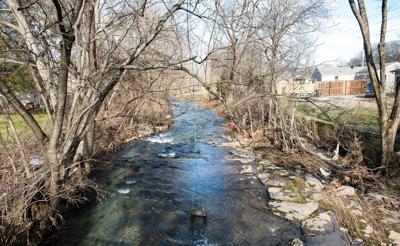
Today, Elysian Fields Road is a lush riverbank staked with “no dumping” signs. Steckel’s property backed up to Sevenmile Creek, which surged during heavy rains in March 2021. Water flooded her entire house. Outside, the rising creek moved her SUV from the carport into her backyard. When the floods receded, she had someone else’s shed in her front yard.
While the historic 2010 flood seems like a logical high-water mark, flood calculus has changed rapidly in recent years. The federal government enacted new flood maps in February 2022, bringing more homes into 100- and 500-year floodplains. Altered weather patterns follow a changing climate, threatening Nashville with more frequent heavy rains. Historically, these come in March, April and May. The city’s building boom has altered the built environment such that stormwater moves differently than it did 10 years ago, shifting flood risk across the city. Steckel attributes her surge two years ago to irresponsible building in South Nashville.
“You cannot leave development out of the equation,” says Steckel. “With new infill and concrete and parking lots, you don’t have a plan for how to divert all that runoff. When water comes down, it has to go somewhere.”
She heard about buyouts during post-flood recovery efforts in May 2021. Nine months later, she agreed to a market-rate price based on her home’s pre-flood condition, determined by an independent appraiser. She bought a new home in Donelson, where she lives now.
In January of this year, Metro Water closed on a 14th parcel on Steckel’s old block, part of a relief program for property owners backed by local, state and federal governments meant to get people out of homes that have become too risky to insure. As of September, Metro had purchased 438 properties, most of which have since been demolished. The process is long and finicky, but after months of waiting, paperwork and emails, it’s a lifeline for homeowners.
Jeremy Shupe lives near Steckel’s new home in Donelson. He bought his house in November 2020, a deep lot that backs up to McCrory Creek. The same rain that took out Elysian Fields in March 2021 badly damaged his home on Lakeland Drive. He’s been trying to get out ever since.
“At that point I just stopped moving in, because I didn’t want to be there, living in a house that should never have been built in the first place,” Shupe tells the Scene. “Every time it rains, I get anxiety. Panic attacks start rumbling through my guts.”
For weeks after the 2021 rain, Shupe had eight industrial fans running at all hours trying to dry his home. He found the buyout program and was told the entire process would take 18 months at most. Almost two years later, he hasn’t heard back about his application. At this point, says Shupe, he wishes he had taken his chances on the housing market rather than get buried under a mountain of red tape with no clear path forward.
Buyouts run on two tracks. Both require coordination between local, state and federal agencies. The Federal Emergency Management Agency offers a Hazard Mitigation Grant program that requires a local agency to apply to the state on a property owner’s behalf, then the state agency to apply to FEMA. Six properties in Davidson County are pending approval for this grant, according to a FEMA spokesperson. Seven are pending acquisition, and 299 have been acquired since the 2010 floods. According to FEMA, the Metro Council approves lists of eligible houses to secure the local portion of buyout funding. Shupe is somewhere in this process, he hopes.
Steckel’s buyout was coordinated with the U.S. Army Corps of Engineers, the federal agency responsible for managing major waterways. She praises Metro Water’s Antonette Plummer, who helped guide her through the process. Plummer declined an interview request from the Scene but came up repeatedly in interviews as Metro’s point person for buyouts. She’s tried to help Shupe, sharing his frustration with a process that can be opaque even for insiders.
“I have no influence over the powers that be (State/FEMA),” Plummer wrote to Shupe in February. “If you would like to sell the property, please do so. FEMA has changed their policies, more times than I care to count. Unfortunately, all FEMA would do is send you to the State and the State would refer you back to me.”
Months after the 2021 flood, real estate speculators bought a few houses at the end of Steckel’s old block. One, a nice brick ranch at 241 Elysian Fields, was just listed online for $399,000.



Post a comment as anonymous
Report
Watch this discussion.
(0) comments
Welcome to the discussion.
Log In
Welcome to the discussion.
Keep it clean. Please avoid obscene, vulgar, lewd, racist or otherwise abusive language. Comments featuring hate speech or threatening or violent content will not be tolerated.
PLEASE TURN OFF YOUR CAPS LOCK.
Be truthful. Don't knowingly lie or mislead.
Be proactive. Use the “report” link on any comment that violates our comment policy.
Share with us. We'd love to hear your feedback.