
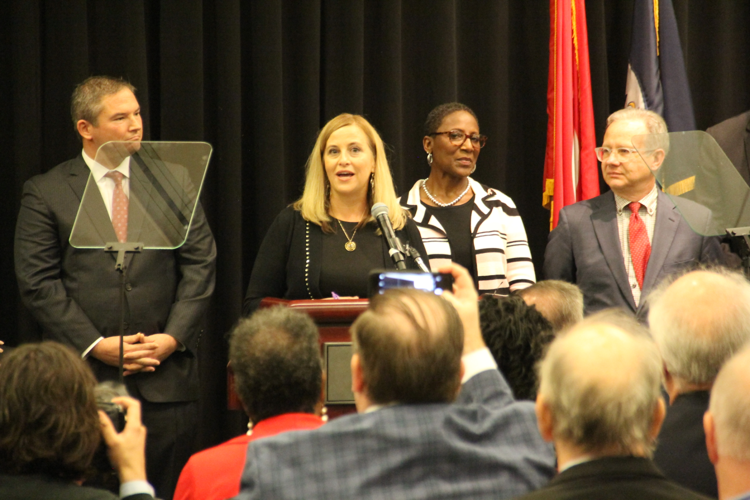


In front of a packed Music City Center room full of transit advocates, former Nashville mayors, city politicians and regional leaders, Mayor Megan Barry introduced an ambitious plan Tuesday to remake Metro's transit system with a network of new rapid bus and light rail lines. The $5.2 billion plan will require Davidson County voters to approve its funding via a referendum in May.
Calling it the "largest project in modern Nashville history," Barry said the "Let's Move Nashville" plan is the result of two years of studies and community engagement. "We heard from people throughout Nashville who said loud and clear that they want light rail in Music City."
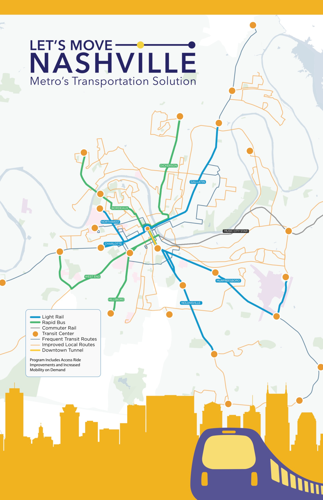
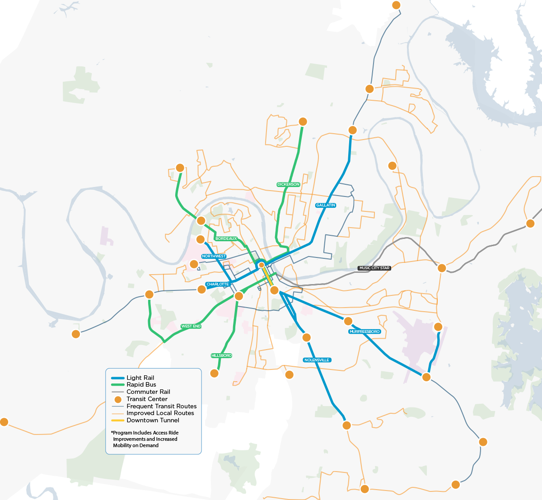
The plan is headlined by 26 miles of light rail, a network that would begin operations in 2026 and be completed by 2032. Light rail routes would be built on four main corridors: on Gallatin Road from downtown to Briley Parkway; on Murfreesboro Road from downtown to the Nashville International Airport; Nolensville Road from downtown to Harding Road; Charlotte Avenue from downtown to I-440; and by utilizing Cheatham County Rail Authority freight rail tracks, a line from downtown along Charlotte Avenue ending north of Tennessee State University. The most eye-catching detail of the plan — which drew audible “oohs” from the crowd at Tuesday’s press conference — is two miles of tunnel underneath downtown, from Charlotte Avenue to SoBro, with an underground stop at Broadway and Fifth Avenue.
The proposed light rail network would also include 37 stations and seven park-and-ride facilities.
Additionally, the plan includes rapid bus routes along Dickerson Road, Hillsboro Road and West End Avenue, with another route in Bordeaux. The fleet servicing these routes would be fully electric, and the proposed plan includes sidewalk improvements and upgraded shelters at bus stops. These rapid bus routes would have “queue jumps,” allowing buses to move ahead of traffic at stop lights where possible.
Barry emphasized that, if voters approve the plan in a referendum in May, they will see “immediate improvements” to existing transportation services, including buses running every 15 minutes during peak service times and running 20 hours of every day, from 5:15 a.m. in the morning until 1:15 a.m. at night. The plan also promises numerous upgrades to pedestrian infrastructure in neighborhoods surrounding transit hubs.
The 50-year plan includes a number of tax increases, set to expire in 2068. (Barry added that the city will pursue federal grant dollars where available.)
If Barry’s plan passes a citywide vote in May 2018, a 0.5 percent sales tax surcharge would be instituted in July 2018, jumping to a full percent surcharge in 2023. She said she understands concerns that a sales tax increase would disproportionately impact the poor, adding that free and reduced transit tickets would help offset those impacts.
District 31 Metro Councilmember Fabian Bedne echoed those concerns after the presentation, but said a sales tax increase was one of the few mechanisms by which the city could raise enough money to fund the ambitious project.
“It would be nice to do this it in a different way, but in this case, this is what we can do,” he said, adding that the new state law limits the ways a local government can fund transit projects.
The business and excise tax would see a 20 percent surcharge. In the example Barry provided, a business currently paying $1,000 in taxes would pay an additional $200 per year. The hotel/motel tax would see a 0.25 percent surcharge in fiscal year 2018-19, increasing to a three-eighths percent surcharge in 2023. The local rental car tax would also see a 20 percent jump.
All that new revenue would result in “immediate improvements” to the MTA system, Barry said, in addition to funding the longer term projects.
The Convention Center Authority would be asked to help fund the construction of a transit stop south of Broadway, and the Metro Nashville Airport Authority would fund the construction of a light rail spur with a terminal at the Nashville International Airport.
Accounting firm KraftCPAs will review the financing plan and is set to determine the financial feasibility of the plan by December.



Post a comment as anonymous
Report
Watch this discussion.
(0) comments
Welcome to the discussion.
Log In
Welcome to the discussion.
Keep it clean. Please avoid obscene, vulgar, lewd, racist or otherwise abusive language. Comments featuring hate speech or threatening or violent content will not be tolerated.
PLEASE TURN OFF YOUR CAPS LOCK.
Be truthful. Don't knowingly lie or mislead.
Be proactive. Use the “report” link on any comment that violates our comment policy.
Share with us. We'd love to hear your feedback.