
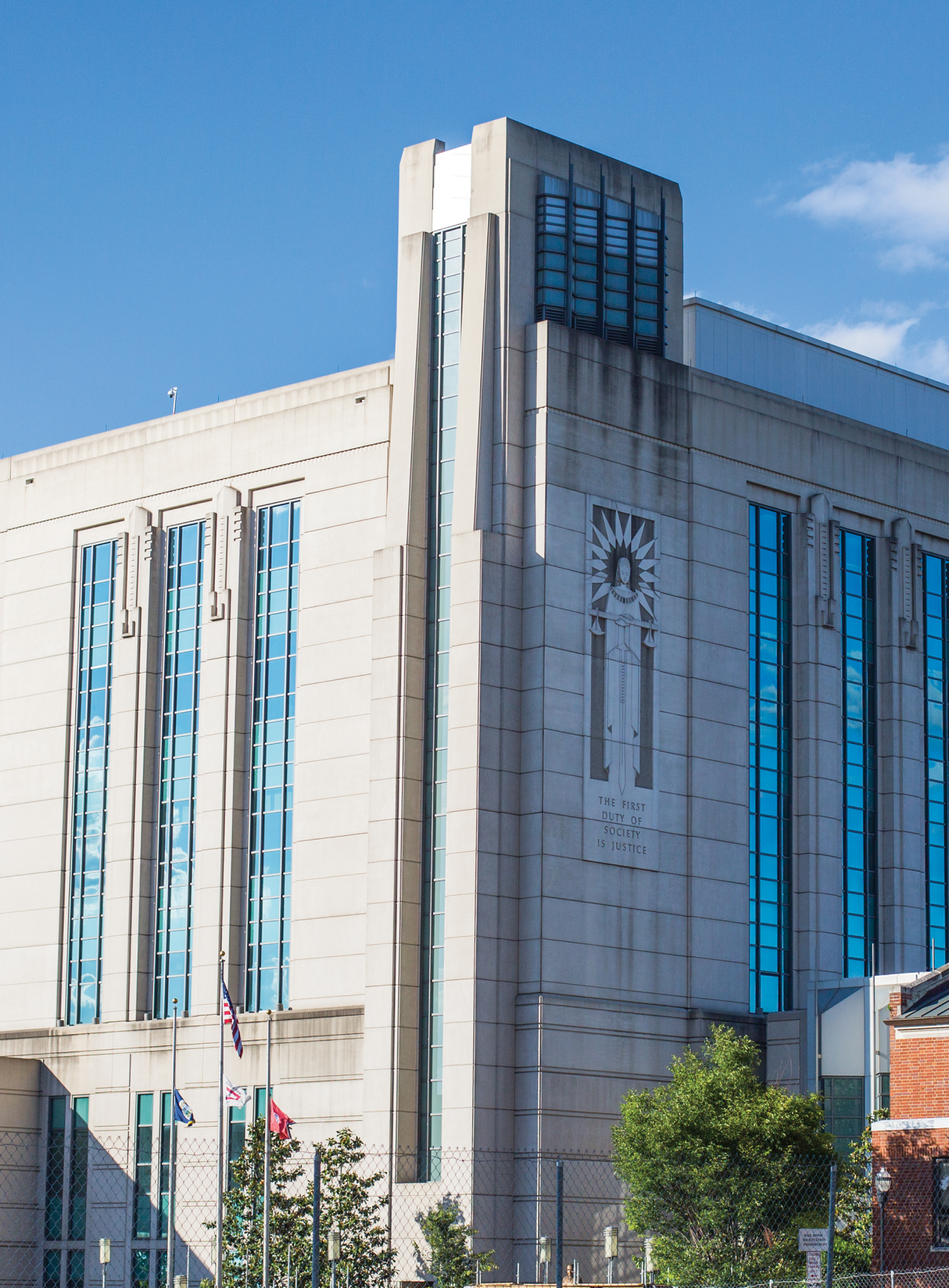


The Justice A.A. Birch BuildingPhoto: Daniel Meigs
Three years after its inception — having now bailed at least 675 people out of jail — the Nashville Community Bail Fund is at the center of what is essentially a proxy fight in the larger conflict over the money bail system. Activists, lawyers and Metro officials who want to end that system, or at least change it dramatically, find themselves at odds with a bail-bonding industry committed to defending the status quo.
The idea behind the fund, which also motivates similar funds across the country, is pretty simple. The NCBF operates as a nonprofit that collects donations and then uses the money to bail out poor criminal defendants by paying the full bail amount in cash. If and when the defendant attends all court dates and resolves their case, the cash is returned to the NCBF. As a result, the same $5,000, for instance, can bail out hundreds of people.
And that’s just what the fund has done, bailing out poor defendants with bonds less than $5,000 and, in some cases, as low as $50.
“These people are presumed innocent and are at risk of losing their jobs, houses, or children,” reads a statement released by the bail fund last month. “These are also individuals that the commercial bail industry will not help — they either have no money to pay the bonding company, or the bail is set so low that the bonding companies will not bother.”
But if it stands, a court order issued May 6 will significantly hinder the bail fund’s ability to continue operating as it has for the past three years.
The order followed an unexpected April hearing called by Nashville’s Criminal Court judges. At the time, the exact impetus for the gathering was not explained, but it drew most of the interested parties to a courtroom on the sixth floor of the Justice A.A. Birch Building — public defenders, prosecutors, representatives of the bail-bond industry and activists who support the Nashville Community Bail Fund and other related efforts.
Throughout the occasionally tense hearing, the judges questioned former Metro Public Defender Dawn Deaner — who was then serving as legal counsel for the bail fund — about a number of bail-fund clients who had failed to appear for court. At the time, 43 of them were in what is known as “conditional forfeit” status. Deaner also faced questions from Assistant District Attorney Brian Ewald about current bail-fund manager Rahim Buford’s access to Metro government buildings and the local jail. Through Deaner and Daron Hall, the elected Davidson County sheriff who runs the jail, Buford was allowed far greater access than commercial bail bondsmen, who are subject to more state laws and regulations than is the NCBF. (In a subsequent interview, Deaner tells the Scene that the bail fund has had three managers since it was created, and she gave each one an access card to the public defender’s office during her tenure “so that they would have a base that was a physical space that was close to the courthouse and the jail and because they were primarily serving as an asset to clients of our office.”)
Weeks later, the court issued the aforementioned order, announcing that going forward, various fines, fees, court costs and restitution would be taken out of bail money before it was returned to the fund. A local rule already requires that, but in 2016, at Deaner’s request, the court exempted the bail fund. The upshot of the May 6 order is that the NCBF will not receive the full cash amount it puts up to bail a person out of jail, disrupting the revolving fund that is the heart of the community bail fund model.
In an interview with the Scene following the court order, Hall says he’s quite sure the bonding companies are behind the increased scrutiny of the bail fund. He knows them well, and says they are, not surprisingly, “aggressive when it comes to bail reform and pretrial release.”
He seems to be right.
Mario Hambrick, co-owner of one of Nashville’s largest bonding companies, Free at Last Bail Bonding, says he and other bonding companies have long been frustrated by the fact that the NCBF receives what he sees as special treatment.
“There’s a lot of things that they do, that they’re allowing them to do, that me and anybody else — the other 40 bonding companies — couldn’t do,” he says.
Hambrick says his complaint is that the NCBF is not being “held accountable” for forfeitures — that if they’re “playing bail bondsman,” then the entity should be treated like a bonding company.
He points to the fact that celebrities and activists have contributed to similar nonprofit bail funds across the country. “So Jay Z and whoever else, all these people sending this money down, that’s fine,” says Hambrick. “Send them $600,000. Hell, matter of fact, if they want to buy a bonding company, give me $10 million, they can have mine, and they can get all the people out they want. But what I have a problem with is that you’re over here writing checks your ass can’t cash. Then when the people don’t come to court, they have nothing in place to find them, because they’re not a bonding company.”
Hambrick also highlights bail-fund manager Buford’s criminal history — he was released from prison in 2015 after serving 26 years for a murder committed during a robbery when he was 19 years old. Sheriff Hall says that’s an unfair criticism.
“There’s been mention of his criminal history — that doesn’t bother me,” Hall says. “We have volunteers who have histories — and so too do the bonding companies, by the way. That’s not a fair criticism. I don’t have a concern at all about access. I would want to make sure, legally, that there is a separation from what is virtually a nonprofit entity and a bail company.”
When it comes to Burford’s access to the jail, Hall says Buford “cleared the hurdles to do that kind of stuff, and I don’t have any concern about it.”
Hambrick expands his criticism, further revealing the tension between the bail bond industry and the bail reform movement. He notes that the Davidson County Sheriff’s Office’s pretrial release program is responsible for getting many more people out of jail than the NCBF, and insists that many of them are a danger to the community.
Hall tells the Scene that the percentage of the arrested population who are released through his office’s pretrial release program has doubled from 10 percent to 20 percent. At the same time, the number of those people who fail to appear at court has increased by 6 percent. But he says that’s not a reason for concern.
“It’s extremely low for the national average,” says Hall. “I’ve told everybody we’re going to monitor that, but even if it goes up, that’s not reason to not want to get people out of jail. I philosophically believe people should get out of jail, and they shouldn’t have to pay to do it.”
As for the members of the bail-bond industry sounding the alarm and saying pretrial release efforts are putting public safety at risk, Hall notes that he’s heard all that before.
He recalls past instances of bail-bond company representatives “spewing all kinds of ridiculous things, that the community was at risk because we were letting people go.”
“Keep in mind,” he adds, “they would also let them go if you just pay money to do it.”
Angie Bergman is an attorney for Bass, Berry and Sims who took over Deaner’s role in representing the Nashville Community Bail Fund at the end of April. She tells the Scene she’s hopeful the court will reconsider.
“We have been in communication with the court, and I think that we are hoping to continue to show them there are a lot of facts that they don’t have before them,” Bergman says.
She says the numbers thrown around about the NCBF’s forfeiture rates — that is, the percentage of bonds posted for people who later miss court — lack context. There is a difference, for instance, between a conditional forfeit and a final forfeit, the latter of which means the NCBF would lose the bail money. While at the time of the hearing, the bail fund had 43 clients in conditional forfeit status, that number had dropped to 40 by the time Bergman spoke to the Scene. And the number of people who are never brought back into custody, forcing the fund to forfeit the bail money for good, is significantly lower.
Bergman rejects suggestions that the NCBF will be going away as a result of the May 6 court order.
“It is not,” Bergman says. “We are continuing to operate, continuing to do the good work that we think is of vital importance to this city. That won’t stop.”



