
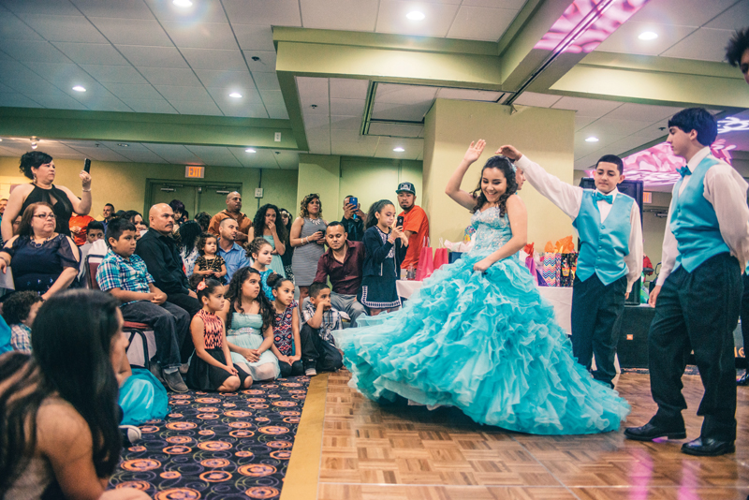
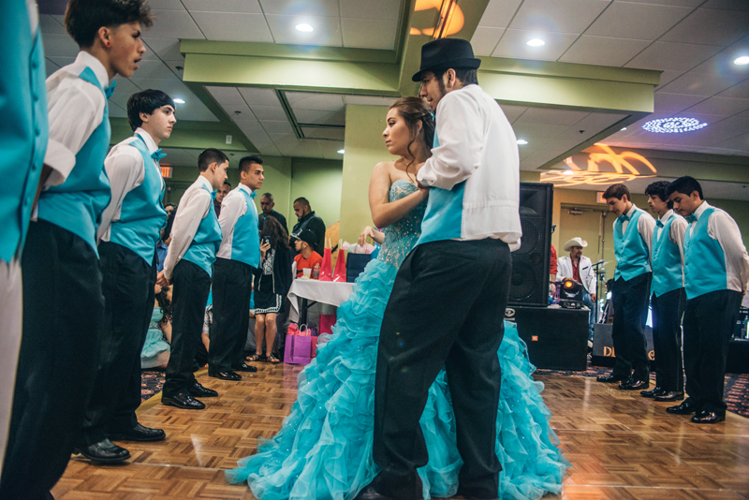
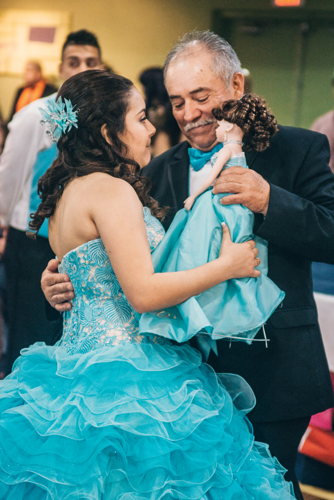
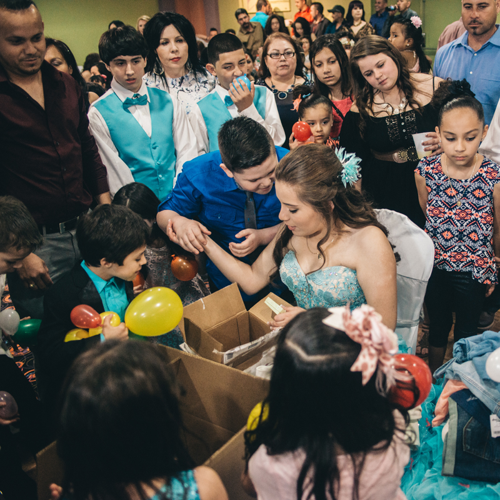
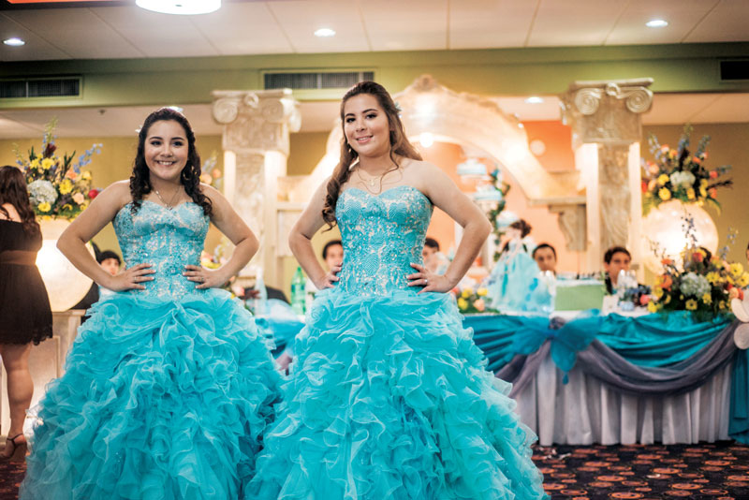

Melanie (Left) and Stephanie Angel
"Un, dos, tres, un, dos, tres..."
It's May outside Franklin, the air is sticky-sweet with honeysuckle, and a lilting tune in waltz time floats like a midday breeze down a country road in rural Williamson County. The music gets louder the closer you get to a small house. Although the area seems pretty quiet, the 15 cars parked in awkward angles across the lawn suggest that action must be happening somewhere.
That's when eight boys walk in perfect order out onto the asphalt driveway. They practice going left. They practice going right. Up and down, up and down, they take each modified, choreographed boxstep as seriously as a marching order. But if this incongruous sight resembles a musical rehearsed in someone's suburban yard, they are just the chorus. The real stars have just made their entrance — two similar but unique teenage girls.
The Angel twins share traits: dark brown hair, almond eyes, full cheeks. But they see themselves as opposites. Stephanie, the oldest by five minutes, finds herself often on the field playing soccer or volleyball and prefers T-shirts and jeans. Her sister Melanie is "a little more girlier," Stephanie says. Melanie knows the latest fashion trends and dresses accordingly, is chirpy and has a wide smile, especially when she's listening to her favorite musicians, Hunter Hayes and Tim McGraw.
But the fraternal twins are about to undergo a common experience that nevertheless has had them frequently at odds. For more than a year, Melanie and Stephanie have been fretting over every tiny detail in one of the biggest celebrations in Mexican culture: the quinceañera that will mark their passage into adulthood.
Quinceañeras, or quinces (pronounced "kin-says"), can be traced back to Aztec rituals in which a young girl was prepared for marriage. Nowadays, a quince could be simply described as a rite of passage where a girl turning 15 is presented to society as a full-fledged member of the community. She will have later curfews. She can date and wear makeup.
Although quinces are a phenomenon across Latin America, the custom is particularly important in Mexican households. Families spend at least a year planning the celebration, which involves — deep breath — photography sessions, catering, limos, cakes, makeup sessions, dress fittings and choreographers for a series of dances performed at the party.
As a result, gatherings like this afternoon's have become a common sight at the Angel household. Systematic ballroom dancing with each boy constitutes the rest of the afternoon dance. With one final twirl, the girls step smoothly to the middle of the driveway as parents, siblings and friends begin to clap enthusiastically around them. As soon as the final practice is over, everyone rushes inside the one-floor home.
On a long table await trays of steaming minced steak, which the Angel twins and their many spectators stuff into freshly heated tortillas. The twins make idle chat and jokes as they fortify themselves with post-rehearsal tacos, but they're covering exhaustion and nerves. They know their final performance is coming soon. They can only do it once. And there is no room for a single slip-up in an occasion this elaborate, and this important.
Not to mention this expensive. After all the expenses are added up, these celebrations can cost anywhere from $10,000 to $20,000. That makes quinces (along with Sweet 16 parties) a $680 billion industry, according to The Rand Youth Poll, which shows that 13- to 19-year-old girls spend billions a year on beauty, fashion and anything else a teenage heart desires.
For their parents, Ana and Enrique Angel, twin girls meant double the expenses, especially since the girls had different ideas on the perfect quince.
Melanie doesn't mind much that her sister is a few inches taller. But when it came to the party, the sisters found themselves bickering. Stephanie wanted a forest theme; Melanie wanted Paris in a hotel room. Usually they ended up resolving their differences before parental intervention was required. But when an epic argument ensued over dresses, their mother Ana was forced to step in. She settled the matter by deciding the girls would wear the same dress.
Nether Angel twin was thrilled. After that, the sisters decided they'd be better off working together and combining their different ideas for the perfect quince. Thus began their immersion in a world few non-Hispanics ever encounter, Nashville's growing quinceañera industry.
That industry has grown as quickly as Nashville's Hispanic population — which is expected to make up roughly a third of the city's overall population by 2040, according to statistics produced as part of Nashville Next. The industry is currently blossoming as demand increases even into surrounding cities such as Smyrna and Franklin, where large Hispanic populations reside. Although the industry is still in its early stages and relies mostly on word of mouth, summertime is the official quince season, and Nashville is brimming with quince activities every month.
Even a decade ago, the services required for a quince would have been difficult to find in Middle Tennessee. Yet families like the Angels now have access to a widening network of shops, suppliers and related businesses whose existence is proof of the dramatically growing — and seldom acknowledged — spending power of the Nashville area's swelling Latino communities.
As quinces are both heavily ritualized and accessorized, Melanie and Stephanie found a number of shops offering packages. These might incorporate embroidered pillows for the ceremony, an autograph book, bouquets, bibles and matching dolls for their dances. Harder to find and secure was a spot to hold the event.
Even planning a year ahead of time, they found that many locations were in short availability, especially on a Saturday during quince season. Popular venues such as Fantasy Hall, an Antioch event space that handles a variety of occasions for Hispanic families, already have two or three quince celebrations each weekend booked years ahead of time.
Dalila Duarte, a photographer for Nashville-based Miyagui Photography and Video, says rising demand has caused businesses across the country to inquire about investing in Nashville. Though the summer months are the height of the season, her business has bookings through December.
The high demand for quince services has also caused businesses to work harder to capture families' attention. If this sounds something like the hotly contested wedding industry, you're right — places such as Fantasy Hall and the Global Market are now hosting pageants and events much like bridal fairs throughout the year to showcase the latest quince products available in the area.
"It's very exciting to see the continuing and maintaining of our cultures and traditions," Duarte says.

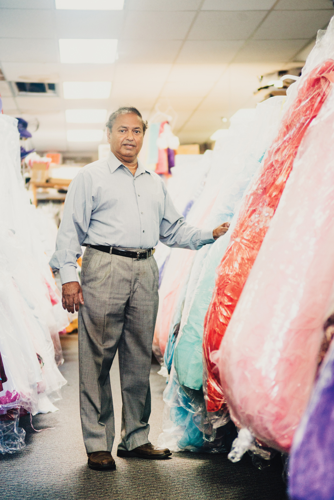
Andrew Vallomthail at Bridal and Formal Wear by RJ
This demand makes the quince industry extremely competitive. Because it's a tough business, some vendors have to rely on supplier advantages. Andrew Vallomthail, the owner of Bridal and Formal Wear by RJ on Nolensville Pike, sells designer quince dresses, and his suppliers have given him a 100-mile radius exclusive.
He needs any advantage he can get, as selling quince dresses can be a particularly difficult business. Because of competition, many dress shops are often forced to sell cheap to keep up — even though a single quince dress can range from $500 to $1,500.
What can also make selling quince dresses a tricky business, Vallomthail says, is that even just a few can take up a lot of space. He motions toward the entire left side of his store, taken up by an inventory of 150 dresses. That doesn't sound like many. And yet the ballgowns, blinding and bedazzled in an array of tropical pastels and colors, are so flamboyant that they fill the room like a rippling cloud of ruffles and sparkles.
The Angel twins already chose their quince dresses. The aquamarine fantasy-bedazzled corsets and lavish, multi-layered gowns they ultimately decided on cost $900 each. They were then sent back for adjustments, since Stephanie is taller than Melanie. That settled, the Angels next had to worry about another important aspect of a quince: the traditional dances.
Rocio Zenon, who owns Coreografias Rocio Zenon and has been choreographing quinces for nine years, says quinces can have anywhere from five to eight dances. Traditional waltz. Entrance dance. A "last doll" dance, a poignant and slightly eerie ritual performed with a doll-like facsimile of the featured girl. Then a "last heels" dance, a father-daughter dance, a godparents dance, a brindis (or toast) dance — and most importantly, a baile sopresa, or a dance with an element of surprise and creative touch.
Small wonder the Angel family began rehearsing three months ahead of time, as do most. They invited their friends and family to be chambelanes, a studly retinue whose sole purpose is to make the quince girl shine. Although Zenon doesn't currently provide the service, some choreographers have been known to rent chambelanes to dance at the party and assure the birthday girl looks good.
The success of a quince may often depend on the perfect coordination and execution of the dances. So families spend months of practice and anywhere from $500 to $1,000 on choreographers. For one thing, the celebration is often fantastical in nature and incorporates as many themes as there are colors in a rainbow or hormones in a teenager. Every quince is as unique as the girls themselves.
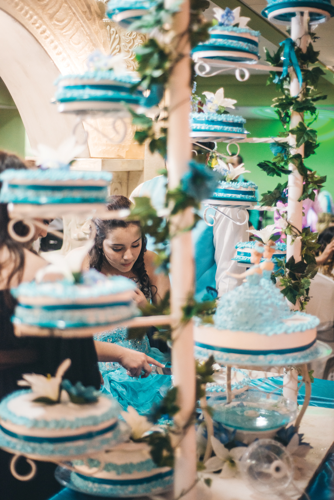
Stephanie and Melanie agree upon a Paris theme — crisscrossing shiny blue and gray-hued ribbons and table coverings coupled with glittering butterflies and pastel floral arrangements, exactly how a Middle Tennessee teen might envision a French forest.
Why would families undergo this ritual, at such trouble and expense? Some say it is the mothers who want the party. Whether it's to relive the celebration through their children or wanting to provide a memory they didn't have, families are willing to spend exuberantly on these festivities. It is partly a symbol that they have arrived.
"A lot of us at our age were not able to complete that wish, so as parents we want to give our children that wish," Zenon says.
And if daughters at a quince are princesses, Ana Angel says, with more than a hint of satisfaction, that makes mothers the queens.
In the U.S., the tradition takes on a different meaning. Most often, those planning a quince are immigrants. So these celebrations double as huge family gatherings. The Angel family expects more than 300 people, seeing as Enrique has 19 on his side of the family alone. He hasn't seen one of his sisters in 17 years, so they have been planning to accommodate family coming from California, Chicago, Florida and Ohio.
"I tell my daughters that this will be something beautiful. Apart from your 15th birthday, the family you've never met will be reunited," Enrique says. He says many relatives are coming just to see long-lost family.
Although quinces are not an official tradition in the Catholic church, the celebration is so important to the Hispanic community that churches may require girls to attend sessions in preparation. Every quince begins at mass, where the young girl renews her baptismal vows and commits herself to a virtuous adult life. They would look almost like brides in their long, poofy, bell-shaped skirts and bedazzled tops, if it weren't for the hot pinks and mermaid teals.
After mass, the family takes the festivities into the main salon, where the birthday girl will perform the traditional dances. The celebration often concludes with a wild and vibrant party lasting late into the night.
How does one afford such an expensive party? The average Mexican family in the U.S. makes $38,000 a year, according to figures cited from the Federal Reserve Bank of St. Louis. This of course makes a $20,000 party difficult to plan without major loans or using up life savings.
Therefore, families have adopted a process called "Gathering of Godparents." Not only do families invest time and reputation, but the extended members also play an important part of the entourage. For instance, the padrinos, or godparents, might be asked to provide different components of the party, including the quince dress (or dresses, in this case).
Traditionally, godparents have been an important part of the celebration. The young girl asks the most important people in her life to be her godparents for her special day. Those godparents may provide support financially and will be properly thanked at the ceremony. Although there are usually only two godparents, such as an aunt and uncle, a modern trend shows families gathering a large number of godparents, and each may support the celebration differently. For instances, an individual can now be a godparent of the dresses, or godparent of the catering — almost like naming rights.
Enrique Angel works for a family landscaping business in Williamson County. For girls who aren't into the party scene, parents may give them the choice of a car or a trip, which may cost less than a quince. But there was no question that his twin girls would have the quince of their dreams, however many extra hours he'd have to put in. He says six family members are helping him cover the costs of the party venue. Many more helped cover other costs. In all, he says he's only paid $2,000.
"A father wants the best, but sometimes it isn't possible," says Enrique, a merry, even-keeled man whose role in the festivities is largely to serve as the laughing, joking calm at the eye of the storm. If it weren't for his family, he says, he wouldn't have been able to afford the quince his daughters had begged him for.
"I told my girls, why don't I get you a car instead?" he recalls, laughing. "But they said, 'Dad, no, we want quince años. You'll be buying us a car later anyways.' "
The role of the quince as a combination status symbol and rite of passage puts enormous financial pressure on parents. Several local businesses in the quince industry, including Floreria Lulu, Photografia Valentina and Coreografias Rocio Zenon, even started "Un Sueño Posible" — a program where girls whose families can't afford the lavish event compete to win one, expenses paid.
Some people express misgivings about quinces, worrying that young girls are being limited to roles as future brides and that in its popularity, the celebration has lost much of its meaning. Critics of the extravagant modern-day quinceañeras see them as indoctrinations into spendthrift consumer culture — a mirror of the emptiest aspects of contemporary America. At worst, they say, quinces force struggling immigrant families to assume additional financial strain.
That's not how Enrique Angel sees it.
"For me, it's my daughter's wish. If they want a 15th birthday party, then I'll give it to them," Enrique says.
For all its extravagance, hair-pulling moments and empty wallets, most Hispanic women remember their quinces fondly.
"My father would always remind me that this is you transitioning from this little girl into a señorita," remembers Duarte. Growing up in a strict household meant she wasn't allowed to wear heels and makeup — that is, until her quince.
"It's very symbolic," she says. "I think it also places emphasis on us as young women to love and care and celebrate ourselves and the blessings of being a daughter and being a young women on this earth and growing. It's a kind of self-awareness that's empowering and kind of exciting and motivating at the same time."
The day the Angel twins will take their first steps into adulthood begins early this summer morning in a rush to get makeup, hair, pictures and video done in time for the ceremony. Following mass, the family then rushes to their salon in Nashville's downtown Clarion Hotel, the quince's site, to make sure final preparations are ready.
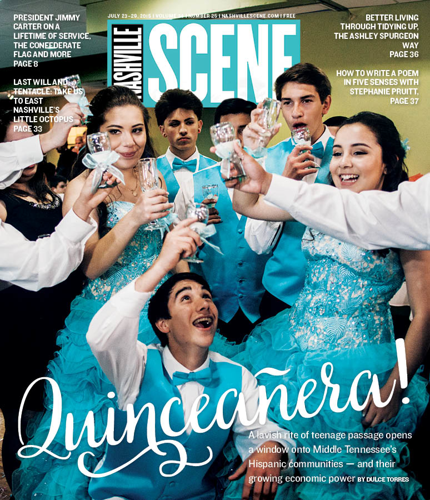
Arriving in a black Hummer limousine, shoehorned into a narrow space across the hotel parking lot, the girls have little time to enjoy their surroundings as they arrive to greet hordes of guests. While their family enjoys seconds of Mexican rice and birria, or spicy goat meat, the chambelanes are dragged outside to practice one more time. They stand fidgeting in their sky-blue satin tuxedo vests, jostling and squabbling about who goes where and when. Finally, they're as ready as they'll ever be, and the younglings line up for one final march from the Hummer across the hotel into the salon.
As soon as they enter the room, overwhelming cheers and whistles fill the air. The chambelanes come out first, coordinated and serious. The girls soon follow behind, and they began to show their family all their hard work of the past few months. As they move across the hotel meeting-room floor, every step and twirl is perfectly executed.
As soon as the song finishes, the family bursts into applause once again, although there are still many dances left to go. Out come the dolls to play their symbolic part, a final discarding of childish things. With their mirror images reflected on their dolls, Melanie dances with her father as Stephanie dances with her older brother. Smiles streak across the Angel men's faces. The babies of the family are growing up.
Next comes the ceremonial changing of shoes, conducted by the girl's godparents. Melanie and Stephanie now strut 5-inch heels, symbolic of their first steps into womanhood. Before they move, their godparents bring out a surprise. Two brilliantly wrapped, refrigerator-sized presents, tantalizing, stand before the girls. They rip into the packages, only to find them filled with balloons and confetti, which they must get past to find the real present.
After tunneling through what seems like endless balloons and fake presents filled with shirts and jeans, they reach the real presents: two gold bracelets. As the band makes its grand appearance, blasting party selections from banda to mariachi to bachata, the many members of the Angel clan, their many godparents, and the many friends and guests who've traveled from far away can contain their high spirits no longer. There will be times to struggle, worry and grieve. This is a time to dance.
Everyone dambursts onto the dance floor, busting their best moves. The party crowds around one chambelane's father. He's doing handstands, breakdancing moves, with each new spin or swivel of his hips bringing shouts of "ey, ey, ey!" in support. While the adults shimmy and twirl, the children scurry across the room with their own conga line. In the excitement, Ana Angel loses her phone. After 10 minutes of frantic searching, she shrugs and joins the party.
The dance floor quiets long enough for the mariachi to serenade Melanie with her favorite song. The assortment of floral, blue-ribboned cakes everyone's been eyeing are handed out, each piece a different flavor of chocolate and tres leches, a sponge cake soaked with milk and alcohol.
As 11 p.m. rolls around, no one wants to go home. Heels have been kicked across the room. Drinks galore pour. People go for thirds and fourths of birria. There are no sleepy children at this party as the band plays every last song it can think of in every genre.
At midnight the party will end, as hotel regulations say it must. After this, Melanie and Stephanie face years of hard work. They will graduate high school and attend college, as their parents hope, then grow into strong women appreciative of what they've been given. They will look back wistfully at photo albums full of proud relatives they may never see again and boys in color-coordinated tuxes, and at the center, their overwhelmed, ball-gowned selves, 15 forever.
But right now the band is playing, the jubilant crowd is surging and shaking, and all is joy, torn wrapping paper and rustling silk and satin. The night is young. And so, for one last perfect night, are the Angel twins.
Email editor@nashvillescene.com




