


On Aug. 13, an oil tanker pulling onto Centennial Boulevard tipped over and exploded. The more than 8,000 gallons of fuel in its payload ignited into a massive two-block-wide fireball that melted plastic siding, scorched telephone poles and rocketed cement pillars out of place.
It's a nightmare that's always a possibility for inhabitants of The Nations, through which fuel trucks often pass at high speed. But for developer and native Nashvillian Michael Kenner, it was all the more reason to make Guerilla Urbanist a success.
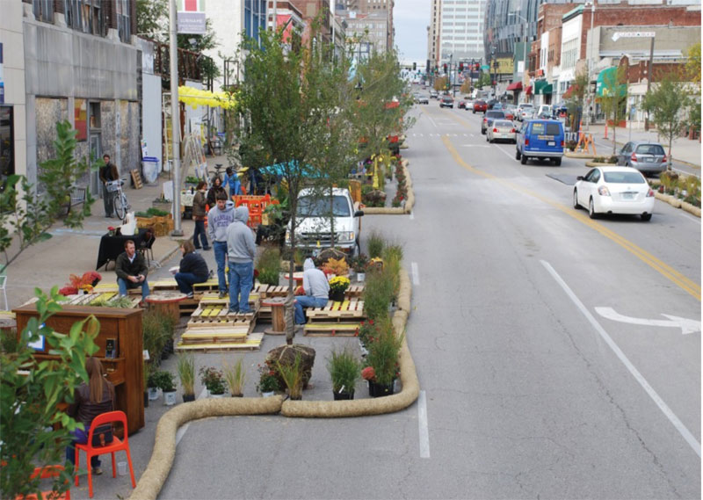
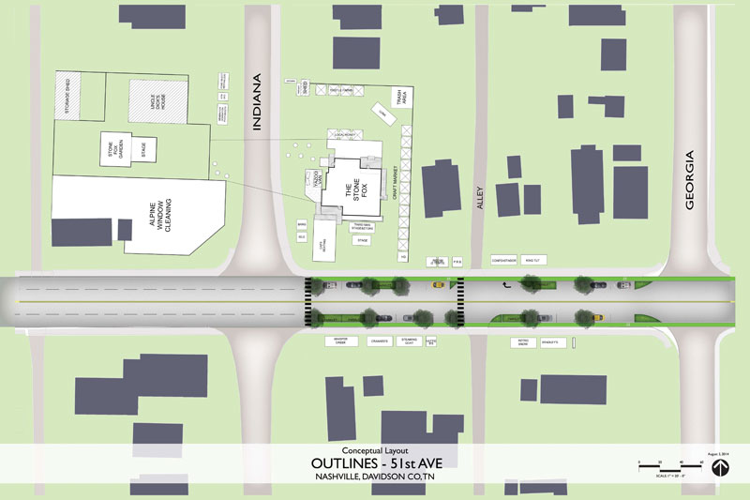
For 12 hours during Saturday's Nashville Outlines block party (see story here), community volunteers will transform 51st Avenue North, the road that bisects The Nations, from a four-lane highway into an ideal block for pedestrians, narrowing it down to two lanes of traffic and adding bike lanes, crosswalks, parklets, traffic-calming measures and more.
The practice called "Tactical Urbanism" — a peaceful demonstration in which residents take initiative to transform a facet of the cityscape on their own — isn't wholly new to Middle Tennessee. Last year's PARK(ing) Day initiative installed parklets in parking spaces along Broadway and other downtown streets. But Guerilla Urbanist is the first community-driven effort to transform an entire block in Nashville, according to Kenner. It follows in the footsteps of initiatives that have been launched in dozens of cities, from better block projects in Memphis to pop-up businesses in Beijing and ad-busting in São Paulo.
"It's a one-day demonstration to permanently affect policy," Kenner told the Scene at the West Nashville Free Will Baptist Church, where volunteers were hard at work on preparations for the takeover. Five weeks' worth of paint-splattered chairs, makeshift furniture and construction supplies litter the area in loosely organized zones, while neighbors and friends of the community build fences outside. "It's a little different approach to things. This isn't profit-driven for us. This is change-driven."
Guerilla Urbanist follows the design philosophy known as New Urbanism. But as Kenner readily points out, it's more like Old Urbanism, in which walkability and pedestrian-friendly measures are prized over speedy car traffic. He describes it as a corrective to the "70-year experiment" of centering urban design on the automobile.
"We've actually engineered our own abdominal obesity, our 35 percent obesity rate in the South, the type 2 diabetes rate — all of that is because of the way we designed America for the last 70 years," Kenner said. "New Urbanism is all about redoing good design and how to redesign neighborhoods to make them efficient and make it so we're not scared to walk."
For decades, 51st Avenue has been the playground of oil tankers, which barrel between I-40 and refueling points on Centennial Boulevard. Yet it isn't just tankers that race through The Nations. The roads were designed with speed in mind, making it hazardous for pedestrians.
"It's not even comfortable to drive across [51st Avenue]," half-joked volunteer Marc Taylor, who previously helped Kenner paint crosswalks in the neighborhood where they were sorely needed. And he's not wrong about that. The arterial road has all the hallmarks of post-war utilitarianism. It would be easy for a developer like Kenner to take that road as the focal point of the community, building to support it instead of the residential streets that line it.
Instead, he and the volunteers on the project are fighting against it. As The Nations booms back to life, the community has identified a need that the powers that be have overlooked. Kenner says Tactical Urbanism, and this event in particular, empowers the people living in The Nations to revitalize their own neighborhood, with or without Metro Public Works getting involved. To the organizers, Guerilla Urbanist isn't just about changing one stretch of road for 12 hours. It's a blueprint for how residents can reclaim problematic areas of their own neighborhoods.
"We'd love to continue to do this all over Nashville," Kenner said. "If neighborhoods can use this as a vehicle to change the problems that they have and to use this as a silent, three-dimensional demonstration to show exactly how it could be and how they want it, then I think neighborhoods could use this tool all over Nashville."
Email editor@nashvillescene.com.



