
Shortly before 9 a.m. on May 30, 2011, in a small rural satellite community just minutes north of Nashville, a Metro Nashville Police Department cruiser rolled to a stop along Baker Station Road, a two-lane tributary of nearby US-41. Its driver, MNPD Officer Neil Wolfe, had arrived to investigate reports of an abandoned vehicle.
Wolfe stepped out to speak with a nearby property owner, who said he had seen the man who left the car. As Wolfe would write in a supplemental report to MNPD dated June 4, the resident "explained to me that he thought that the subject was 'on something.' " Over the radio, a call came in describing a shirtless white male wearing only one shoe trespassing through the backyards of residents near Happy Valley Road, a quiet two-lane road on the north side of US-41 less than a mile from the abandoned automobile.
Wolfe got back in his cruiser and drove to the scene. He arrived to find a half-naked man heading into the trees and underbrush that ringed the area, his naked torso slick with sweat and pockmarked with cuts and bruises. According to his report, Wolfe futilely called after him. The man yelled back — what, exactly, Wolfe couldn't make out — and continued his dazed trek into the woods.
Wolfe began following the man on foot. Around that time, a fellow officer who had run the plates on the mystery car identified its half-naked, partially shoeless owner. He was Michael Lee Minick, a Gallatin man with a criminal record and an outstanding warrant for failing to appear in court on a driver's license charge.
Wolfe plunged into the forest, jumping over barbed-wire fences and across creeks for roughly half a mile to keep pace as Minick's lead narrowed. In the middle of a clearing, the shirtless, visibly distressed Minick appeared to give up, panting like a wounded animal and muttering incoherently, according to footage obtained from a camera embedded in Wolfe's Taser.
Training the device on the small of Minick's back, Wolfe warned, "I'm gonna Tase you! I'm gonna Tase you right now!"
The quality of the Taser-camera audio makes it unclear what Minick said in the moments before two metal barbs exploded from the MNPD-issued Taser and latched onto the sweaty flesh of Minick's back and left shoulder. But his screams ring clearly under the canopy of trees. For five seconds, electric current rushed through Minick's nervous system, instantly causing him to collapse in a heap onto the underbrush. Wolfe straddled Minick's back, cuffed him and radioed for an ambulance.
In his own report, MNPD Sgt. Gene Martin, the officer who ran the plates on the abandoned car, said Minick seemed paranoid. He believed drugs had been planted in his car, though none were found. He had wandered through the woods all night, he told Martin, thinking someone was following him.
Yet in this and other reports, officers said Minick told them he suffered from bipolar disorder and regularly took anti-depression medications — a sign of at least momentary lucidity. What's more, he apologized for his behavior. Without further struggle, Minick was cuffed and placed into MNPD custody. An ambulance was called, and Minick was finally given some water. He was admitted to Nashville Metro General Hospital and detained under the authority of the Davidson County Sheriff's Office, and no further incident was expected.
Just hours later, however, the man police say put up little resistance when captured seems to have become a different person. According to multiple police reports, Minick flew into a violent rage, broke free of his restraints, and began fighting with his captors. Though Minick weighed only 135 pounds, no fewer than four sheriff's officers fought to subdue him. The ensuing melee would end with Minick, initially picked up on a minor driver's license offense, in a coma that lasted a month. He never awakened from it.
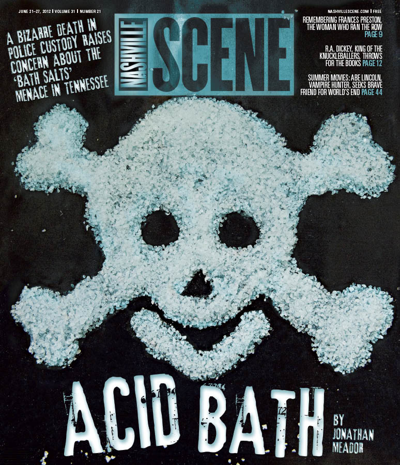
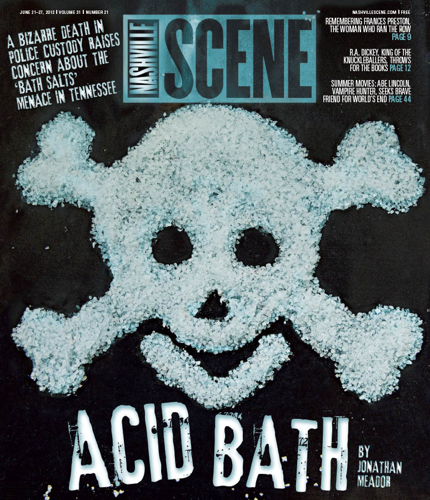
Minick's death has raised many questions, some of which have yet to be answered in court. But one troubling issue concerns a vial that members of Minick's family brought to the attention of an MNPD officer. Minick had apparently consumed 500 milligrams of a substance called "Loco Motion Bath Salts" — a designer drug of a type that is suddenly getting national notoriety. Easy to obtain, hard to detect, it has figured in a rash of lurid crimes across the country, prompting homicidal, even cannibalistic behavior in users.
Was it enough to make Michael Minick fly into a belligerent fury that resulted in his death? That would be extremely difficult to answer. But the case suggests Tennessee is hardly immune to a drug that's looming as a growing threat.
For most people, the phrase "bath salts" conjured up nothing more harmful than a hot soak with a glass of wine and an Enya CD. That changed on May 26, 2012, when media around the world seized upon the bizarre case of Rudy Eugene, a naked man who emerged from a Miami freeway ramp after ingesting copious amounts of the drug, according to police speculation.
A couple of blocks from the Miami Herald building, Eugene encountered Ronald Poppo, a 61-year-old homeless man. The attack that ensued was almost medieval in its barbarism. Crouching over the defenseless Poppo, Eugene gnawed off the man's nose, part of his lips, eyelids and a swath of his forehead before police shot him to death.
The Miami attack brought attention to other ghastly tales of bath salts users gone insane. In 2011, a Louisiana man raked a knife across his throat in front of his father and sister, convinced police cars were massing outside his home. In West Pittston, Pa., police arrested a knife-wielding couple who were trying to stab the 90 people they said were living in their walls. Rescued unharmed was their 5-year-old daughter.
Information about the drug itself, however, was as vague as the reports of its effects were repulsively precise. Even the term "bath salts" created confusion between the respectable product available at any Bath & Body Works and the entirely unrelated drug available from online retailers and across the counter at convenience stores in some states under names such as Cloud Nine and Vanilla Sky. Last month, as reports of the drug's damage were appearing across the country following the Miami attack, a trade consortium issued a press release addressing the mix-up — coincidentally, on the anniversary of the very day that Minick was rousted from his fevered idyll.
Representing the interests of Big Sodium, the Virginia-based Salt Institute described in a lengthy presser the difference between Epsom bath salts (which you dissolve in a hot bath for the purposes of relaxation and skin exfoliation) and the designer drug bath salts (which you snort, smoke or shoot for the purposes of recreational drug use).
"It is clear that these products should in no way be confused with the traditional bath salts that have been safely used for millennia and were first discovered by the Chinese in 2,700 BCE," the release reads. "These traditional mixtures of inorganic Epsom salt, table salt and baking soda, when added to warm bath water have the effect of soothing sore muscular aches and pains and were even recommended in the medical writings of the ancient physician, Hippocrates."
Morton Satin, the Salt Institute's vice president of science and research, blamed the press for the confusion. "The media should do a better job of making sure the public does not confuse the modern drug jargon term 'Bath Salts,' which are in reality dangerous narcotics, with the traditional and beneficial bath salts that have been used to promote good health for centuries," he said.
So what are the drugs known as bath salts? They're synthetic stimulants, similar in chemical makeup to the cathinone compounds in the khat plant popular among African immigrant communities. Bath salts have their roots in mephedrone, also known as 4-methylmethcathinone, a drug first synthesized in 1929 but revived in 2003 by an underground chemist going by the handle "Kinetic." When swallowed, smoked or ingested, it's said to produce a high comparable to methamphetamine or cocaine.
Even so, 4-methylmethcathinone took some time to become the epidemiological threat it currently seems to pose. In the mid-to-late 2000s, law enforcement agencies in the United States witnessed the rise of synthetic cannabinoids — artificial weed manufactured and distributed by foreign "street chemists" that could be sold over the Internet. As state legislatures began to ban the purchase of certain cannabinoid strains, the children of 4-methylmethcathinone began to multiply, and became a new entry in the quasi-legal "gray market" of as-yet unregulated designer bath salts.
[page]
The list of drugs based on the root molecule 4-methylmethcathinone, aka mephedrone, "is up to about over a hundred now," says Sullivan Smith, a physician at Cookeville Regional Hospital and a lieutenant in the Cookeville Police Department. "They're tweaking the molecule a little bit here and there, but the effects are largely the same. There's a little difference here and there, but by and large, it's largely stimulants. It hits people like Ecstasy, but as the dose wears on it's like methamphetamine. You get a real rush, but it also causes very high blood pressure, heart rate, seizures, high body temperatures, bad stuff. Legitimately bad stuff." Including, evidently, face-chewing.
To skirt federal narcotics laws, manufacturers and distributors bend Schedule I classification rules by explicitly stating "not for human consumption" on its packaging, in addition to camouflaging their product as "bath salts" or "plant food." Thus a drug that causes people to commit bizarre and frequently violent behavior can be sold on the Internet — and, in some cases, depending on the state, purchased in convenience stores — whereas marijuana remains not only illegal, but in the same Schedule I classification as crack, heroin and LSD.
T.J. Jordan, special agent in charge of drug trafficking cases at the Tennessee Bureau of Investigation, says that bath salts' legality turns it into a Trojan horse that most users aren't prepared for.
"For a young adult, the problem it creates ... is that they're selling it at a convenience store and so it must be OK, it must be legal," Jordan says. "One of the difficult aspects from a law enforcement perspective is that these distributors and manufacturers of this stuff are always trying to stay one step of ahead of law enforcement."
And, Jordan says, they usually maintain the lead. Any time a legislature bans the purchase or importation of a chemical strain, as the Tennessee legislature did during its most recent legislative session, the manufacturers respond by tweaking the formula, perhaps rebranding the new version, and it's back to business as usual. The polarity between the creation of new laws and the creation of new drugs presents a Sisyphean task of sorts for Jordan: Every time a drug is banned, two more replace it, and the gray market stays open for business.
Worse, the saturation of the drug across the country suggests it's growing in popularity. As of May 1, 2012, according to figures culled from U.S. poison control centers, more than 1,000 people received some kind of treatment for bath salts abuse — nearly four times the number reported for 2010. Data from the Middle Tennessee Poison Control Center at Vanderbilt University shows that since 2009, reports of bath salt usage — listed as "hallucinogenic amphetamine" and "other stimulant" — have slowly increased over the years, with 54 cases already reported in the first five months of 2012. And as market penetration grows, so do incidents of bizarre behavior, like Minick's, or gruesome behavior, like Rudy Eugene's, and all the tragedy in between.
"Tragedy" describes what happened to Michael Minick after he arrived at Nashville General Hospital on the morning of May 30, 2011. At approximately 10 a.m. he was admitted for treatment of dehydration and his apparent ingestion of bath salts. He spent a few hours in the emergency room and was ultimately moved to Room 7104, aka "the lock-up floor," where he was held by the Davidson County Sheriff's Office as a pretrial detainee later that afternoon.
Still reeling from the painful conclusion to his exhausting nocturnal trek, Minick rested with little incident until 7 p.m. According to police reports, the guard assigned to Minick's room, DCSO Cpl. Christopher Foster, notified nurse Cynthia Allison that Minick had removed his IV. Foster and Allison returned to Room 7104 and found Minick bleeding from the fresh wound on his arm.
Allison ushered Minick out of his restraints and into the bathroom to clean the blood off his body. Minick docilely complied, and when he returned to his bed Foster re-affixed the constraints and leg irons attached to the bed frame and secured Minick.
But in his interview with internal affairs investigators, Foster said that Minick began to have "peaks and valleys." He told IA that the captive's behavior started to oscillate wildly. One minute he would be combative, the next he was apologetic and conciliatory. During one of his aggressive peaks, Minick left his bed and refused to return to it. He started cursing and yelling at Foster, who called for backup.
Moments later, three sheriff's officers entered a now-crowded room 7104 and joined Foster, now facing the task of getting a man of 135 pounds back into his hospital bed. Officer Jeff Davidson ordered Minick to return to his bed.
"Fuck you," said Minick, according to Davidson's police report. "I'm not getting back in my bed."
"Sir," Davidson said. "I am giving you a direct order. Get back in your bed."
Minick again told the officer to go fuck himself. With a move that touched off a flurry of violence, he defiantly kicked his right leg with such force that his leg iron feebly broke loose. Now he was free to move toward the men, body crouched and head bowed in advance of a tackle.
In the ensuing struggle, Davidson fired a can of Punch pepper spray into Minick's face with no discernible effect. His colleague Matthew Barshaw, however, was temporarily blinded. Accounts differ as to what followed next. Davidson says Minick actively resisted the entire time, biting and kicking at him, and that multiple punches to Minick's face and head had no effect on him. Foster told investigators that he didn't remember any biting attempts. Officer Morris Craven said Minick "was throwing them around like ragdolls" and administered three strikes of his baton to Minick's upper right thigh to stop him from kicking.
All officers contend that Minick was never choked, sat on, or struck once restraints were reaffixed. They also agree that in the midst of the struggle, Minick urinated and defecated on himself. Regardless of the fragmentary nature of human perception, one fact emerges objective and crystalline: Shortly after being subdued, Minick lost consciousness and stopped breathing. Davidson dispatched Foster to get a nurse.
He returned a few moments later with a pair of nurses who performed CPR. Initially overpowered by the cloud of pepper spray that hung in the air and the presence of human waste, the nurses went to work trying to re-establish a pulse.
Within moments a Code Blue team arrived to resuscitate Minick. It worked, but only to a point. He was revived, but remained in Nashville General Hospital in a comatose state until his transfer to Sumner County Medical Center for Hospice Care. He died there on July 2, 2011.
According to the coroner's report, the listed cause of death was "complications from an asphyxia event ... during a struggle with others," and that the manner of death was homicide.
Yet the final ruling from DCSO's internal affairs "use of force" investigation cleared the officers of any liability over the coroner-identified homicide. "At this time it appears that excessive force was not used based on the responding officers' written and verbal statement," read the August 22, 2011, report, issued just a month and a half after Minick's untimely death. "It is unclear what affects, if any, the 'Loco Motion Bath Salts' had on Minick."
Also unclear was the role that bath salts could have played in insulating the relatively slight Minick from the blunt force inflicted by a handful of baton-wielding sheriff's officers. In documents provided by the sheriff's office to the Scene, the officers say they performed wrist joint-manipulation techniques in an effort to subdue Minick, as well as what is known as a "hypoglossal maneuver," which amounts to a kind of nerve pinch that usually incapacitates attackers relatively quickly. Both tactics failed.
The documents also show that the leg irons used to restrain Minick suffer from a design flaw that allows for easy escape. In a video, a DCSO officer demonstrates the feasibility of Minick's actions by affixing a leg iron attached to a bed to himself. After a few kicks, he breaks free with relative ease.
On May 24 of this year, Minick's family filed a federal complaint against several parties in a wrongful death suit, including Sheriff Daron Hall, MNPD Chief Steve Anderson, the Metro Nashville Hospital Authority and Corrections Corporation of America, among individual officers and nurses. The complaint petitions for a jury trial and damages of $15,000 excluding attorney's fees and other costs.
Attempts to reach the Minick's family's attorney, Danny M. Hryhorchuk, were unsuccessful. But in a recent interview with The City Paper's Pierce Greenberg, Hryhorchuk questioned how the slender Minick could pose a "serious threat" to multiple officers.
The events depicted in Hryhorchuk's complaint differ substantially from the DCSO narrative, alleging that the officers taunted Minick, beat him over the head with their batons and continued to beat him long after he had been placed back into restraints. It further alleges that the Nashville Hospital Authority failed in its duty to properly care for Minick.
The Scene directed questions to Metro Nashville General Hospital about the circumstances of Minick's death and the existence of hospital closed-circuit network camera footage. The hospital authority forwarded the questions to the Metro Legal Department. Spokeswoman Keli Oliver responded via email:
"As I am sure you are aware, Mr. Minick's family has now filed a federal lawsuit against numerous Metro Defendants. Pursuant to the local rules of the Middle District Court, I cannot comment on pending litigation," Oliver wrote. "As for the request for any security camera footage, it is my understanding that NHA is not in possession of any such footage."
Another issue that Metro Legal and Nashville General Hospital declined to address is the matter of Minick's initial blood work of May 30, 2011. The samples and results were "lost" by the hospital authority, according to Dr. Adele Lewis, deputy chief medical examiner for Forensic Medical Inc. With them went any potential traces of whatever drugs were coursing through Minick's body.
But that may not matter as much as you'd think. Cookeville physician and police lieutenant Smith, who's been called on numerous drug cases, says the chemicals that typically compose bath salts are so new, doctors don't yet possess an effective means to test for the drug.
"There are a number of cases across the United States [like this], and I have to realize that there are no good chemical testings" for bath salts, Smith tells the Scene. "The tests just don't exist yet. When we talk about the epidemic, we're looking at the tip of the iceberg."
With a foot firmly planted in the realms of law enforcement and medicine, Smith is frustrated by the lack of progress that medicine is making to effectively identify the drug in the user's physiology. That ability is crucial to allowing physicians and police to better understand the drug and, it is hoped, to provide better treatment for abusers. The resultant lack of data, Smith says, puts them at a disadvantage despite emerging improvements.
Currently, legislation to enforce a comprehensive nationwide bath salts policy is being stalled in the U.S. Senate by libertarian Sen. Rand Paul, R-Kentucky, who says bath salts should be an issue settled on the state level. In April, Smith testified in front of a House Judiciary Panel concerning the stalled legislation and personally debated the senator from Bowling Green.
"I told him, people are dying from this," Smith recalls. "Do they commit crimes to support their drug habits? Sure. It's the same issue of many other drugs in terms of what it does to our society. One guy strung out on this was a fella who thought he was being attacked, somebody stealing his drugs. As a convicted felon, he can't own a firearm, so what did he do? He sprayed pepper spray on the people he thought were attacking him.
"And the oldest of those people was 3 years old."
Email editor@nashvillescene.com.



