

From a file marked "Only in Nashville": It's a weeknight in October, no big deal, and you pull into an empty space outside Douglas Corner on Eighth Avenue South across from Zanies. You pay the $10 cover and take your seat at a rickety back table. There are maybe 30 other people in the cozy room, all music fans like you.
Well, not exactly like you. See that guy with the sandy gray hair, over by the wall? His name is Dan Penn. The late Jim Dickinson once said he had the greatest blue-eyed R&B voice he'd ever heard. He co-wrote a song called "The Dark End of the Street," a magnificent 1967 soul ballad about the helpless thrall of cheating that's as harrowing as film noir. To your amazement, he quietly gets up from his own rickety table, takes the stage — and sings it.
The two men sitting at the table in front of you exchange weathered grins. Their names are Delbert McClinton and Russell Smith. They're joined by a couple of younger cats, Paul Thorn and his drummer Jeffrey Perkins. Near the soundboard sits another friend who dropped by, Billy Swan — yes, the artist who cut the ageless 1974 rockabilly single "I Can Help," with its unforgettable cascading guitar lick. There are more world-class musicians in the room than there are civilians. And one by one, each takes the stage, slipping with an ease beyond practice into effortless, primordial R&B grooves, only to sit back down like Minnesota Fats coolly putting away his cue. Thorn whispers, "Why isn't this a PBS special?"
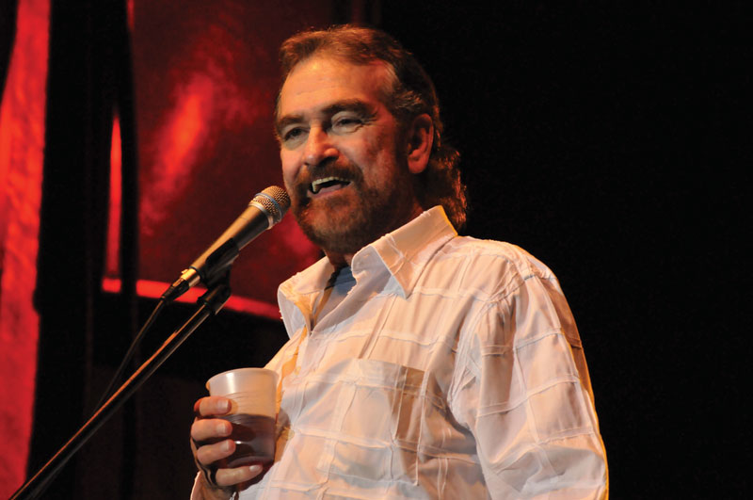
This is what $10 gets you on a Thursday night in Nashville. And it wouldn't be happening if not for the guy at the keyboard.
The man Kris Kristofferson immortalized in "The Pilgrim: Chapter 33" as "Funky Donnie Fritts" sits stage center. Onstage and off, these are his friends, some of whom (like Penn) he's known since Fritts was backing Hollis Dixon at frat houses in the early '60s, before the Muscle Shoals scene in his native Alabama became synonymous with some of the century's most enduring music. His bass player is David Hood, whose encyclopedia of credits extends from The Staple Singers' "I'll Take You There" and Etta James' "Tell Mama" to Paul Simon's There Goes Rhymin' Simon.
All this is to say that when Fritts convenes his third annual Silent Night, Funky Night Christmas show Thursday at Douglas Corner, you have no idea what or who you might find. You might get his former Oh Boy labelmate John Prine sitting in for a few numbers; you might get a visit from swamp-rocker Tony Joe White. You might get whichever of his Muscle Shoals buddies happens to be in town.
Fritts has had health scares in recent years — too many to count. But on a November afternoon in the Copper Kettle on Granny White, he's in good health and a great mood. A raconteur whose backlog of anecdotes stretches from Music Row to Hollywood, he's been a much-covered songwriter, a solo artist, a loyal sideman to Kristofferson for more than 20 years and even a grizzled outlaw in Sam Peckinpah's stock company. That's him getting banged upside the head with a skillet and blasted by Warren Oates in Bring Me the Head of Alfredo Garcia.
"I always said that was one of the high points of my life," Fritts says in his sorghum drawl, "getting hit in the head with a skillet by Warren Oates, and getting shot to death by Warren Oates in slow motion in a Sam Peckinpah movie. Shit, you don't get any better'n that!"
By that time, in 1974, Fritts had been in the entertainment industry more than a decade. A kid from Florence, Ala., he was already established at Muscle Shoals when he started coming up to Nashville in the '60s looking for cuts. As a songwriter, he'd co-write at least two standards: "We Had It All," originally recorded by Dobie Gray, then Waylon Jennings on the 1973 Honky Tonk Heroes LP and later Dolly Parton, Rod Stewart, Tina Turner and even The Rolling Stones on the recent Some Girls reissue; and the gorgeous "Breakfast in Bed," made famous by Dusty Springfield on the landmark 1969 Dusty in Memphis LP. The latter came about at the urging of legendary Atlantic producer Jerry Wexler, his friend and fellow Southern literature devotee, starting with a single note inspired by "Moon River."
"What happened, he talked to me and Eddie [Hinton] about writing a song for him," Fritts remembers. "You know, we had written a lot of songs, but ours was just like R&B, funk. That's what we knew. That's what we played. That's what we loved. Dusty's more uptown, more pop-sounding. So we had to really work on that song. I'll be honest with you: That one took us a while to write. But it's been probably the biggest moneymaker I've had."
Fritts met Kristofferson in the late '60s when their publishers were housed in the same building. The two hit the road in 1970, just as Kristofferson's influence was sending a sultry new breeze down 16th Avenue. From 1969 through about 1978, Fritts says, "that was the coolest time in Nashville. Things were changing. You had Kris come in in the late '60s and bring all these amazing songs, and people started writing songs differently thanks to Kris Kristofferson — it wasn't all just three chords and the same damn stories over and over, although there were great songs written before then. He put a little more into it, with his style of writing. That was a great time to be here."
At the same time, Fritts started acting alongside Kristofferson in Peckinpah's most daring 1970s films, the revisionist Western Pat Garrett and Billy the Kid and later the reviled Alfredo Garcia. People assumed his boss Kristofferson had gotten him the gigs; the truth was that Peckinpah told Fritts he looked like the kind of guy who'd fit in with a scurvy crew of cutthroats down Mexico way.
Although he made lifelong friendships with actors like the late Oates and Harry Dean Stanton, Fritts will not share some stories from this period. He will not tell what happened when he, Kristofferson and Peckinpah made their first venture to Mexico, except to say sheepishly, "A lot of it was my fault." He will not pass on the foul instructions Peckinpah kept giving him in his Pat Garrett bedroom scene with a Mexican girl, except that it ended with the mercurial director exploding, "You son of a bitch, you'll do what I tell you to do!" He and Peckinpah got along great — except for, y'know, the time the director tried to kill him.
"You never knew what he was going to do," Fritts says. "To be honest, he did a lot of things I didn't understand. He treated us great, except one time he pulled a gun on me and Harry Dean. We wanted to see him, and he was sick. It was a Sunday afternoon, and he had a high fever and everything. We walk in the room, and he has a .38 snub right in my face. Harry takes off, like any smart person would. I said, 'Sam! It's me and Harry Dean!' And he looked up and just passed out. Passed out. I told Harry Dean, the bad part is, if he'd shot one of us, he'd probably've gotten by with it in Mexico."
Fritts will return to the big screen next year in Billy Bob Thornton's new movie Jayne Mansfield's Car, in a small part written just for him by the writer-director — he's playing a friend of co-star Kevin Bacon who's "an old hippie who's deaf." Fritts laughs and says, "In other words, I'm not going to have to act much!" He's also planning his first solo album since 2008's One Foot in the Groove, a prospect too good to say more.
But for now, there's Silent Night, Funky Night. Fritts has no idea (or won't say) who might sit in, but his band alone is worth the drive: Hood, longtime Amazing Rhythm Aces/Little Richard band member Kelvin Holly on guitar, Hank Jr./Gregg Allman vet N.C. Thurman on keyboards, Cowboy's Scott Boyer on rhythm guitar and Mike Dillon from The Dickey Betts Band and Grinderswitch on drums.
"I'm proud of what I've accomplished," Fritts says. "A lot of people had bigger hits, but I've had a lot of songs cut." And a lot of the people who played on them will be playing again, with Fritts at their side, as if they didn't collectively represent some of the greatest pop music ever recorded. Like the man says, you don't get any better than that.
CORRECTION: Internet reports to the contrary, the Mike Dillon who plays with Donnie Fritts is not the one who played with Les Claypool and Garage a Trois, though he's still a total badass on drums. As he said, "I've met him, and he's 20 years younger and a lot better looking." The Scene regrets the error.
Email music@nashvillescene.com.



Post a comment as anonymous
Report
Watch this discussion.
(0) comments
Welcome to the discussion.
Log In
Welcome to the discussion.
Keep it clean. Please avoid obscene, vulgar, lewd, racist or otherwise abusive language. Comments featuring hate speech or threatening or violent content will not be tolerated.
PLEASE TURN OFF YOUR CAPS LOCK.
Be truthful. Don't knowingly lie or mislead.
Be proactive. Use the “report” link on any comment that violates our comment policy.
Share with us. We'd love to hear your feedback.