
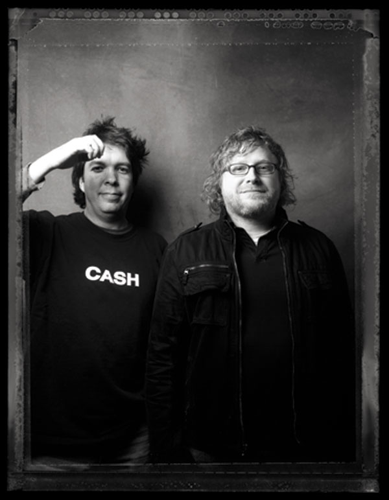
On Sept. 11 of this year, Marc Byrd, Andrew Thompson and Matt Slocum of the Nashville band Hammock were minutes from taking the stage in Hot Springs, Ark., ready to immerse an expectant crowd in an unbroken hour of lush instrumental soundscapes. Then the growing din of sirens and perplexed voices pulled them outside.
Not far from where they stood, a young man lay partially pulled from the rear seat of a Ford Taurus. He had been beaten to death in the midst of a crowd in town for the city's annual motorcycle rally. Perhaps fearful that the show wouldn't go on, the club owner approached the band with a not-so-subtle invocation to "put some beauty back into the world."
The suggestion — frail, serendipitous — recalled another odd confluence of events. Hammock's latest album, Chasing After Shadows ... Living With the Ghosts, was released just days after the Nashville flood. Loosely a comment on life's impermanence, the record accurately aligned with the city's unfolding drama on its own, but the artwork on its cover was even more eerie in retrospect: two motionless bodies submerged just beneath the surface of an anonymous lake.
These coincidences are likely just that, but Hammock's work is synonymous with elegy, or baptism — the slow, moving score to life's alternating complexity and majesty. Indeed, over the course of six years as a band, their music, which is self-described as "Southern ambient," has been utilized for just about every occasion, including the literal passing of a loved one, as Byrd says. It's also caught the attention of music supervisors at just about every major TV network, gaining license for NBC's coverage of the 2006 Winter Olympics, Showtime's Californication, and ABC's Dirty Sexy Money, among other film and documentary projects. This, on the heels of being personally invited by Sigur Rós' leading man, Jónsi Birgisson, to perform at an afterparty celebrating the U.S. debut of his Riceboy Sleeps exhibition with partner Alex Somers. The press have been kind to Hammock, too: Near-universal praise of the band has come from the likes of Pitchfork, BBC, Drowned in Sound, All Music Guide and NPR. Even Radiohead's Phil Selway reportedly became a fan recently after seeing David Altobelli's gorgeous video for "Breathturn," which was shown at this year's L.A. Film Festival.
This level of international respect has not garnered Hammock the widespread attention one would think emanates naturally from pinging the radar of such taste-making elites, a fact that's joked about irreverently by Byrd and Thompson, the band's principal members.
"I feel like we're the ambient version of the Velvet Underground," remarks Byrd. "People that like us are either in bands or are going to start bands, and that's about it."
Even in Nashville, the band's traction has been negligible despite releasing four LPs since 2004. This is due, to some extent, to the lack of live appearances they've made locally, but it's perhaps rooted more in the experimental styles that inform Hammock's sound, which, according to Byrd, caused the venerable Nashville songwriter Matthew Ryan to assume the band were from another country upon first listen. (Ryan co-wrote a song with Hammock for his upcoming album, and the two camps have discussed collaborating on a full-length.)
None of this is to suggest that Hammock's music, which recalls Max Richter's minimalism and the ethereal qualities of Stars of the Lid, is somehow inaccessible or self-involved. On the contrary, the band's densely textured aesthetic can and has appealed to audiences of nearly every persuasion — all that's required is the willingness to slow down long enough to be drawn in, to relent to the sheer envelopment of their glistening, washy compositions. Their songs, the band has suggested, were written in part to provide calm in the midst of what is possibly the most frenetic, narcissistic period of human history. To be sure, this is music that lacks an ego, a meditative sound built on moods and atmosphere in lieu of clever riffs and bold personalities — a quiet defiance of modern culture's unrelenting pace and demands.
"Slowing down is a good thing to do, considering where we are as a culture," said Byrd when interviewed for a previous article in May. "We feel that 'listening' to music as an experience and an exercise is being lost." Speaking to a blogger for The 405 recently, he expanded on this point: "I think our music gives people some hope to face the present while at the same time [it] creates a space for melancholy and sadness to exist. ... We're trying to get people to slow down and just listen."
Slocum, who is best known for his work in Sixpence None the Richer, is not a de facto member of the band, but has performed cello on every Hammock album, in addition to almost every live performance. He describes Byrd and Thompson's approach in quintessentially classical terms: For him there are "bigger payoffs," and those unbroken, hour-long performances are a "journey."
The imagery is fitting considering Hammock's transcendent, sweeping sound — best conceived on Chasing After Shadows, the band's most elaborate record to date — but also due to the path that's brought them here. Collectively, Byrd and Thompson's careers have been dotted with many industry successes — one of Byrd's songs, for example, was used as a wake-up call for NASA astronauts floating in space — but Hammock is their deliberate refuge from that world. More than that, though, it's a new, more creatively satisfying chapter for the duo, one that doesn't come with any "onus around it from the start," according to Thompson, a refreshing approach in a time that's begging for less chatter.
Email music@nashvillescene.com.



