

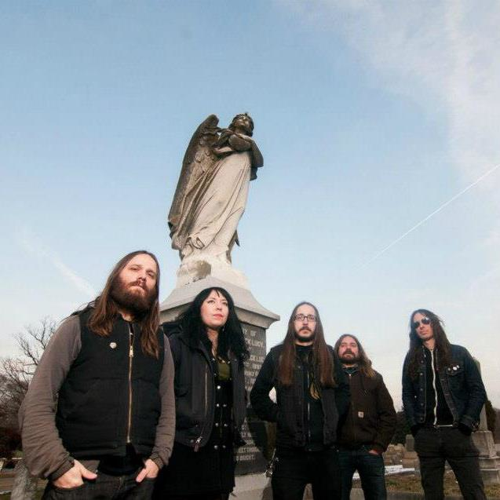


First off, a hardy thank-you to Cream commenter NashStu for tipping me off to
Richmond, Va., doom-metal outfit Windhand. While I may have missed their show at The End back in June and their gig at Dino’s back in '12, I’ve more than made up for it by listening to their new album Soma on repeat all summer long. (Getting added to the Relapse Records promo list was one of the greatest moments in my professional life. So. Much. Good. Shit.) And while former Scene contributor and current Pitchfork metal dude Grayson Currin — who I trust intrinsically, mind you — found the album a little disappointing (just a little though,
it still got a 7.0), I would have to heartily disagree.
Where Currin finds fault, I find freakishly good tunes — the acoustic “Evergreen” is gorgeous and the 30-minute “Boleskin” is a wicked gnarly riff meditation that ends on a (SPOILER ALERT!) breezy, creepy note. But who cares what I say? Let’s listen to what I have to say in this week's dead-tree edition about their Oct. 1 show at The Owl Farm!
Finally! You guys have no idea how badly I’ve wanted to talk about Windhand, but I just haven’t had the chance. Ever since the promo gods bequeathed us a copy of Windhand’s Relapse Records debut Soma, I’ve been champing at the bit to hail its praises in print. For serious, Soma has been on repeat at the Scene for months on end, and each listen is more exciting than the last — I’ve been head-banging to this record so much that my chiropractor won’t even talk to me anymore. This Richmond, Va., doom outfit makes epic stoner rumble that soars into the stratosphere, transcending the genre with sweeping majesty and shocking beauty. Vocalist Dorthia Cottrell’s ethereal singing elevates the band’s monstrous riffage to a level that is simply sublime — think The Melvins meets Mazzy Star — and separates Windhand from the rest of the doom pack. Plus they’ve got a song called “Woodbine,” which might not actually be a tribute to my favorite neighborhood, but I’ll take it anyway.
I caught up with drummer Ryan Wolfe while the band was on yet another cross-country trek to discuss songwriting in stoner metal, staying engaged in and staying cool on the road while things are heating up for the band.
Windhand plays The Owl Farm on Tuesday with Brother Ares, Tijuana Goat Ride and Wood Splitter. The show is all-ages and $5, and the doors open at 8:30 p.m.
Check out Soma and dig into the interview after the jump.
I wanted to ask about your songwriting process — where do you guys start, and how do you know you’re done?
That’s a good question. A lot of the writing is done with Garret [Morris, guitar] and Asechiah [Bogdan, guitar] for the most part. There will be a verse/chorus and we’ll kind of jam it out and then just kind of arrange things to our liking. A lot of it is through jamming. We’ll take a long time writing the songs. There’s lots of parts that we like to leave open to interpretation — mainly me playing drums and the bass player Parker [Chandler].
A lot the times we think we’re done with the songs and then we go out and play shows and something will happen in our live show just because we’ve allowed a lot of room to insert parts. It will take us places, and all of a sudden we’ll do something differently. On one tour we'll do it differently than on the last tour, and the song just keeps moving forward. Right now we’re playing the album live, and there are a couple of songs and a couple of parts of songs that aren’t at all like they were recorded, because we’ve stumbled onto something while we were onstage jamming live.
It’s cool. So as far as the songs being done, they are done, but you can look at it another way: they’re still rolling. There’s still part that people don’t recognize, just because we’re playing live, jamming, improving.
What’s the biggest challenge for you as a drummer in a band of this style?
My whole thing is not being very confident in playing and always trying to find another beat, a different sound. You always see bands and a lot of the time the drummer just plays four-four-four-four. I guess the hardest part is deciding if that’s the part that it needs, if it needs to have that straightforward beat or do I need to get a little weird and come up something that’s going to keep my interest and also the audience’s [laughs] .
And a lot of it too is that I get bored with myself — I’m always trying to do something, and then I’m like, "Did I just mess this all up because I was just trying to do something wild because I was bored with myself [laughs, somebody else in the van laughs]?" It’s honestly just trying to make the songs sound good, trying to find a balance. And back to the whole jamming part; you just get a feel for it — there’s just feelings I get playing these songs, and sometimes it doesn’t feel right and doesn’t have that feeling that I want, you know?
I think you do a really great job with very expressive, communicative drumming. It’s maybe not "lyrical," but there’s an emotional content in the drums that isn’t in a lot of doom or stoner records.
Cool, I appreciate that. It is something that I try for. And I never play the same thing, or [play it] twice. I’m going, "Hands, I want to play it like ... " That again comes back to the emotion and feeling of how the songs are.
How did you guys hook up with Relapse? Did you already have an album in the can?
I played in a band previously that was on Relapse, and so did Asechiah, but this whole management team that’s at Relapse now is a whole different crew. Our dealings with them were done and there was no communication whatsoever. But Parker plays in [fellow Richchmond doom purveyors] Cough, and they’re on Relapse. And we needed a bass player a year-and-a-half/two years ago, and he was offering his services, so we were like, "Hey, cool!" So somehow through him, [Cough] asked Relapse if we could do a split and they agreed — Cough agreed and we agreed.
And from that, [Relapse] came to us and asked if we would want to do some future dealings — if we wanted to sign to Relapse, because we were not signed to Relapse when we did the split. A lot of that was that Cough were about to go to Europe, and they wanted to put a release out for Europe, and they asked if Windhand could be on it. That’s kind of how that happened. We’re very thankful to them.
How has the reaction been on the road since the split came out?
It’s been good. We did pretty good at shows within certain markets, but now it’s like, "Oh wow, we’re able to play this show now." Especially in New York shows have gotten way bigger. Some other shows that were usually like 30 or 40 people — we’ve gone through a lot of towns in the past few months — and this time it’s growing exponentially. We played at Saint Vitus the other day — and before we’d be like the opening band on a bigger show — and we headlined Saint Vitus the other day and we sold it out with Ramming Speed. It’s growing; there’s way more people. We just went through on tour in June, and the crowds were good, but three months later there’s a huge difference in the crowd — people are very responsive.
Does the energy in the room shape the way you guys play? That sold-out headlining show, is there a difference between that and a 30-person show?
No, not really — we’re still kind of playing the same venues. There’s just more people out at the shows. We’re going through cities that we’ve been through three or four times in a year, and for the most part we’re playing the same clubs. But the crowds are bigger, and you recognize people after a while, so it’s still the same shows. There’s no difference to how we play, we’re still doing what we do, drinking the same amount. Still drinking, still the same, ya know?



