
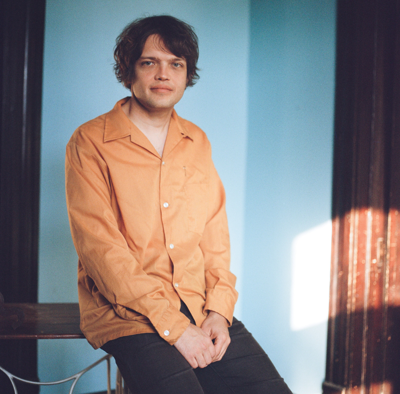

In 2010, when William Tyler released his first album of instrumental music, Behold the Spirit, it was a bit of a revelation for folks who knew the mop-topped guitarist primarily as a sideman for indie stalwarts such as Lambchop, Silver Jews, Bonnie "Prince" Billy. Filled with lush fingerstyle arrangements and hypnotic ambient interludes, Behold the Spirit turned a lot of heads among both critics and fans.
Still, it wasn't clear at the time whether the album represented a major shift to a career as a solo artist, or simply a side trip for an in-demand sideman. Six years, two studio full-lengths, a couple of EPs and a live album later, there's no doubt that Tyler is now his own boss.
Though Tyler has always been a masterful guitarist, his latest album, Modern Country, due out Friday on Merge Records, reveals a significant evolution as a composer of instrumental soundscapes. Nowhere is this more evident than on the gorgeous and mysterious "Gone Clear." Clocking in at six minutes, it's not the longest (or even the second-longest) piece on the album, but it feels like an opus, with several different movements, and at various times recalls everything from baroque chamber music to Philip Glass and '70s Krautrockers Neu!.
Full disclosure: William Tyler is a friend of mine, and has sat in with one of my bands, a Grateful Dead cover project. He recently sat down with me to discuss the making of Modern Country, and his life as a solo performer. We also took also took a trip down the Grateful Dead rabbit hole.
Where did you record the album?
We recorded it in Wisconsin, near Eau Claire, at a studio called April Base, which is owned by Justin Vernon, who is Bon Iver. Justin is really good friends with my manager Brad Cook, who also co-produced this record with me. John Ashley recorded it. We recorded the first week of January, so it was covered in snow, and it was below zero. There were bunk beds, guest bathrooms, a common area with a kitchen.
So you were living there in the studio.
Exactly, and there were other people in the studio at the same time, in the mixing room: the band Low, mixing their new record. It was kind of a wild scene! [laughs] "Oh, these guys are here!" Everyone's rolling joints and eating granola. It was a pretty incredible way to make a record. We tracked it in five days.
Who all is on the record?
So the band was me, Glenn [Kotche] on drums and percussion, and Darin Gray on bass guitar, and Phil Cook, Brad's brother, on mainly keyboards. He's a multi-instrumentalist. A little banjo too, but mainly keys. Glenn is in Wilco, Darin plays bass in Jeff's solo band, Tweedy. But their partnership goes way back. They have a duo project called On Fillmore, which is sort of an experimental jazz, modern classical project — prepared bass, percussion, drums. So they've worked as a rhythm section together for a long time. But Darin has played with a ton of other people in the improv/free jazz world. They also were the rhythm section on all those late-'90s Jim O'Rourke albums, like Insignificance, Chicago stuff that was very influential to me when I was younger.
So getting them to be the band was kind of a big deal. It's weird. It was exciting, also them not being condescending about it. My music is so influenced by that late-'90s, early-2000s Chicago stuff. And they were like, "This is great." And I didn't know Glenn at all.
What Chicago stuff influenced you?
Jim O'Rourke, Tortoise. There was a time where we would go to Tower and buy anything that Thrill Jockey put out. Gastr del Sol, that kind of stuff. Mainly O'Rourke stuff. It's weird. For my generation, that's what we were listening to when we were 19 or 20. Now there are people who are playing music in our world who were barely alive when that music came out. [laughs]
When I was 22, you couldn't use Tortoise as a reference point, because it was contemporary music. Now that music is 20 years old. You can totally use that as a reference point. That music was how I found out about a lot of experimental music and a lot of jazz. I feel like Tortoise was the first rock band brave enough to get up onstage and basically just play jazz. They could kind of get away with it because they had tattoos and looked like punk dudes. But they were basically just playing Miles Davis-influenced '70s kind of stuff.
So [hearing that music] was a real big lightbulb moment for me, before I even started making this kind of music. And that was the same time I started playing with Lambchop. And Lambchop always kind of fit in that world a little bit, just because it wasn't rock music.
So that was the band. And Brad and I produced it. Luke Schneider played a little bit of steel as an overdub. And Brad and I did some synthesizer overdubs, pad kind of stuff.
It sounds like you did multiple guitar tracks. Did you double acoustic and electric on certain things?
Yeah. There's only one song where it's just acoustic guitar. That was a conscious decision, that we should probably have one song on the record that was me and a guitar. We didn't want too much of a drastic departure from what people might be familiar with.
I really like "Gone Clear."
That was the one I was most proud of compositionally, and also what we were able to do with it from a production standpoint, because it had very distinct sections. I'm not even really sure where that song came from. Actually, I do remember. You'll appreciate this. I was recording some stuff with Joe Pisapia, like three years ago — maybe it was less than that. We were sitting in his control room. I don't smoke pot that much anymore, but I took a huge hit, and then [James Haggerty] came over, and we listened to Side 2 of [the Grateful Dead's] Terrapin Station. And then that Joni Mitchell record that Jaco played on, Hejira. And I was so high I slept on his couch, and woke up the next day and started writing that song, "Gone Clear."
That song is one where we were able to arrange it in a way that I can still sort of play that one solo and pull it off. There are certain songs on the record that are going to be a challenge to play without a group.
I guess you're going to have to tour with a band now.
Great. Now I have a band. I've been fighting that for 10 years. [laughs]
When you were developing as a solo performer, was that as much a financial decision as a musical decision? Is that something you love doing musically? Or is it just more financially viable?
I think it was a musical and social decision. What I mean by that is that I didn't have the confidence or energy to envision myself being a band again where I was the leader. I went from having a band in high school where I was the singer and we got signed, and then it didn't work out, and we stopped playing.
Lifeboy?
Yeah, Lifeboy. I was the singer, guitar player and songwriter. I'm still really good friends with those guys, but there was definitely the tension of being the frontperson and then having the two other people who aren't.
And also, watching the way [Lambchop frontman] Kurt [Wagner] has to navigate everyone's egos and his own in a band with 15 people, and I was the youngest person in that band. So when I started making my own music, I felt, whatever it is, I need to figure out how to do it by myself, or with one other person.
And then when I started touring, the first couple times I actually came home with some money, I did have kind of a little lightbulb moment: "Oh, you can actually do this." I mean, it's not commercial music, but even if you're the opening act for someone bigger, and you're getting paid a couple hundred dollars, that's pretty good for a solo artist. It just evolved from there.
Do you ever find it lonely traveling solo, or do you like that?
It's both. I basically really like it, because I love traveling, and I like movement, and being in control, so being alone is perfect for that. But there are numerous limitations. Fatigue is one thing, all the driving. At some point it starts to look like you're one step away from busking. You want to think you might have one other guy there driving, or collecting the money or doing the merch. The last tour I did everything solo. It was fun, but a little bit too much.
And in a band, you can let your attention wander, or tweak your pedals, grab a sip of your drink, while the others play. But solo, all the attention is on you.
It's kind of like golf or stand-up comedy. I don't like golf, but I really understand the psychology of it. Playing solo, there is so much psychology and technique that intersect.
I remember about 10 years ago, when I started doing it, somebody who's also a solo guitar player, older than me, said something that really stuck with me. He said, "When you're playing acoustic [guitar] by yourself, everyone knows when you mess up, even if they don't know anything about music, because it's so obvious." When you're in a band and you mess up, you can get away with a lot of things, especially when it's electric and loud. I definitely went from playing solo electric, then feeling comfortable enough to play acoustic. And now I like mixing it up with both.
You've developed a following and some name recognition. Do you still ever find it hard getting a reaction playing solo instrumental music?
The minute you have somebody as a vocalist — it doesn't matter if they're literally singing gibberish, like Sigur Rós or whatever — it makes it commercial. It doesn't matter if the lyrics are good. Just the fact that there is somebody emanating vocalism makes people immediately connect onto something. They may hate it, but they will connect with it.
When you're not singing, and you're in a pop music setting, which is essentially what I'm doing, it's just so much harder for people to relate, unless they can just dance to it, which is what techno music is. So I'm trying to get people to accept it for what it is. It could be ambient, it could be engaged. But just the fact that there's not a singer buys me a lot of good will sometimes with the bands that I'm opening for. Although a lot of times people will come back and be like, "Why don't you sing? Why don't you have words?" I don't know!
I tend to find instrumental music more powerful than music with singing, as a rule. I mean, I love some music with lyrics, but I feel instrumental music can sometimes communicate emotions that transcend words.
I think there are certain people who are so good at writing lyrics that they can be explicit and evocative at the same time, like someone like Dylan or whoever. My problem, a lot of it is growing up in a town like Nashville — this whole town is predicated on songwriters. I just want to be a musician, or whatever. A composer.
I know that you can technically say more when you're singing. But the way you can get so much emotion from a painting that maybe just has a title, but there's abstraction there, and you can read what you want to into it — that's what I get out of instrumental music.
Have any songwriters approached you to write lyrics for you because they like your music?
No, but that would be awesome! [laughs] Yeah dude! Let's co-write! Nashville!
So how do you go about naming instrumental songs? Do you have any methodology?
I do. It usually involves a historical event or a book or a concept or an image or something that I'd like to have a conversation about with the world. I feel like I'm starting it by using a title that would reference something like that. There are loose concepts to the albums I do, some more explicit than others. I tried to get all the titles on this album to work together in a certain way. This whole concept of traveling, rambling, being on the road all the time, exploring the country, and ruminating about what's happening to the country. There are larger themes, but it's not necessarily the way I make the decisions about what to call the songs. A lot of times they'll live without titles until I feel like there's something.
What about "The Kingdom of Jones," for instance?
That's pretty specific. That's a reference to this county in Mississippi that fought against the Confederacy during the Civil War. I just thought that was a cool idea, of an outlier in the Deep South.
Now "Gone Clear" obviously makes me think of Scientology. Was that a play on that?
It was. I knew that I couldn't call it "Going Clear," because of the book and the movie and everything. So it was so hard for me to get my head around not wanting to use those words. So I typed "gone clear" and some reference came up about it being a slang term for deceased CB radio operators. And I thought, "Wow, that's perfect! That's exactly what I'm trying to get with the concept of this song, the ghost of the airwaves." That was a happy accident.
Should I even bring up your recent obsession with the Grateful Dead?
It's all because of you, Jack. [laughs] It's all your fault! Yeah, thanks. I tell everybody, "I was poking around the rabbit hole, and then Jack asked me to sit in with their band." And I became full-on in, like a dope fiend.
It can be quite the rabbit hole.
I will say this. In all seriousness, I totally get it. It clicked. It was when I was listening to that set list to sit in with y'all, like a year ago.
Is that really when it took off?
That's totally when it clicked. I always had the records. But it was more like ... this is going to sound sacrilegious, but it's kind of like the way I feel about Neil Young. I've got all his albums, and I get it, but I don't get it at a gut level. ... I had all the albums, and I was just kind of like, "That's all right. Yeah, Europe 72, I get why this is good." There'd be moments where I'd be like, " 'Wharf Rat,' yeah, that's a really intense song."
But something about hanging with y'all, that definitely changed it. But the big picture thing, and this is something I've gotten on my own, but also from hanging with you a couple times — it doesn't really apply to the way I play guitar, because obviously Jerry didn't really fingerpick and used standard tuning, and he was in a band — but it has really ignited my wanting to learn more and more about the guitar. Something about the way he plays, and the way he incorporates stuff like the jazz idiom in his playing, feels inclusive and not overwhelming. I don't have formal training in jazz. That world to me has always been like, I can only learn so much because I don't even know where to start with it.
And also, from an aesthetic standpoint, they're such a great touchstone. Obviously, as you know, since you've always been waving the flag, they're a very alienating band too, but there's really no other band in American popular music that I can think of that brought as many weird musical elements and accessible musical elements together. That sort of inclusiveness is something that big-picture-wise is really interesting to me as a musician who is interested in roots music and also interested in experimental music and melody and noise and the ways they intersect.
Opening for Wilco, it felt like these guys are kind of like the Dead. They'll play a three-hour set, and have crazy jams. And also have songs that everyone can sing along too. And it's just weird enough that it pushes everbody's acceptance level, but it's inclusive. It's not like a super-atonal free jazz show that no one's going to connect with.
So tell me about the closing of The Stone Fox, the restaurant and music venue you ran with your sister, Elise Tyler. Was it that you and Elise were just too busy?
It wasn't that we were too busy, but we were torn in other directions. I always tell people that I don't think there's a way to start a small business without an equal mixture of naivety and arrogance. And we had plenty of both. You need false confidence. Especially starting a restaurant or a bar. It's probably the hardest kind of small business you can start.
With one of the biggest failure rates.
Of course. And you know that going into it. It's almost like those guys who had to lead the charges in World War I. It's a pretty bad success rate of the dudes who get out of the barbed wire. But you have be kind of like, "Aw, whatever."
As soon as we opened, I started touring with the last record that I did. It really worked as long as Elise was willing to really run the place, pretty much by herself. I would do what I could. And when she got to the point where she was, "I don't know how much longer I can do this," that's when we really started entertaining the scenarios of anything: selling the business, closing the business, bringing someone else in.
How long were you open?
Almost four years.
Wow, time flies so fast.
It does. It definitely didn't for Elise. [laughs] She definitely felt all of it.
But it has a place in the musical legacy of Nashville, kind of like the Slow Bar.
Sure, and that was what we were trying to emulate, as much as anything. I will say this: I don't think creative people should try to run businesses, unless they literally are nonprofits — which, unfortunately, bars don't retroactively qualify as.
If you're an artist, and I don't mean to use that word in a pretentious sense, but both my sister and I are, you just can't run a business. Because your idealism is going to come into conflict with the pragmatism and capitalism of having to run a business. That's not fun. Especially being a musician, and trying to run a venue, and there being nights, as you know, "Oh, nobody came, nobody paid. I can't pay you, because I don't have any money either." I hated that feeling.
I know [The Stone Fox] did a lot of good things, and anything like that is going to be super imperfect. I'll say this: Not having it, there are times when I'm sad, mainly for the people that don't work there anymore, because they were all friends, and some of them are still really close friends.
But I can go in a place now and feel this kind of relief that I haven't felt in so long. "Oh, I don't have to bus this table or worry if this guy's getting paid." We went and saw Chris Scruggs [and the Stone Fox Five] the other night, where they're doing their new residency, at this bar over near Centennial Park. It's this place called The Country. It's awesome! It's really great.
Honestly, that's probably what The Stone Fox should have been. It's half the size. They have probably a little bit more of a dialed-in bar food menu. It's more under control. But it was funny being in there. ... For a moment I was like, "Oh my God, I have to make sure the tip jar goes around," or I have to make sure people aren't waiting. And then, "No, I don't! I'm just a paid customer!" It's like post-traumatic stress syndrome. [laughs]
Email music@nashvillescene.com



Post a comment as anonymous
Report
Watch this discussion.
(0) comments
Welcome to the discussion.
Log In
Welcome to the discussion.
Keep it clean. Please avoid obscene, vulgar, lewd, racist or otherwise abusive language. Comments featuring hate speech or threatening or violent content will not be tolerated.
PLEASE TURN OFF YOUR CAPS LOCK.
Be truthful. Don't knowingly lie or mislead.
Be proactive. Use the “report” link on any comment that violates our comment policy.
Share with us. We'd love to hear your feedback.