
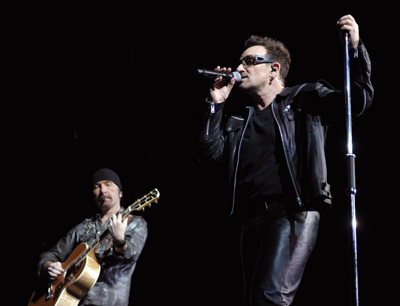


It's been nearly 30 years since U2 last played in Nashville. More specifically, it's been nearly 30 years since U2 played at Vanderbilt University, where over the course of a week, a crew of hundreds will erect and then dismantle the largest concert stage ever built. Sitting in the end zone of the school's augmented-to-45,500 capacity stadium and dubbed "The Claw," the stage itself — a spaceship-like, arachnidan steel structure that puts the band "in the round," nestling them in the audience's palms — is 164 feet tall.
That's a far cry from the university's long-gone Underwood Auditorium, where, on Dec. 2, 1981, the band, along with opening act R.E.M., played to a crowd of hundreds, who splurged a stiff $5 on tickets — a crowd conceivably outnumbered by the amount of crew who will slave away on Dudley Field building The Claw at a cost of more than $750,000 a day.
The Boyish, bushy-haired Irish lads who those few-hundred lucky showgoers saw singing about throwing bricks through windows and Oscar Wilde inside Vandy's old law building on a cold and wet December day in 1981 won't much resemble the U2 that will make a Commodore's walk to the field to the sounds of 45,000 screams on Saturday. Over the past 30 years, U2 — rock 'n' roll's longest-lasting big-name act to never have a lineup change — has been five different bands, each with its own iconic imagery and cache of hits. None of these U2s has ever played Nashville — though The Joshua Tree Tour did hit Murfreesboro in the fall of 1987, where none other than Wynonna Judd was brought onstage as a guest.
For kids who narrowly missed out on punk, U2's defining image is one of a be-mulleted Bono, white flag in hand, scaling Red Rocks' mountain walls while his every chilled breath lingers in the air with as much earnest indignation as the couplets they follow. Or perhaps the image is of Bono saving a front-row female fan from the crush of thousands at Live Aid and slow dancing his way to pop stardom.
For kids of the MTV generation, it's the image of the singer shining a spotlight on The Edge while the guitarist plays the "blues" and Bono sings about his god's fat pocket. For kids of the (HW) Bush Era it's The Edge getting a face full of feet, or the fly-shade-wearing, leather-wrapped enigma The Fly stealing inspiration from Lou Reed and Elvis and singing about the people of Sarajevo's grief.
For kids of the Clinton Era it's the band lampooning their own commercialism and Spinal Tap-ishness, before finding themselves stuck in a giant lemon they couldn't get out of. As those kids have grown into adults, many have embraced U2's past decade of aggressively and decidedly uplifting, exaggerated praise choruses, and they had no qualms snatching up concert tickets for prices reaching as high as $250 a pop. And for the kids of today, it's, unfortunately, the South Park caricature of Bono, depicting him as an aging, messianic turd who wants to save the world — even if he can't count to four in Spanish — that is burned into the mind's eye.
Each of the band's eras has had its imitators — its Coldplay, if you will. But through it all, U2 has defined itself in the era they're in, and not the ones behind them. For better or worse, that has continued to render them as overwhelmingly relevant as they have been successful. To three generations, U2 was, and still is, seen as a cutting-edge commodity.
For some that's inspiring, and for others it's annoying. Really annoying. But even U2's fiercest (and funniest) critics (aside from Henry Rollins, maybe) have a U2 they'd like to see shake Vandy Stadium to the ground on Saturday, and the rest are at least curious to witness the spectacle.
A 24-song, two-hour overview, the band's likely playlist for their neon-lit, virtual spaceship ride Saturday night is bound to satisfy most fans, spanning the arc of their catalog — from "I Will Follow" to (sigh) "Get on Your Boots" — hitting most of their sonic staples, and sliding down the surface of each palpitating, Claytonic bass trap and delayed, reverb-rife Edge-ism. Cursory fans and curious concertgoers alike can expect to hear hits like "Sunday Bloody Sunday," "Pride (In the Name of Love)," "With or Without You," "Mysterious Ways," "Beautiful Day" and, yes, "Vertigo." And die-hards can expect to hear a host of deeper cuts along the lines of "Ultraviolet (Light My Way)," the scarcely played "Zooropa," October's Joy Division aper "Scarlet" and the single redeeming quality of the cinematic train wreck that was Batman Forever: their soundtrack contribution, "Hold Me, Thrill Me, Kiss Me, Kill Me."
Given the Mel Brooks-worthy comedy of errors surrounding this year's Spider-Man: Turn Off the Dark rock musical that Bono and The Edge have attached themselves to, most would probably agree that "Hold Me ... " is perhaps as far as the band should've ever taken their affinity for comic-book characters. Still, the association is fitting, as more than becoming a band, U2 wanted to become rock 'n' roll superheroes. (Or at least Bono ... but come on, who's ever heard of a superhero named Larry?)
Time and time again, U2 has accomplished that. But despite their continuing influence and an unprecedented level of relevance and success — especially for a band entering its fifth decade, and a band that got its start as a Clash- and Sex Pistols-inspired teenage garage outfit in 1976 — U2 is looking into the past more than they are the future, as their two-year-plus 360 ° Tour winds to an end.
Anyone who caught the worldwide live feed of Bono & Electric Co.'s Glastonbury performance last week may have noticed that the band opened with a five-song string of hits from their career-redefining 1991 classic Achtung Baby, a record that unseated Garth Brooks' multiplatinum juggernaut Ropin' the Wind from its perch atop the Billboard Albums Chart nearly 10 years to the day after the band's first Nashville show. Not only that, but the U2-goes-kraut mini-set was complete with a visual overload of images culled from the vaults of their 1992-1993 Zoo TV Tour — a jaunt whose prescient, vivid take on pop-culture and multimedia oversaturation redefined the tenets of stadium rock, setting the, uh, stage for The Claw.
While on Zoo TV, Bono adopted an onstage persona dubbed "MacPhisto" — a gold lamé suit, devil horn- and platform shoe-wearing aging rock star who'd sold his soul to Mephistopheles. To U2 detractors — and sometimes even fans — the character occasionally seems like a prophecy self-fulfilled by the singer. If Bono wanted to be rock 'n' roll's Spider-man, it's hard not see MacPhisto as his Green Goblin — an inner demon with which he's still at War. And, as he spends his 50s breaking his back and reveling in rock stardom and Nobel Peace Prize nods, it's hard to decide whether to root for the villain or the righteous rock 'n' roll crusader. But regardless of who wins, it promises to be a great show.
Email music@nashvillescene.com.
*Correction, Jan. 29, 2019: Per a representative of R.E.M., the band did not open U2's 1981 show at Vanderbilt University. As seen in a 2016 post on the R.E.M. HQ Facebook page, that astonishing bill was advertised, but R.E.M. was replaced by Atlanta outfit The Roys at the last minute.



