
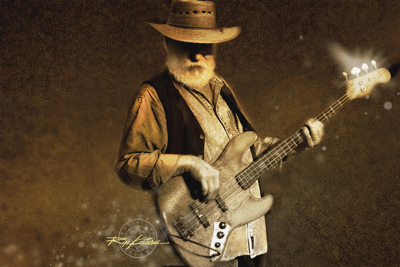
Michael Granda, a tall man, 64, sports a formidable ponytail and a toothy grin as he ambles through the crowd at the Nashville Farmers' Market. He's carrying an armload of supplies bound for ButterCake Babe Coffee Cafe, a hippie-themed coffee stand and gift shop in the facility's Market House pavilion. He chats with folks in line while Julie, his wife and business partner, keeps the line moving.
In some ways, Granda is a one-man time capsule, brandishing the torch for a culture that he and his live-and-let-live peers helped shape in the '70s. Granda's backyard in Southeast Nashville is a Zen blend of stately bamboo arches and uncovered teepee-style structures, some 30 feet tall, scattered among ground-cover flowers. They're strategically planted in the sunny patches of their thickly wooded lot. His ranch-style home is filled with a healthy mix of gold records, incense, musical equipment and eclectic art. And just about wherever he goes, he wears hyper-casual clothes, loose fitting and breezy. And decidedly everywhere he does, he carries with him an enviable laissez-faire cool.
"Hey, Supe!" calls out a fella wearing cargo shorts, a collared shirt and a baseball cap.
"Hey, man!" Granda answers back earnestly.
In all likelihood, the man in the ball cap doesn't know Granda's given name. Most everybody who's met Michael Granda over the past 40 years simply knows him as "Supe."
In the pre-disco/post-British Invasion thick of the '70s, when American rock bands with long names and long hair were de rigueur, Michael Granda was enjoying life as the founding bass player for The Ozark Mountain Daredevils. In 1974, the Daredevils were riding high on the success of their first single, "If You Want to Get to Heaven (You've Got to Raise a Little Hell)," which cracked the Billboard Top 25. The band's biggest hit, "Jackie Blue," would peak at No. 3 less than a year later. All told, the band would chart five songs on the Billboard Hot 100.
While on tour during the band's heyday, Granda came across a Superman costume in a dressing room, and hit the stage wearing it. In the weeks that followed, he donned the costume with enough regularity that his bandmates and friends started calling him "Supe." The name stuck, and he eventually began introducing himself as "Supe duJour," if only for comedic effect.
All told, Supe racked up some pretty heady rock 'n' roll bona fides during the '70s. He traveled the world playing music, worked for Herb Alpert and George Martin at A&M Records, recorded at London's famed Olympic Studios, smoked weed with Paul McCartney (leaving the former Beatle with a fistful of homegrown, hand-rolled Missouri mountain spliffs), jetted off in private planes to exotic locations ... if only to have lunch, and still managed to sock away enough money to pay off his home and put two kids through college — children, by the way, whom he and their mother delivered themselves.
"We were hippies, man," Supe tells the Scene. "We were 27-year-old kids, getting checks in the mail, and we had no idea who they were from."
In 1990, Supe set his hippie status aside long enough to run for public office in the names of capitalism, the free market and free speech. He entered the Republican primary to draw votes away from Missouri State Rep. Jean Dixon, who made national headlines by proposing warning labels on records that contain "objectionable lyrics."
"I realized that might affect my livelihood," he recalls. "So I registered as a candidate. I knew I wasn't going to win, but I thought I could be helpful by getting young people to vote."
Supe withdrew his candidacy at the 11th hour, and encouraged his supporters to vote for a third candidate.
"When the election results came around, we had successfully unseated Dixon," he says. "I felt pretty good about that."
The next year, Supe moved to Nashville.
"I didn't come here to get famous; I had already been famous," he says. "I moved here because the place afforded me the opportunity to live my life and to support myself through my art and my music and my writing.
"I started a band called Supe and the Sandwiches. I put the comedy bits in my songs, so when you sat down for a show, it was complete entertainment."
Nowadays, when he's not touring, writing columns for the official fan publication for his beloved St. Louis Cardinals, or working on his forthcoming book of essays about America's pastime (the follow-up to his self-published 2008 memoir It Shined: The Saga of The Ozark Mountain Daredevils), Supe is often found at the Nashville Farmers' Market. Sometimes he's working alongside Julie, other times he wanders through the market with an armful of supplies, chatting up passersby.
Supe will play several gigs with The Ozark Mountain Daredevils this summer on the "corn dog circuit," as he calls it, referring to a string of gigs at state fairs and music festivals, as well as play gigs with Supe and the Sandwiches. He's also been known to pop up unexpectedly around town, as he did recently when actor/musician Billy Bob Thornton invited him onstage at the Franklin Theatre to sing "If You Want to Get to Heaven" with his band the Boxmasters.
Email music@nashvillescene.com



