
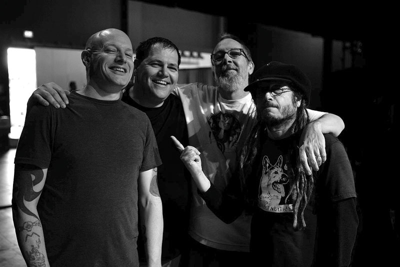

In early 2013, Black Flag fans got a double dose of interesting news. The hardcore pioneers' guitarist, lone constant member and central creative force Greg Ginn announced a new Black Flag album and tour with onetime frontman Ron Reyes. Given the lack of popularity (and often listenability) of Ginn's my projects since Black Flag's 1986 breakup, fans were understandably more concerned than excited. Later the very same day, four other former members of Black Flag announced the formation of FLAG — a tribute to all eras of the band, featuring founding singer and current OFF! frontman Keith Morris, bassist Chuck Dukowski, drummer Bill Stevenson, singer-turned-guitarist Dez Cadena and newly adopted guitarist Stephen Egerton, Stevenson's longtime bandmate in his main outfit, fellow SoCal punk legends the Descendents.
Suddenly, America's most beloved hardcore outfit went from being a more-than-quarter-century-old memory to existing in two wildly different forms — one ostensibly intent on pushing forward and expanding its legacy and another just trying to honor it. Par for the course, Ginn did the punk thing, lawyered up and sued FLAG's members (and, for good measure, non-FLAG former Black Flag frontman Henry Rollins) for trademark infringement. A federal judge threw out the suit in October 2013. And that wasn't the only thing that didn't go Ginn's way.
From the attempted comeback album What The ... (perhaps the most maligned punk stinker since The Clash's Cut the Crap) getting universally panned by critics and fans alike when it arrived in November 2013, to Ginn kicking Reyes out of the band (onstage!) and drafting their manager, Mike Vallely, for the role Black Flag frontman No. 5, Ginn's attempt to cash in was a disastrous embarrassment. Fans' skepticism was well-founded.
Meanwhile, FLAG played a string of festival dates to what seemed like unanimous praise, leading most to wonder: Is Ginn's "official" Black Flag really necessary? While his adversaries' timing and sheer existence might suggest an intentional counterpoint to Ginn's eventual blemish on the most iconic four-barred logo in music history, FLAG never claimed any such intention. Rather, the band cites the response to a one-off 2011 reunion at the 30th anniversary show for SoCal concert promoter Goldenvoice as the catalyst.
Even at its most infamous, Rollins-led peak, Black Flag was always Greg Ginn's vehicle. As its only consistent member, Ginn was the guiding force behind most of the band's material, for better or worse steering the band through all its stylistic twists and turns. Though later heralded for boldly injecting punk with elements of metal and jazz, inspiring the sound of bands like the Melvins and Slayer along the way, the initial impact of later-era Black Flag records like Loose Nut and In My Head alienated the band's audience to a sometimes violent extent. So while kind words for What The ... are pretty much impossible to find, Greg Ginn making new music that pisses off fans is still kind of a Black Flag thing to do — even if it's a mess of underwhelming, phoned-in, three-chord mall punk.
On the other hand, there's the legacy. Though these days you can order items like Black Flag baby onesies online at Etsy or the SST Records "Superstore," nobody ever got rich from being in Black Flag. The band's immeasurable influence and mythic street cred is really all any of its (many) members ever really got out of getting in the van for that tumultuous 10-year ride of constant police harassment, hardcore poverty and punk rock. Their shows often resulted in riots, and audiences regularly turned violent. Underfunded tours were par for the course, and members sometimes ate dog food to survive. In that respect, FLAG — whose set consists of two-dozen career-spanning Black Flag cuts with no new material on the horizon — may be one of the most important tribute bands in rock.
At the end of the day, the bad blood between Ginn and the rest of his Black Flag alums is a real bummer. As amazing as it will be to see these hardcore elder statesmen pummel an Exit/In crowd of diehards with timeless, ageless rage, it's a little like seeing The Who without Pete Townshend or Mötley Crüe without Nikki Sixx. But as with 1984's Family Man — an LP that featured Rollins' spoken-word pieces on one side and Ginn's weed-hazed metal instrumentals on the other — fans are just going to have to digest both versions of the band and assemble them in their head to get the full experience. Which, again, is still a pretty Black Flag thing to do.
Email music@nashvillescene.com



