
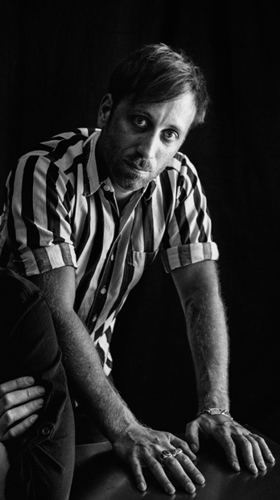


Dan Auerbach
To kick off
the Scene’s 2014 Year in Music issue(out today!), we caught up with Nashville neighborhood rock stars The Black Keys, who dropped their eighth studio album, Turn Blue, back in May and headline Bridgestone Arena for the second time on Monday.
Below, check out my Q&A (an abridged version of which appears in print) with Keys singer-guitarist Dan Auerbach. Kicking back in his antique-adorned 8th Ave. studio, Easy Eye Sound — where the 2013 Producer of the Year Grammy winner helmed such records as Dr. John’s Locked Down, Lana Del Rey’s Ultraviolence and JEFF the Brotherhood’s Hypnotic Nights — Auerbach gets to the point on topics ranging from life in Nashville,to the benefits of licensing songs for commercials, bro-ing down with Robert Plant, adjusting to arena-rock success and more. He also hints at cutting a follow-up to his excellent 2009 solo record, Keep It Hid.
And tune in tomorrow to read our Q&A with Auerbach's bandmate, drummer Patrick Carney.
Do you think it's better for the band to have come up the way it did, gradually from the indie world?
Absolutely it was better. However, we didn't do it on purpose. There's no way you could plan a career like ours; we just kind of stumbled into it.
I think people would like to think there are these boilerplate examples for how to be successful, but there's a lot of serendipity involved.
Absolutely. Yes. Stars have to align. It's luck, and timing [and] a lot of hard work. But you know, we have a lot of friends that worked just as fuckin' hard in bands and didn't get any reward.
Is there a moment that stands out in your memory as the turning point for the band, where you realized you'd reached rock-star status?
Not really, man. We just kept working. We never stopped. I remember playing our first show, and we kind of sucked. We were supposed to play a half hour, and we played so fast it was [over in] 18 minutes. You know, it's just lots of luck really. And, you know, the one thing that was really important was that we were broke and stupid, young and stupid. Because if I had to go back and start over now — I couldn't. It was just brutal. The touring was brutal, we weren't making any money, and we did that for years.
One of the things I find interesting about The Black Keys story vs. other big rock bands of the day is that you guys don't have any huge powerhouse hits. It seems like it's really the general sound of the band that's ubiquitous more than it is individual songs. Putting yourselves out there relentlessly; playing tons of gigs; licensing lots of songs — the sound and aesthetic of the band became more and more familiar, before you started having airplay and big singles. Does it seem that way to you?
Yeah, I mean, I think the licensing was hugely important to the success of our singles. I think there's something to be said about the public consciousness, and the unconscious mind of the public, really. Like, I've never owned a Tom Petty record. I know all Tom Petty's songs. How is that possible?
It's just in the water, right?
It's there. And there's something to be said about that. That is something that I think major labels used to mastermind but they can't anymore. They used to be in control of the radio and in control of every outlet where you would hear music, it's not so much like that anymore.
Was that part of strategy when licensing Black Keys songs?
No [laughs]. No, man! They were like, "We'll give you $200,000 so we can play your song that you recorded on your four-track in your basement, and we're going to play it on TV for two months [laughs]." Like, "Yes! We'll do that!"
Well it used to be, like, you can't do that and still be cool. But now people don't really seem to care.
All the people who said that were upper-middle-class white kids in bands. Like, college bands. And that was a fad. That was a thing that I had no part of. I'm from a working-class, middle-class family; I didn't go to art school. I'm not part of that world. I never lived in a scene — living in Nashville is the most of a scene I've ever lived in, and I don't hang out with anybody, really. So that whole [indie-cred] thing, I never understood that, you know, because I just always loved music, and if people are going to pay you for it, then fuck, that's great! It's gonna help you make more music. Yeah, that's just a win-win I think.
As far as you saying Nashville is the most like a scene that you've lived in, explain that a little bit. You're saying you don't hang out with people, but you do hang out with musicians, because you work with musicians, right?
Yeah, a little bit. But not a whole lot. I mean, I'm just saying, I come from Akron, where I was absolutely alone. I was absolutely alone in the music I liked and what I was doing. I mean, really, like when I was just obsessing over blues records, and playing electric guitar, and trying to figure out how to make music. I kind of got Pat roped in — he didn't know anything about any of the music I was listening to, but because he understood, like, Captain Beefheart's Safe as Milk. He could sort of grasp where I was coming from. Other than that, I had no one to share my love of music with, except for, like, my mom and dad.
Did Pat get you into other stuff that he liked?
Yeah! I mean, Pat played me, like, Modest Mouse for the first time. Pat played me The Sea and Cake. You know, art-school shit [laughs].
I was gonna say, he's coming from that classic art-rock, indie-rock pedigree.
Although, on the same hand, I never listened to Led Zeppelin; I never liked Led Zeppelin, and Pat loved them, so he would play their records for me, and I'd never heard them. Which was crazy, because we would be touring as a rock band and I'd never heard Led Zeppelin. It seems sacrilege.
And ironic. As far as the blues-rock powerhouses go, they're sort of the archetype.
Yeah. I never liked them. I was a real snob. I was a real snob, you know? I mean, yeah, why did I wanna hear these dudes from, like, England when I'd seen Al Green at his gospel tabernacle or, like, hung out with T-Model Ford in Greenville. It just seemed weird to me.
Were you that way with the Stones, too?
Yeah, absolutely, although I really liked a lot of the Stones stuff. But again, I wasn't really a fan. I was more a fan of The Beatles. I was more a fan of The Kinks.
Do you listen to Led Zeppelin now?
No, not really.
Have you met Plant?
Oh yeah, I'm friends with Robert Plant. I love Robert Plant. We have a lot in common. When we get together we talk about blues records we love. He still has that flame — that fire of energy and interest.
Yeah, he really resists nostalgia.
He fuckin' hates nostalgia. He understands that it will ruin him, if he lets it. I love it. Self-deprecating humor. He's fucking great. He's a really good role model, I think. He works hard. We played a show with him in France, and his band [The Sensational Space Shifters] was fucking great. ... They were really good — quirky, weird, awesome.
As someone in a big band, arena-level band, do you think about what it's going to be like being a musician 20 years from now, knowing you're going to have a legacy, knowing you're going to have certain songs that people expect to hear you play a certain way?
You know what, man? Even though we're an arena band, I just still feel out of place with that level of musicians. We just played [The Concert for Valor] gig in D.C., and I felt like a garage band [playing] with a bunch of arena bands. Really. We don't do shtick, man! We don't pander to our audience. I'm not going to sing, like, "Amazing Grace," you know what I mean? But Zac Brown right before me will. And Carrie Underwood right after us will. And, like, Dave Grohl will go out there with an acoustic guitar and do it with them. And then we go out there and we're just, like, playing the same songs that we've been playing for 10 years, and there's no shtick. I don't understand how we got to this level. Because I've never seen a big act be really big without seriously doing some, like, shtick. Do you know what I mean? Like really pandering to an audience. So it's weird, I don't know.
Has playing arenas in front of your own fans become a comfortable thing?
Yeah, absolutely, it’s really comfortable. It’s really cool, and I love our audience, because it’s not just one type of person. We used to play shows and it would be the same dudes who worked at the record store in the audience [Mimics head-nodding with a look of passive approval].

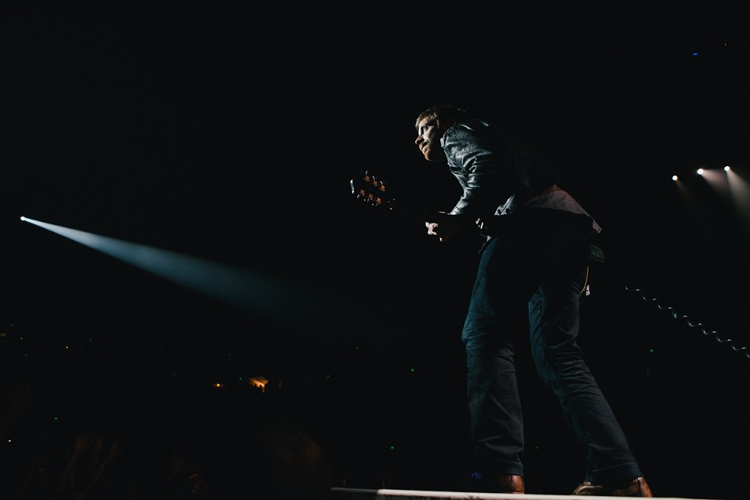
Dan Auerbach, performing with The Black Keys at Bridgestone Arena in 2013
Does that factor in with that same mentality as licensing songs, where you don’t care so much about scoring points with the cool police?
It’s great. Yeah, our audience is really great and we’re so fuckin’ spoiled. … They’re usually the kind of people that are really excited to be at a show, not just like, ‘Oh, another show.’ “ These are people who’ve saved their money and want to go see a show — one of just a couple [they’ll go to] a year.
With this being the band’s second arena tour, how has this tour been different than the last one?
It’s the same. We have the same exact crew. We had to hire a few more people because we bring the stage and the lights and the speakers, so we have to have certain people to set those up, but we have the same core crew that we’ve had for eight years.
What about as far as the show itself, though? On the last tour you guys were played the same set at almost every show. Did that get old or did it make it more comfortable?
Usually every leg of the tour we’ll work out a set and kind of stick to that. And then each time we start a new leg of the tour we’ll subtract a couple songs, add a couple songs and switch it up a little bit. But yeah, we’ve never been, like, a jam band. We’ve never been capable of just improvising. But I do love that kind of stuff. I was always a fan of The Allman Brothers and stuff like that.
Do you like playing old songs live?
Yeah. We just started playing “Leavin’ Trunk” for the first time. We actually recorded that for the first record and never played it, because when we recorded it, it had bass on it and guitar overdubs and stuff, so we just couldn’t play it as a two-piece. Now as a four-piece we can play it and it’s really fun. Yeah, I like it.
There’s looseness to your records. Is it hard to replicate that live or is it still natural after hundreds of shows?
No [laughs], it’s who we are. It’s natural. Absolutely. It’s hard [for us] to sound like anybody but us. It really is.
Is it easier to sound like yourselves with the extra musicians on stage?
It depends on what musicians. We’ve got guys who understand now and are very sympathetic. Richard Swift, he gets it. He understands how not to be perfect.
The last time you talked to us, it was right when you'd first moved to Nashville. And now, four years later, has being in Nashville been what you expected it to be?
Yeah, for the most part it's been what I expected. It's just a great small town. Really. Anytime I need to do a session, there are amazing musicians I can call. And it has the best airport in the world; easiest airport in the world. I can be from my front door to my gate in 12 minutes.
I did it in seven once.
Holy shit! Yeah. ... It's incredible. And we're always in airports. It is the worst, man! On some level our fans need to thank the Nashville airport for keeping us on the road. Because if we had to deal with the L.A. airport every day, I don't know that we'd tour as much.
Nashville is a town that's been in flux for a little while now, culturally. The Black Keys are definitely a part of that. I don't think there's any of these New York Times pieces or culture pieces, Nashville trend pieces that don't mention that the band is here. And you're interviewed for things like the Dave Grohl documentary, or the ABC documentary. How does it feel to move to a town that has all this musical history, and then within a few years you get to be one of the talking heads on what the city's like?
[Laughs] I don't know, it's really nice. I'm flattered. But it's certainly not why I moved to the city. I didn't want to become a talking head for the city. I wanted to be left alone and, like, be able to go watch bluegrass at The Station Inn whenever I wanted to. That was why I moved here.
You can still do that, right?
Of course. I still do that, yeah. Absolutely.
At the time you guys moved here, the band was breaking through kind of right at that moment, with Brothers. By that point, were you anticipating it getting to that level?
What do you think? No, man, we don't expect anything. Never, man. To break through on our sixth record? No. We didn't think that was going to happen. We went to Muscle Shoals, recorded in a defunct studio. We recorded, like, 18 songs, which is way too many for a record, put 'em all on the record — none of what we do really makes sense on paper, but it just seemed to work out.
How has being in Nashville, especially with you doing so much production stuff and working with the musicians you've worked with here — has it influenced The Black Keys sound at all, or your songwriting?
I mean, it's definitely influenced me and inspired me. But I mean, I've always been such a fan of country music, and bluegrass music in particular, that it just feels almost a little bit closer to home, like when I'm here and I get to [record] this music. Because, you now, my favorite musical moments when I was a kid were the family reunions, when everybody would get together and play bluegrass. That's the only reason I wanted to play guitar, was so I could learn how to play those songs with my family, and sing those harmonies and those Stanley Brothers songs and stuff like that. Moving to Nashville feels like I'm closer to that feeling every day.
When you first built this studio, were you planning on doing as much production work as you’ve ended up doing. You’ve gotta pretty impressive production discography going.
It’s my favorite place to be, is in the studio. I wish I could do it more, but touring is like the blessing and the curse — it’s the way we make a living and at this point we can’t say no to it. So it’s just like tour, tour, tour. We keep ourselves real busy. But I’m always going to be in the studio because I just love it so much. I love making records. It’s so much fun. I love going into the studio, coming in with nothing, and at the end of the day you have something. It’s just the absolute best feeling, and you’re using a completely different part of your brain than when you’re onstage. [Recording] is way more creative, and thoughtful, and it’s more exciting for me to try things and then have them work sometimes. Playing onstage is more, like, muscle memory, it’s more interacting with the crowd.
What are you working on right now?
Nothing crazy. No big projects lined up. Well, I’ve got a couple but I can’t really say [what they are].
Are you writing? Do you write while you’re on the road?
I always try to write, yeah. I’m always recording, always writing. I’ve recorded a bunch of songs on my own but I don’t know what the hell; just like my last solo record — I’m always recording.
Do you think you’ll do another solo record?
I think so. … I loved [Keep It Hid]. I loved touring it. It was really fun. Brothers wouldn’t have been possible without that record. I wrote a lot of those songs at the same time.
Turn Blue is a moodier record, definitely a more experimental record for the band. Is that the direction you see the band continuing to go in?
I have no idea. We never know until we get into the studio. And it always seems to change a little bit. A lot of it has to do with the time and the place. We could take all those songs from Turn Blue and record them now and they’d probably sound completely different. I always say, it’s like a snapshot of a moment in time. It’s like a Polaroid. It’s like we captured the songs that week and this is what they sounded like that week.
If you’re living in Nashville and you’ve got a studio in Nashville, why do you end up going to Michigan and California to record Turn Blue?
Well, we wanted to get out of town when we first recorded, and I’ve got friends that own a studio called Key Club in Benton Harbor, Mich., and they had Sly Stone’s old console, which is a really rare, old console called a Flickinger. And so mainly for studio-nerd reasons I wanted to go there and, like, nerd out in their studio and be isolated. So that’s what we did. And then we went to L.A. because Brian [Danger Mouse] lives in L.A., and we made him come to us last time, so [this time] we obliged and went out there.
What are your some of your favorite spots in Nashville, maybe even some of the ones people don’t always hear about as much? Whether it’s restaurants, hangout spots, antiquing destinations?
Well, you never give away your antique spots. My dad’s an antique dealer. I go out to antique malls every week, just out of habit. I’m just so used to it from going with my dad as a kid. It’s a part of my routine now to go hit the little route of antique malls.
Is that where a lot of this stuff in the studio comes from?
That’s where everything in my life comes from! [Laughs.] Some of my favorite spots. You know what, man, you can’t ask me that now, because I’ve been gone too long on tour, my favorite spot is home, or the studio. I don’t want to go anywhere, you know what I mean?
But you do like Barista Parlor, right?
You know, I’m an absolute coffee snob, and I bought a building in The Gulch and [Barista Parlor] opened in my building down there. … It’s amazing, because being on tour I got introduced to really good coffee. You certainly could not get it in Akron, Ohio. There was just no place to get good coffee. So it’s crazy just, like, being in a kind of a small town and having multiple places where you can get coffee that’s as good as you’d have had in Italy.
As far as local music goes, you took Those Darlins on tour when you were touring your solo record. You've produced Nikki Lane and JEFF the Brotherhood records. Is there a through-line, or something in common, that you think the Nashville artists you’ve worked with have?
I think they all have, like, a DIY spirit. They’re all kind of rambunctious and independent.
What made you want to work with those artists and artists like that?
The only reason that I’ll ever work with anybody is because I like them. I know a lot of producers who make a living producing, and they have to work with a lot of bullshit that I know they don’t like, but they do it because it’s a paycheck, it’s major-label money. I don’t have to worry about that because I make a living with my day job, so when I produce a record, it’s only because I like it. I’ve never really made money producing a record. As awesome as anybody thinks my fuckin’ production resume is, I’ve never made money. And if I had to do it for a living, it would become very difficult, because you can’t only do what you like.
Do you think there’s a “Nashville sound” right now? Are you part of it?
As far as production styles? No, I don’t think so. But I mean, there’s so many different worlds going on at once that don’t even really connect, ever. Like, I don’t know anybody from the pop-country world. I know some musicians who do those sessions, and the way that they describe them to me is insane. They’ll cut, like, 25 songs in an afternoon, never see the [singer], never hear the finished product and they get paid. It doesn’t seem musical to me. It’s bizarre. But I think that, you know, I personally have always loved music history, and I’ve always been attracted to old music and I've always loved records, always loved country music, and it’s still exciting for me to be in Nashville, because this is where all that shit went down. It’s still exciting to me.
It seems almost like the opposite of how you described your experience with music growing up in Akron, alone, geeking out by yourself.
Yeah. However, I couldn’t have been here without Akron. That isolation, it helped me sit in my room for hours and just practice. It wouldn’t have happened if I’d lived in New York City and there were six million people and a bunch of private rehearsal spaces that everybody wanted to use. So as frustrating as it may have been, in retrospect, I just wouldn’t even exist without that isolation in Akron.



