
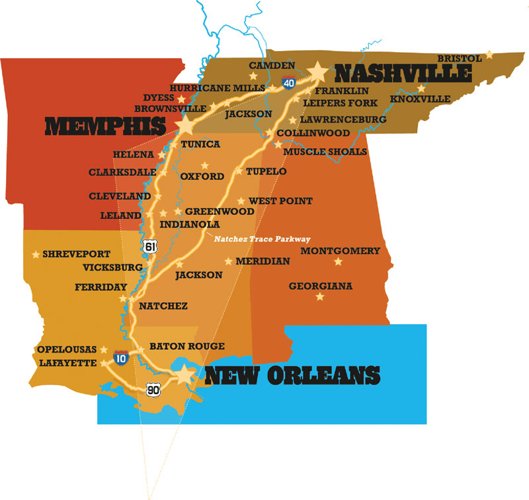

Standing under the blue-and-red glow of stage lights at 3rd & Lindsley's, singer-songwriter Paul Thorn croons and captivates during a late summer show. He's playing a mix of rock and blues that falls in line with Leiper's Fork philanthropist and preservationist Aubrey Preston's latest brainchild — the Americana Music Triangle, which launched in full earlier this spring. It's basically a boosterism and cultural education effort. One that aims to tell the history and spread the legacy of American roots music by connecting the dots of incubators like Nashville at the northeast-most point, East Arkansas to the west and New Orleans at Southern tip, with landmarks like Oxford, Miss., Memphis, Tenn., and Muscle Shoals, Ala., in between.
Thorn is one of several musicians who've helped Preston launch the effort. His current tour — supporting his latest LP, Too Blessed to Be Stressed — is forged on the same route of the triangle.
"Nashville wouldn't exist without the elements of the Americana Music Triangle," Thorn tells the Scene. "Gospel, rock, black gospel, country was just the fertilizer you put on flowers."
Dubbed the Gold Record Road, music enthusiasts who want to adventure out of Davidson County can head down to Muscle Shoals, Ala., head west toward Tupelo, Miss., and make a turn to head south through Mississippi's other haunts before reaching the end of the line 1,500 miles later in New Orleans. AMT organizers like Preston — a dedicated preservationist who was a crucial benefactor in the efforts to save RCA Studio last year and The Franklin Theatre in 2008 — want to frame the triangle and distinguish it in a similar fashion to Napa Valley, Calif.'s "Wine Country." Preston & Co. hopes Americana Music Triangle becomes a well-known phrase that's synonymous with the within-driving-distance birthplaces of American music.
"If someone has an interest in music, this is foundational," Americana Music Association executive director and AMT key player Jed Hilly tells the Scene. "It's pretty badass. I have done the trip many times."
One such trip Hilly and Preston took was exactly where the AMT idea picked up speed. As Hilly recalls, the pair was heading down to New Orleans when Preston pitched him the concept. Four years later, the AMT has evolved into a slick website, full of driving maps, concert information and facts interlaced with historic timelines about the nine genres — from country to R&B — that it supports. Most of the history — like the evolution of instruments and how the banjo and fiddle bred to forge a new sound — goes back centuries.
"We see a lot of people that are supportive from tourism to education to different attractions," Preston tells the Scene. "[The AMT] defines it for people on a global basis in a simple way that erases the border between the states and the cities to tell the true story of how it developed and migrated throughout the United States and throughout the world."
This CliffsNotes version of music's migration throughout the South that contributed to American music's transformation will, its organizers hope, become more than just a Google search result for southbound tourists. Rather, it should be a one-stop kiosk for tourists to discover where they can learn about and experience that history in the flesh.
"I think it's more than a website," Hilly muses. "It's a place. It's something to be proud of. It's the ultimate American experience through this being a great melting pot that is filled with everything from conflict to love."
Preston said Nashville was the marketplace for AMT because the confines of Music City are where many artists find each other and collaborate to blend sounds that otherwise might stay within its own silo. In fact, Preston feels that Nashville artists have found themselves in a new music migration, creating a new renaissance so to speak with the convergence of genres.
"I think what Nashville is right now is hard to define," he says. "And it's hard to know when you're in the middle of a tornado or historic moment, and it's in the middle of a historic migration. We are right in the center of that storm. Everyone can kind of feel that, and we can feel it but cannot define it."
Email Music@nashvillescene.com



