
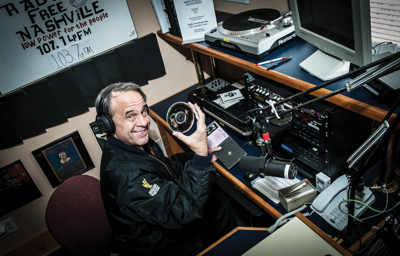
For anyone exploring the FM band in Nashville last week, there was a notable new piece of real estate on the dial — the often admired but seldom heard signal of nonprofit independent station WRFN, Radio Free Nashville. In the nine years it's been on the air, Radio Free Nashville has built a reputation for exciting, eclectic music programming and a fiercely liberal political voice — even though its 100-watt signal at 107.1 FM was largely confined to the far western portion of Davidson County. Now, with its signal rebroadcasting on W279CH 103.7 FM in Nashville proper, WRFN is making its big-city debut.
The story of Radio Free Nashville's journey to conquer the local airwaves is a tale of frustrations and victories. Established in 1997, the low-power FM station spent years navigating FCC bureaucracy and overcoming various legal challenges from commercial radio stations before taking to the airwaves in 2005. Since then, the challenge of being "out of range/out of mind" for the majority of Nashville's listening audience has dogged WRFN. It's an issue the station's management anticipated before they went on the air.
"The application for the second frequency was actually fielded in 2003 before we were even on the air," station manager Ginny Welsch says. "We had to take advantage of the window to apply because they don't open very often."
According to Welsch, the FCC rarely allows the creation of new "broadcast translator" stations, frequencies that are specifically licensed to rebroadcast a signal from another station (thus expanding the coverage area). Because of the massive number of applications the FCC received, it took a decade for the applications to be sorted out, processed and granted. WRFN's construction permit was granted in May 2013, and a year-and-a-half later the translator signal went live on Dec. 1 from its location on the WSMV-TV tower on Knob Hill in West Nashville.
"It seems solid in downtown Nashville and over in East Nashville," Welsch says. "There are pockets where it comes in and out, but if people move their radios around or get an antenna, they should be able to pick it up. We feel like it's going farther than what we anticipated on our projection. We've gotten reports that people are hearing us in La Vergne and in Goodlettsville."
Although the signal of WRFN can now be heard in Nashville proper, the station has no plans to relocate from its headquarters in the wilds of western Davidson County.
"Everything will stay in Pasquo," Welsch says. "As far as the FCC is concerned, Radio Free Nashville is still 107.1 FM, and we're still the little low-power FM station that we always were. It's just that now we have this chance to have our signal heard over a wider area." Welsch hopes the larger listening area leads to greater support for the station.
"In terms of ongoing support, there has been a feeling that if people couldn't hear us, why should people support us?" Welsch says. "We hope that's going to change now. More people will underwrite programs, and more people will become sustainer donors, making monthly contributions." Welsch notes that deeper coverage of local news, more political discussion and specific community-based programming are all on the agenda.
"We've had some local news programming sporadically but not on a regular basis," she says. "Hopefully, we will be getting into more specific communities or neighborhoods. It will serve the people in those communities, but also let Nashville know about these wonderful pockets of life and culture that they may not even be aware of."
The new emphasis on program variety doesn't mean that WRFN will de-emphasize the station's many beloved music and culture shows. If anything, the broadcast translator means bigger audiences for the likes of DJ K9's foot-stompin' Rocknbilly Hot Rod & Blues Review, the frolicking power pop of Angie Dorin's Cat Beast Party, or Whit Hubner's home-cooked weekly live showcase Mando Blues.
"We are very open to new shows," Welsch says, "but I keep getting the same show pitch all the time — a hundred thousand Americana shows or shows focusing on local musicians. We really need people to start thinking outside that box. We're only limited by FCC rules and the programmer's imagination, so we want the different stuff. We want the quirky stuff. I feel that what's been on the air in Nashville is kind of white-potato radio, and we're sweet-potato radio. I hope that people will tune in to get a little of that added flavor and texture that the sweet potato can provide."
Email music@nashvillescene.com



