
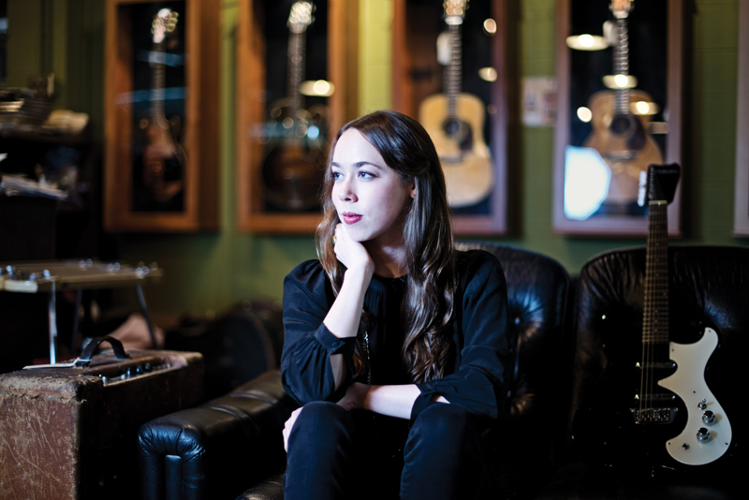

It's sometimes easy to forget that Sarah Jarosz is only now in her mid-20s — the singer/multi-instrumentalist has been releasing albums since she was 15, displaying an uncommon maturity in her songwriting and musicianship. But before she started working on her fourth album Undercurrent, Jarosz experienced a series of big life changes that should ring familiar to many young adults. After finishing her schooling, she relocated to New York City and was adjusting to living on her own in a new place.
This newfound solitude presented Jarosz with a focus that steadily began creeping into her work. For the first time in her life, she was able to treat songwriting more like a regular job, dedicating hours to the craft instead of hoping inspiration would hit between school obligations.
"[Now] I have the freedom and luxury of being able to sit down at my desk and work on it every day, even if the inspiration isn't there," she tells the Scene. "So I feel almost a greater sense of ownership over the work because I felt more present for the process than ever before."
Jarosz also found herself frequenting the Central Park Reservoir, seeking some more natural sights and sounds away from the hard surfaces and noise of the city. Officially known as Jacqueline Kennedy Onassis Reservoir, the body of water inspired album-closer "Jacqueline," one of four songs on Undercurrent that Jarosz performs solo.
"It almost looks like a heart in the middle of the city," she explains. "Living in New York for the last three years, it's been really important to me to have that escape of walking into the park and feeling like you're escaping the craziness of the city. The reservoir is this calm, central zone amidst the hustle bustle of daily life."
"Jacqueline," along with "Early Morning Light," "Take Another Turn" and "Everything to Hide" — which gave Undercurrent its flowing title — helped shape the album's direction and marked the first time Jarosz has recorded without additional musicians. Here she's on her own, working through her relationship blues by herself.
"I was just playing them for friends and family, and a couple people along the way [were] being like, 'That's how I want to hear that song. I only ever want to hear that song that way. How amazing would it be if you made a CD and it was just you singing this song? Because it doesn't need anything else,' " she recalls.
Though not overstuffed by any means, Jarosz's previous albums (like 2013's Grammy-nominated Build Me Up From Bones) have tended to swaddle her poppy brand of roots music in elegant instrumental attire. Conversely, Undercurrent takes the elemental approach — even the songs that feature additional instruments in the mix feel naked. Working with her longtime producer Gary Paczosa (Alison Krauss), Jarosz aimed to capture performances she could actually re-create when she plays live.
"We kind of went into it with more of a 'Let's capture the true marrow of what this is and get down to the raw form of what I do,' " she explains.
That's not to say the album is without its brighter, fuller moments. "Green Lights" pulses hypnotically with star-dusted vocal melodies, while "Comin' Undone" (which Jarosz co-wrote with Parker Millsap) doggedly fights off despair with a bouncy rhythm and sunny hook. Friends Aoife O'Donovan and Sara Watkins (with whom she started the band I'm With Her) drop by to add heavenly harmonies on "Still Life." Interestingly, Jarosz deploys her considerable instrumental prowess sparingly throughout, making those moments where it bubbles up all the more powerful and surprising.
"In the past I always put some sort of pressure on myself to feel like I needed to showcase how I could play an instrument and work that into the actual song and the songwriting process, which ultimately changes the song," she admits. "This time I just felt like I wanted to not put that pressure on myself."
That attitude of making conscious, deliberate changes to her approach flows back into the album's title. Read as a kind of mission statement, Undercurrent hints at the unseen forces shaping Jarosz and her creativity during this latest phase of her life.
"I just really grasped onto that word," she says. "It's like an underlying feeling or influence, one that's contrary to the prevailing atmosphere and maybe not openly expressed, and two, a current of water below the surface moving in a different direction. For me this album always felt like it was gonna be different in that way and that that word encapsulated that imagery."
With Undercurrent, Jarosz tunefully enunciates one of adulthood's important lessons about the being alone: It can be lonely, sure, but it can also be a source of great strength.
Email music@nashvillescene.com



Post a comment as anonymous
Report
Watch this discussion.
(0) comments
Welcome to the discussion.
Log In
Welcome to the discussion.
Keep it clean. Please avoid obscene, vulgar, lewd, racist or otherwise abusive language. Comments featuring hate speech or threatening or violent content will not be tolerated.
PLEASE TURN OFF YOUR CAPS LOCK.
Be truthful. Don't knowingly lie or mislead.
Be proactive. Use the “report” link on any comment that violates our comment policy.
Share with us. We'd love to hear your feedback.