
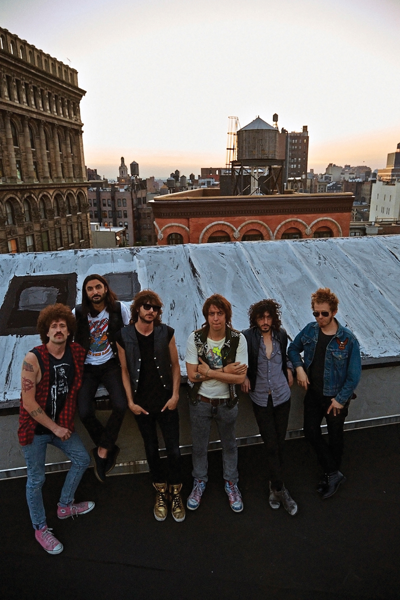
Sooner or later, any artist who achieves recognition faces the same conundrum: Change styles and risk losing the audience, or stick to the same formula and risk losing the audience just the same. It's been 13 years since Julian Casablancas struck a collective nerve right out of the starting gate as principal songwriter, arranger and driving force behind The Strokes, so he's had plenty of time to consider the fact that he's essentially damned either way. The Strokes' 2001 debut Is This It provoked such heaving praise from the music press upon its release that it retains mythic status to this day.
But if Casablancas does indeed envision himself between a rock and a hard place when it comes to his creative growth, he handles it with gleeful abandon on his new sophomore solo effort Tyranny (out via his own Cult Records under the handle Julian Casablancas and the Voidz). One thing you should know off the bat: If you're a fan of that signature Strokes sound — stripped-down, no-fat arrangements, pilfered Television riffs, lazy oom-pah grooves and an aloof vocal delivery that borders on disinterest — Tyranny may confound, even horrify you.
"We like a lot of stuff that's underground and out-there," says Casablancas, laughing at the suggestion that he was trying to confuse his fan base. "But the goal really was to try to make this music catchy and understandable. Maybe we can be the bridge between super-weird music that we love and music that's considered mainstream. But no, I wasn't reveling in confusing people, or trying to be weird for weird's sake. There's such a variety of things that people listen to, I'm surprised you can even make something where people go, 'Wow, this is so different.' "
Much like Stone Temple Pilots frontman Scott Weiland did on his flamboyantly expressionistic 1998 solo debut 12 Bar Blues, with Tyranny Casablancas ventures out on a limb far and away from the defined limits of his main band — precisely, perhaps, where an artist of this stature belongs. Last month, Casablancas dropped a huge hint of what was coming when he selected the 11-minute "Human Sadness" as the first track to premiere off the new album. Dirge-like yet majestic, "Human Sadness" unfolds more like a shape-shifting dream inside a cloud than a pop song — unthinkable under the regime of the concise pop song The Strokes came to embody.
Likewise, on "Father Electricity," Casablancas, The Voidz and producer Shawn Everett draw links between upbeat Ghanian highlife rhythms, Suicide, Zeppelin at their most progressive and Herbie Hancock's "Rockit." On "Johan Von Bronx," Casablancas melds Bono and Morrissey but drops both out of their element. Several times, The Voidz thrash out as if tossing punk and New Wave into the same washing machine and setting it on spin cycle. Meanwhile, Everett filters all that variety through a slew of abstract sonic effects. It's hard to believe, but the band recorded mostly live, which bodes well for translating Tyranny to the stage and no doubt contributes to its most shocking feature: that it gels into a coherent whole.
Clearly, Casablancas hasn't thrown his songwriting acumen out the window — just the restrictions he once imposed upon himself. Given to dramatic gestures, Tyranny still maintains an emotional directness and lack of pretense that bode well for Casablancas should he ever choose to compose for film or theater. At times, the album is pleasantly disorienting in a way that we should be hoping for in new music.
Says Casablancas, "So much stuff is boring nowadays, so I guess disorienting is a good thing."
Email music@nashvillescene.com.



