
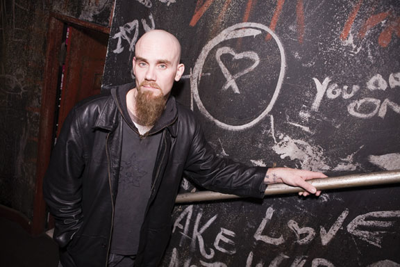
The rock spirit burns brightly in Nick Oliveri. The bald-pated musician with the long signature goatee and a predilection for onstage nudity, has offered his guitar, bass and/or vocals to plenty of noteworthy projects including The Dwarves, Moistboyz, Turbonegro, Mark Lanegan, The Knives, River City Rapists, and most recently, Slash's much-anticipated solo album. For the last dozen years he's fronted his band Mondo Generator, though he's perhaps best known for his contributions to Kyuss and Josh Homme's subsequent project Queens of the Stone Age.
His relationship with Homme began in 1987, when they were both still in junior high and started Katzenjammer, which eventually morphed into stoner rock progenitors Kyuss. Fueled by thick, deeply rutted grooves that move like molasses, they channeled the quaking bottom-heavy spirit of Black Sabbath, which served as the foundation for the pugilistic psychedelic guitar jams that have come to characterize the genre. He stuck around for their first two albums, 1991's Wretch and 1992's Blues for the Red Sun, before departing to join outrageous garage-punk troublemakers The Dwarves.
The Dwarves took a break in the mid-'90s, at which time Oliveri started his project Mondo Generator while living in Austin. Their loud, raunchy rock blends the garage-bred fury of The Dwarves and The Stooges with a glam-punk, hip-swinging strut. In town for SXSW in 1997, Homme happened upon Oliveri blowing fireballs and generally intimidating industry suits at a showcase unassociated with the festival. Homme invited him to move back to Palm Desert, Calif., and join QotSA for a tour supporting their unreleased (at the time) debut LP.
While retaining some of Kyuss' heaviness, Homme infused Queens with more pop song structure and a more adventurous, eclectic vibe that blended its muscular hard rock with samplings of garage, prog, punk and classic rock. Oliveri, who sings on several tracks, remained with the band as they shot to stardom behind 2000's Rated R and the even bigger Songs for the Death, which climbed into the Billboard Top 20 and went gold. (He calls it the best record he's ever been a part of.)
Everything blew up during a 2004 Australian tour. Homme's offered a variety of explanations for firing his longtime chum, from hinting that Oliveri hit his girlfriend to blaming excessive partying and alleged drug use. In 2005, Oliveri told Punk Globe: "He has said about 10 different things in 10 different mags. The fact still stands, I was fired right before the record advance for what would have been our next release came in."
The two are still apparently estranged, though Oliveri has continued to express a willingness to reunite with QotSA or Kyuss, putting the ball firmly in Homme's court. After leaving Queens, Oliveri moved Mondo Generator front and center. In 2006 they released their third album, Dead Planet in Europe, and it arrived in America a year later. However, they've been on hiatus the last couple years (if not completely done), and Oliveri has recently turned his attention to yet another act, Nihilistic Army, with whom he's recently been recording in Norway.
In October he released — of all things — an acoustic album, Death Acoustic, forgoing a band altogether, and supporting it with this ongoing tour. It's an odd choice for an artist whose pedigree was made with ribald, ball-busting rock and thunderous riffage. Though there's some folk-punk aggression in the strumming, and plenty of hardcore spirit in the vocals, it's difficult to escape the feeling that something's missing. Oliveri (who was not available for an interview before press time) told Ultimate Guitar this month: "I choose to approach acoustic in the same fashion I would electric: Full volume, screaming vox. The crowd won't know what hit 'em."
Email music@nashvillescene.com.



