
The Staple Singers' classic piece of reggae-tinged, gospel-soul sunshine "I'll Take You There" has never really left the public consciousness, thanks to things like Chevy ads, and David Hood's breezy, nimble bass line and soloing are a huge part of the recording's appeal. "I haven't played 'I'll Take You There' in many years," Hood says. "That's one of our bigger records."
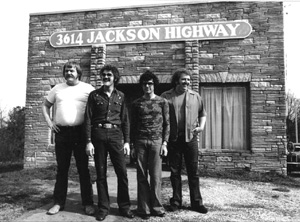
When he says "our," he's referring to the Muscle Shoals Rhythm Section (a.k.a. the Swampers), a legendary group of Alabama studio musicians rounded out by guitarist Jimmy Johnson, keyboard player Barry Beckett and drummer Roger Hawkins. Since the group used to nail a song on the first or second take and move on—an approach that endeared them to producers like Jerry Wexler—it's no wonder they don't have their parts from that early-'70s session memorized.
They'll want to start dusting off the cobwebs, though, since the Muscle Shoals Rhythm Section is being inducted into the Musicians Hall of Fame on Oct 28. "I'll Take You There" may have been a Staple Singers hit, but it was also a Swampers success. And that goes for hundreds of other recordings they played on from the late '60s until the mid-'80s, when Beckett left for Nashville.
Giving credit where credit is seldom given but certainly due (especially to studio bands that toiled behind the scenes in Muscle Shoals, Memphis, Detroit, New York, Los Angeles and Nashville) is exactly the point of the 2-year-old Musicians Hall of Fame and Museum.
"It does recognize the guys who are in the trenches, so to speak," Hood says. "That's why it appeals to me. I have worked with a lot of people who are inducted into the Rock and Roll Hall of Fame—a whole bunch of them. But I doubt if we will ever be in that. So this is great."
Rock and Roll Hall of Fame members Booker T. and the MGs—who doubled as Stax Records' house band and created soul instrumentals like "Green Onions"—and rock guitarist Duane Eddy are also being inducted this year. The common thread among the 2008 Musicians Hall inductees—which also include the Memphis Horns, The Crickets, Al Kooper and producer Billy Sherrill—is that they each made unmistakable contributions to pop music recording.
For Sherrill, it was a grand, string-swathed, countrypolitan production style that lured pop listeners to country; for Eddy, it was low, twangy, tremolo-heavy '50s guitar instrumentals; for The Crickets—drummer Jerry Allison, bassist Joe B. Mauldin and guitarist Sonny Curtis—it was pioneering the self-contained garage band prototype with Buddy Holly; for Kooper—at least to start—it was the unschooled yet infectious organ licks on Bob Dylan's "Like a Rolling Stone."
Booker T. and the MGs (keyboard player Booker T. Jones, guitarist Steve Cropper, bassist Donald Dunn and drummer Al Jackson) and the Memphis Horns (Wayne Jackson and Andrew Love) shaped an energized, organ-and-horn-laced Southern soul sound at Memphis' Stax during the '60s, while Hood and his cohorts—who owned their own studio, Muscle Shoals Sound—lent a more laid-back, Wurlitzer-favoring, distinctively Southern groove to R&B, rock, pop and country recordings.
"Now, looking back, there is a very distinctive sound, but we weren't really aware of it then," says Hood. "We really thought that we weren't putting our fingerprints [on recordings]. Because we wanted to sound like Rod Stewart's band when we worked with Rod Stewart or Aretha's band when we worked with Aretha or Paul Simon's band when we worked with Paul Simon. We tried to make each one unique. But I see that we still sounded pretty much the same."
Hood says Mavis Staples can't attend the ceremony, so somebody else will have to sing "I'll Take You There." (Maybe it'll be American Idol third-placer Melinda Doolittle, who's one of the special guests on the bill.) But Percy Sledge—who recorded "When a Man Loves a Woman" in Muscle Shoals—will be there. And so will other legendary voices from R&B, country and rock, including Eddie Floyd, George Jones and Phil Everly of the Everly Brothers and—even Keith Richards.
The current retro-soul revival notwithstanding, musical styles have changed a lot since the '50s, '60s and '70s, and so has studio recording. Gone are the days when a core house band—like the Muscle Shoals Rhythm Section, the Nashville A-Team, Detroit's Funk Brothers or L.A.'s Wrecking Crew (the latter three were inducted last year)—recorded together constantly and helped forge a distinctive and often regionally identified sound.
Hood—who's the father of the Drive-By Truckers' Patterson Hood and has played on albums by Bettye LaVette and Jason Isbell in recent years—knows those shifts as well as anybody: "When you hear music today, you don't know where it's recorded. It could be recorded in somebody's bedroom or it could be recorded in a penthouse in New York."
Hood was already asked to donate gear to the Musicians Hall of Fame and Museum, but there's a reason why he hasn't: "I still use my instruments. I'd feel kind of fake just going out and buying an instrument and giving it to them. That wouldn't really be the real thing."



