
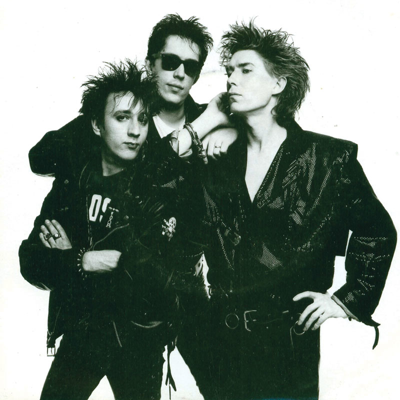

"I've never seen a Furs show, but I hear they're pretty good," Psychedelic Furs bassist and co-founder Tim Butler tells the Scene. "I've heard people who've never seen us before say that they didn't know we were such an aggressive, hard-edged band. And I think that's because we're doing Talk, Talk, Talk."
Talk, Talk, Talk, The Psychedelic Furs' 1981 sophomore LP — the one they are revisiting in full on their current tour — does feature perhaps their best-known song, the seminal "Pretty in Pink." But fans who come just to hear it can expect to get an overdue lesson in post-punk as well.
Having inspired John Hughes' genre- and era-defining 1986 teen dramedy of the same name, "Pretty in Pink" — which The Furs re-recorded for the film's soundtrack — draws a line in the sand for audiences who come to see the band. It, along with other Furs staples like "Love My Way," "The Ghost in You," "Heartbreak Beat" and "Heaven" — their "hits and near misses," as Butler jokingly characterizes, "the fun stuff" — are what will likely draw in the many 40-somethings who came of age vicariously through the Brat Pack.
But for those who stuck pins in voodoo dolls fashioned after Molly Ringwald, pinned Andrew McCarthy posters up on dart boards, dined on duck confit in effigy of Duckie and burned the midnight oil by making mixtapes of early Cure and Midnight Oil as part of their nightly Reagan Era teenage rituals — those are the folks who The Furs will spend the first half of the night catering to.
This is the interesting subterfuge that arises with acts currently touring the nostalgia circuit and the now de rigueur practice of performing their establishing LPs in their entirety. It forces longtime radio listeners to finally endure all those album cuts they've willfully, ignorantly or willfully ignorantly avoided for so many years. But in the case of Furs die-hards, that means being rewarded with rare performances of overlooked Talk, Talk, Talk gems like "I Wanna Sleep With You," "So Run Down," "It Goes On" and "She Is Mine" — each in the set list according to Butler, for the first time since the band originally toured in support of the record.
Songs like those, the warped, horn-infused dirge "Dumb Waiters," and the still-thrilling "Into You Like a Train" — which, in addition to having as badass a title as an angst-ridden, anthemic love song could ever hope to have, really should've been as big a radio staple as "Love My Way" was a year later — are where Butler says casual fans find themselves feeling "nonplussed" while they await the set of heavenly New Wave hits he promises will follow.
"When we wrote [Talk, Talk, Talk] we were angry young British rockers who wanted to take on the world," says a chuckling Butler. Notice he said "young British rockers" and not "young punks." There is a difference. Though Butler, along with brother/singer Richard Butler, guitarists Roger Morris and John Ashton, drummer Vince Ely and saxophonist Duncan Kilburn — the latter three of whom are not in the current Furs lineup — did form the band at the height of punk in the late '70s, they were equally influenced by sleeker-sounding Brits like Bryan Ferry and David Bowie, as evidenced by the album's and producer Steve Lillywhite's lush conflation of sax, synths and compressed guitars. "I like to think of our sound as like a melding of The Sex Pistols and Roxy Music," says Butler.
And indeed, John Lydon's sneering cues and The Furs' own anger and youth do pervade Talk, Talk, Talk — which, to this day, leaps off the decks with a nervy, palpable urgency. But while it's the world at large Butler says the band targeted with their angst and aggression, it was personal relationships, love, lust and loss — rather than abortion, garbage strikes, record label woes and The Queen — that they hit right in the heart. Talk, Talk, Talk is a record rife with the frustrations of adolescent heartache — the kind that makes the world seem as if it might as well be ending when love, or at least belief in love, runs cold.
Simply put, it's all pretty emo. Take for example lines like, "Talk about yourself again, talk about the rain again / Another lie for you, another point of view / How can you believe in them? Don't believe in anything" from "No Tears," or a couplet like "Movie stars and ads and radio define romance / Don't turn it on, I don't want to dance" from "Mr. Jones." What makes said stanzas stand the test of time, keeping them from aging like the worldviews of the band and their fans, is the cool vocal delivery of Richard Butler.
"I think it's one of the most distinctive voices in music," Tim Butler says of his brother. "You can't mistake it, just like you can't mistake Morrissey, or Bono." Long the band's secret weapon, and the most defining feature of their sound, Butler's raspy, gravel-chugging British tenor saves his sentiments from the histrionics that usually plague such subject matter, transcending their callow context, and allowing them to mean, really, whatever the listener wants them to mean. And, at 55, Butler's unmistakable croon sounds as if frozen in time — 1981, to be exact.
So, do you want to dance?
Email music@nashvillescene.com.



