
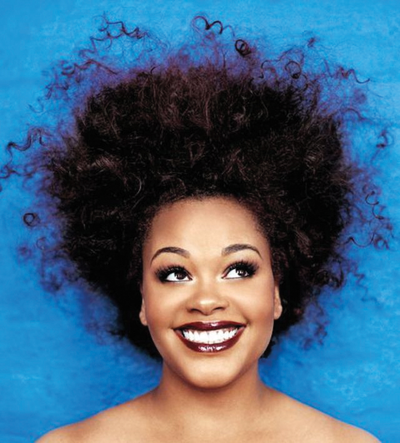
Jill Scott will forever be associated with Philly, where she grew up, frequented poetry slams and fell in with kindred spirits The Roots more than a decade-and-a-half ago. Since December, though, she's been living somewhere in Tennessee. (That's as specific as she'll get, except to say that it's a small enough place that she "can talk to my neighbors or strangers about nothing. ... They don't know who I am, and I love it.")
But Scott's happy to talk about how she recorded roughly "68 percent" of her new album Woman in Nashville with collaborator Aaron Pearce. The 16-track set is poised, poetic and empowered, not to mention streetwise, sensual and sophisticated — at home in a catalog that's placed Scott in the Essence Fest-friendly pantheon of beloved grown-up neo-soul voices.
The singer-songwriter and actress spoke with the Scene about finding an unexpected source of inspiration in country radio, choosing live bands over programmed beats and recognizing what's at stake whenever she speaks her mind on topics like the Bill Cosby rape allegations.
You've talked in other interviews about your interest in exploring connections between soul, hip-hop and country. What were you after on this album? I've always found country music to be really soulful, and I love the art of storytelling. I believe hip-hop was intended to tell stories as well. And the best R&B music always has a great story to tell. So I thought, "Hmm, since I like these genres and I find them [to be] so close together, like they're family, I might as well bring them together for kind of a family reunion."
In mainstream country music right now, there are a lot of acts borrowing liberally from hip-hop and R&B production styles. What you're doing strikes me as being very different from that. I mean, I suppose so. I just like the simplicity of country music. I like live instrumentation. ... I was in Nashville working with Aaron [Pearce]. Listening to the radio, I heard all these simple stories about trucks, or simple stories about handholding, or, you know, a bottle of beer. And I thought, "That's so human." ... A lot of R&B or hip-hop, it tends to talk about the things that surround our humanity, but not the actual humanity so much. I'll say [that] particularly for hip-hop; R&B tends to talk about love and relationships. And I thought, "I'll take the simple, simple storytelling of country music, add the passion and soul of the Philadelphia soul sound, and I'll take some beats from hip-hop, and I'll mix it together and see what I get."
There are tracks on this album, like "You Don't Know," that have roots in earlier generations of R&B or soul. What's the appeal of reaching back for you? I reach [back] because I think some of the best music is behind us. We had artists that would sit in one room, have the entire band in there rehearsing and rehearsing, then hit record. There's a certain honesty involved in it. When I listen to a song like "You Don't Know ... " — originally performed by Carl Hall — I know that everybody's in that room, and I know that there's this gut-wrenching passion and sincerity that's involved in it. ... Now do I enjoy hip-hop music, and do I enjoy [what] I call "button pushing"? I do, I do. Everything has its place. So I added some of that button pushing and sampling and mixed it with great storytelling and instrumentation that feels honest. I wanted to make sure that everything that's played is played for a reason. ... My hope is to tell stories and have people actually listen — really listen.
Some of the songs on this album, like "Prepared," have almost a straight-out-of-the-journal tone to them that somehow doesn't feel isolated from others' experiences. As a songwriter, do you see yourself as being in conversation with a community? Always. I never ever feel like I'm alone in any thought or feeling. There's too many people. Somebody somewhere can relate. Somebody somewhere understands. Somebody somewhere gets it.
You discussed single motherhood in an Ebony magazine cover story and weighed in about the Bill Cosby saga on Twitter. How do you feel about that aspect of being a public figure? It can be tough, I'll put it that way. It can be tough to be a person who believes in her right to have an opinion. I believe I'm allowed. I know that nobody else is walking in my shoes, and they may not be able to relate to what I'm saying at all. ... That's art — I'm an artist. My perspective is not going to be everyone else's, but it's valid.
Recently people have paid a lot of attention to your responses to the Bill Cosby scandal. What were you trying to contribute to the conversation? My point of view. Everything is so simple when you're not invested, when you don't know the person, when you don't love them. Everything is so simple and black and white. But when it's your son that's on death row, people may not be able to understand how it could be that you could still love them. You understand? I can't even begin to explain how many ways I've been inspired by Bill Cosby. I can't. I'm from North Philly. ... And currently my father is going through dementia. So I'm losing my father in front of me, and I'm losing a father figure in front of me. ... I never put that man on a pedestal, but I respected him.
I've noticed in this business that the love that people say that they have is like water — as soon as something gets hot, it just evaporates. So I take it all with a grain of salt. I appreciate the people who appreciate me. I thank them kindly and sincerely for being supportive these last 15 years. And as an artist to have an outlet to be creative, which is my passion, is just a gift.
Email Music@nashvillescene.com



