
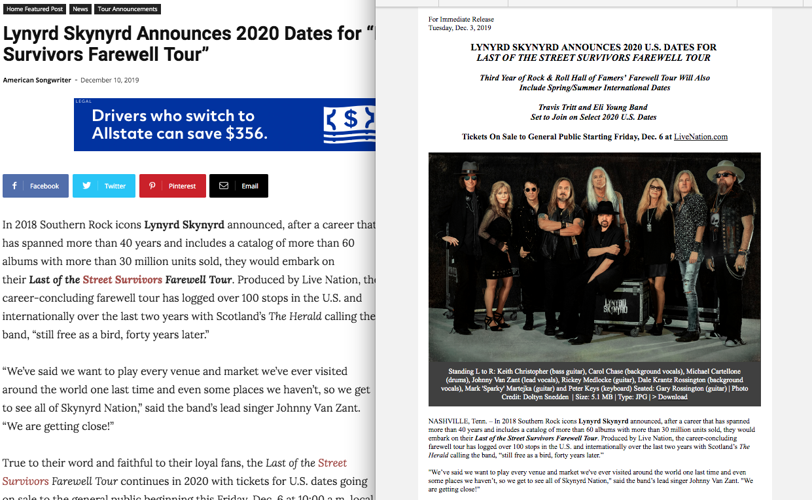

Have you guys noticed the weirdness over at American Songwriter’s website? If you’re active on Twitter, there’s a decent chance that you have, but in case not: The digital side of the 35-year-old Nashville magazine covering the songwriting community seems to have gone completely off the rails in the past several weeks. Besides running recycled content through its social media like a cartoon miner trying to find a gold tooth he swallowed, the website appears to have given up on journalistic integrity. A cardinal J-school sin has been committed: Press releases are being run in the newshole — for the non-journos in the audience, that’s the space in a publication reserved for actual news — unattributed and unacknowledged.
That’s no fault of the publicists who send out an avalanche of releases every day. When a publication runs them with identification, they’ve at least made the distinction that the pieces aren’t an earnest expression from a writer or editor. Sponsored content or native advertising is a whole separate issue, regulated by the Federal Trade Commission — and one to which the current online presence of AS treads dangerously close on occasion.
Making the jump to posting these pieces as if they’re true editorial content is a sad and disturbing move from the viewpoint of anyone who has trusted the writers and editors at the magazine. I'm a longtime contributor to American Songwriter, and I have to admit it’s frustrating to know that my work is now surrounded by press releases masquerading as editorial copy. I’m aghast to know that 10 years' worth of my writing is now tainted by lazy, dishonest policy decisions beyond my control.
The most infuriating instance: Someone has taken my old work, stripped it of context and repackaged it to make some cheap and slimy clickbait. I wrote this piece on Ryan Adams in 2010. (You can tell by looking at the timestamps on the comments.) I was a cub reporter, and 50 bucks to rank someone’s catalog — even someone whose music I thought was bullshit — wasn’t something to sneeze at. It was not the sort of thing I expected to haunt me years later.
In October, the article was given a new published-on date and a new title. It’s still pretty clear from the body of the piece that I don’t like his work, but this presentation of the content as new makes me look like I’m too dumb to acknowledge a decade’s worth of new releases, as well as too callous to acknowledge that Adams was outed as an abuser in an extensive New York Times report. The fact that some content-management jockey has bent my work to look like a tacit endorsement of Adams has me fuming.
But why is a venerable institution like American Songwriter suddenly reverting to shitty content strategies? Fucked if I know! The editor I worked with for almost a decade, Caine O’Rear, has not been editor-in-chief nor part of the decision-making process for the digital operation since October. He’s currently working on a contract basis to help with the January-February print edition, and after Dec. 20, he will no longer be affiliated with the magazine. Brittney McKenna, who was the mag’s associate editor and is a frequent freelance contributor to the Scene, resigned in October. My attempts to reach out to the new editorial team have so far been met with silence.
I do know that a new ownership group took over in September, and that they have not reached out to longtime contributors about any changes. New publisher Savage Media Holdings is headed by Sam Savage, formerly part of the publishing team behind personality-devoid, SEO-pandering online pubs like PopCulture.com and ComicBook.com.
My theory is that the new owners are going to just strip and flip American Songwriter, cutting operating costs to the bone and selling it off before ad revenues crater. It’s the sort of strategy that is very popular in media C-suites around the country, especially when private equity firms get involved (see: Deadspin), and it was only a matter of time before the practice intruded on the happy little media bubble we have in Music City.
If American Songwriter’s new owners are intending to keep the print edition growing and expanding the magazine’s digital footprint, they are going about it in the worst possible ways. But then again, there is more money to be made from the SEO shell game than from honest reporting and criticism — so why bother, right?
Music journalism isn’t the most important of vocations, but it is a vital part of our cultural conversations. Regardless, financial support for it has been declining steadily over the past 10 years, with publications and music sections withering and dying at every turn. During his tenure, O’Rear cultivated an incredible crew of writers and fostered an engaged and empowered audience against all the odds. To see one of the last outlets with both an audience and integrity turn away from both is just dispiriting. It is a shame to see that fine work come to such an ignominious end — to see a legacy strangled beneath a pile of press releases.



