
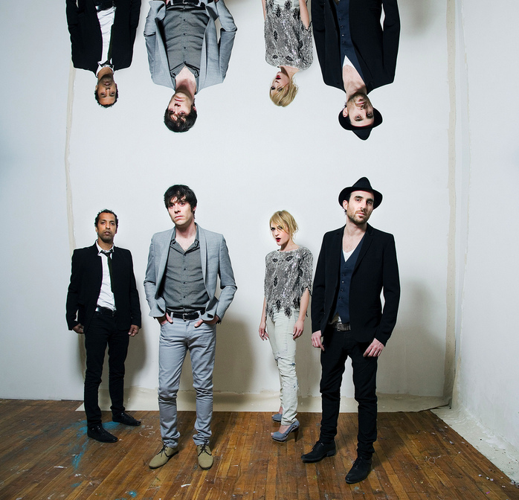



Jimmy Shaw (left), Joules Scott-Key, Emily Haines and Joshua Winstead
Well-established Canadian indie rockers Metric are headed back to Nashville on Friday, co-headlining Marathon Music Works with Mexican group Zoé (whose LP Aztlán just won the Grammy for Best Latin Rock, Urban or Alternative Album) and supported by fellow Canadians July Talk. Metric was here not that long ago, at Bridgestone Arena in July supporting the Smashing Pumpkins’ reunion tour. They followed that run with a new album, Art of Doubt, and a headlining tour of Europe.
The new LP is their seventh studio album since forming two decades ago, and the prominence of guitars is something we haven’t heard from Metric since the early days. The refined, guitar-heavy sound is the result of a decision by co-founder Jimmy Shaw. After serving as both guitarist and producer for many Metric records, Shaw handed production to studio wizard Justin Meldal-Johnsen (among his many credits, probably best known for his association with Beck) and focused entirely on his role in the band.
We caught up with Shaw over the phone following the first show of the tour. He talked about his choices and growth as a guitarist, what Metric does to stay fresh and his new “’70s guitar-mania guy” stage presence that he says will make me laugh.
How'd the first show in Cleveland go?
It was good! The first show of the tour is always kind of just throwing it to the wind and seeing what happens, but it was great. It can't not start a little rough around the edges, but I think probably only we notice that kind of stuff, and it was a great crowd.
How's it been getting back into things after time with the Smashing Pumpkins?
We did a European tour in the fall and about half the tour was countries we'd never played before, so they were pretty small venues. We've done so many different-sized shows over the course of our career that it's not a big shock to us. It used to mess with our heads more when we were starting out and trying to adapt to different situations. I think now we just kind of know what our show is and what we're capable of, and to be honest with you, we kind of just do the show regardless of how big the room or the stage is.
I know that with Art of Doubt you got to step back into full-time guitar mode and out of the production seat. What made you make that choice, and how did it work out?
When we were doing the demos for this record, Emily [Haines] and I were at my studio and we were writing, there was a part of me that was like: “OK. I know what going into the production entails for me. I know how much responsibility it is. I know how much work it is and I know how much it separates me from the band.” There's something about that, that I just didn't wanna do. I really wanted to be in the band and have the same level of responsibility as everybody else.
If life happens to me and I can't show up to the studio until 4, it doesn't mean that nothing can happen until 4, you know? I think over the last couple of years, I'm trying to sort of go through a slight paradigm shift where my surroundings don't rely on me as much. That was kind of the beginning. When we called Justin [Meldal-Johnsen] and asked him if he would be interested, his first question was, "Why am I here?" knowing that there's a built-in producer in the band. I was like, “I just don't think I can do it anymore. I think I need to be a part of the band. I think I need to join the other three and be able to be over on the other side of the glass with them, musically and emotionally.”
And he totally got it, and facilitated that. Then, what I think ended up happening was that the instrument that gets put in my hand is the guitar, and all the sudden I have like 80 percent more brain space and 90 percent more time. All of a sudden, I was playing the guitar. We had this running joke with the guy who had mixed all of our records prior to this one — a guy named John O’Mahony — that the first thing he does when he sets up to mix a Metric record is set up a guitar amp. When I'm producing a record, I never play guitar! We go to the mix studio and it's like, “Dude, where’s all the guitar?” I always just put it as the lowest priority and then had to do it all at the end, whereas this one wasn't like that. It ended up being more of a guitar record because I just wanted to go back and be a part of the group. Instead of being behind the console, I wanted to be in the live room.

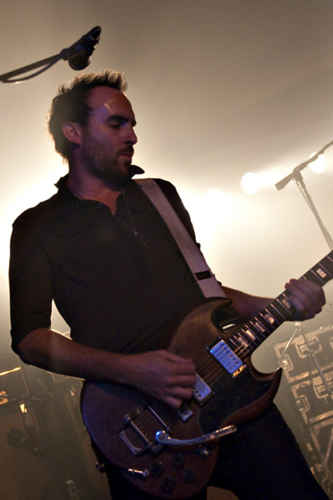
Jimmy Shaw with Metric at Cannery Ballroom, 10/13/2010
Is that something that you think carries over in your band dynamic out of the studio? Has it impacted the performance since you've gotten back in that role?
I'm a better guitar player than I was two years ago, I definitely advanced in the instrument. I don't really consider myself a very technically adept guitar player. I think that there's an interesting thing with the guitar, especially because there are so many people that play the instrument and there are so many people that can literally shred circles around me — but do it as a hobby. For me, I've never really felt the need to become some super-shredder, Steve Vai, kind of guitar god. I just use the guitar to express the music that I want to express. I think it’s changed the live show a little bit. It's a little bit more guitar-centric. I mean, if you come to the show in Nashville, you'll laugh because the guitar amps are just mammoth. I made this giant guitar rig that looks like I'm some ’70s guitar-mania dude, which is really fun. I probably wouldn't have done that five years ago.
I've heard y'all talk a lot about how important it is for Metric to not get stuck in the past and become a nostalgic band that'll be definitive of one era. What do you do to try to keep that timelessness about you?
That's a good question, and I don't really know the answer. I guess the idea is that if your mind stays fresh and you stay true to what you wanna be doing, and what doesn't make you bored, and what doesn't make you self-conscious, then you'll stay fresh. I never really was that concerned about what we were doing, and how it was gonna fit, and whether people were going to like it or not.
I feel like one of the things I learned early on was that I think our audience is expecting us to be true to ourselves and really nothing but that. When we want to try something, we try something. I think that the minute we start making music that we think is going to work for a certain part of our fan base, we'll probably start to lose the plot. I feel like when you're doing that, you probably shouldn't make a record right then. If you don't have anything to say and you're sort of just thumbing through a recipe book to make a new record, you should probably just wait until you're hungry.
You’ve spoken before about how much you dislike it when bands play shows that only feature their newest record and how Metric doesn’t and won’t do that. But with so much material, what is it like deciding what makes the cut for live shows?
I mean, it definitely gets harder after each record. Now, that there's, what, seven records or something? It definitely gets harder. But I find that thing of rewarding your fans with their favorite song after 17 new songs is so irritating. I've left so many concerts because even legacy bands just refuse to play the hits. Why would you write a good song if you refuse to play it for the next 25 years? It's so stupid! So, for us, we're just trying to balance out what would make the best show in the moment.
But things are different according to time or place. When we were on the European tour, the last show was in London and we did this long setlist and I think it was one of our favorite Metric shows in memory. We really came at it saying, ‘I really think that is the perfect setlist.’ Then, we started rehearsals with the same setlist five or six days ago for this tour and it didn't feel the same. It's weird how that happens. Only three months have passed, but it’s a different continent, and it’s a different part of the world, and it’s a different year, and we're different. It just didn't feel the same.
So, we're just trying to pay attention to what would actually be the most successful, fun, banging evening for everyone involved: us, our crew, and every single fan who buys a ticket. We all have to have the best time possible. There's a medium, and when performer and audience are equally having the time of their life, the whole thing just elevates and becomes this completely spiritual experience — which is entirely the goal.



