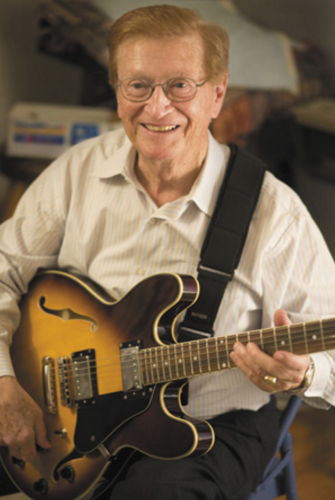


Harold Bradley, who died today at age 93 at Vanderbilt University Medical Center, played guitar on many of the Nashville recordings that established the city in the 1950s and ’60s as one of the world’s great centers of pop music. In an era that saw Nashville’s old-time country evolve into what we would now call countrypolitan, Bradley was a musician whose contributions were essential to that evolution. Bradley’s light touch and feel for what worked in the context of a tightly controlled recording session defined one aspect of the Nashville Sound, a style of accompaniment that respected, above all, the primacy of the song.
With his brother, producer Owen Bradley, Harold began in 1954 one of the city’s most famous recording facilities, the Quonset Hut Studio at 804 16th Ave. S. Originally called Bradley’s Film and Recording Studios, the Quonset Hut was, quite literally, an Army surplus Quonset hut the brothers attached to the house they were converting into studio space. When their recording business began to outgrow the house, Harold and Owen Bradley moved it into the Quonset Hut. Harold played on many of the now-classic hits that were cut there, including Patsy Cline’s “Crazy” in 1961 and Tammy Wynette’s “Stand by Your Man” in 1968. (Today, Belmont University owns the Quonset Hut, which is housed in a facility at 34 Music Square East. The Bradley brothers were also part of the group that built RCA Studio A.)
Provided to YouTube by Ingrooves
Crazy · Patsy Cline
The Incomparable Patsy Cline
℗ 2017 Emerald
Released on: 2017-01-01
Composer: Willie Nelson
Auto-generated by YouTube.
Bradley, who was a largely-self taught guitarist, brought a clean, understated simplicity to his studio work that meshed perfectly with his brother’s vision of universally appealing country pop. As you can hear on Harold’s 1963 solo album Bossa Nova Goes to Nashville, he never played an extraneous note. Bossa Nova Goes to Nashville contains no bossa nova tunes, which makes it an exemplary product of ’60s Nashville. Listen to Bradley’s playing on the record’s “Walk on By.” It’s tasteful, but just slightly inflected with down-home bluesiness.
Provided to YouTube by Sony Music Entertainment
Walk on By · Harold Bradley
Bossa Nova Goes To Nashville
℗ Originally released1963. All rights reserved by Sony Music Entertainment.
Released on: 1963-12-31
Co- Producer: Don Law
Co- Producer: Frank Jones
Composer, Lyricist: Kendall Hayes
Auto-generated by YouTube.
He was born in Nashville on Jan. 2, 1926. He took up the banjo when he was a child, switching to guitar at the behest of his brother. He toured with Ernest Tubb while he was still in high school, served in the Navy, and upon his release from the service in 1946 began playing guitar on the Grand Ole Opry, backing future country superstar Eddy Arnold and singer Bradley Kincaid. He left the show when Arnold did, and in 1947 lent his skills to recording sessions at Castle Studio, which operated in the Hotel Tulane on Eighth Avenue North. It was the city’s first major recording studio, and Bradley contributed his distinctive rhythm guitar to the November 1949 recording session that produced Red Foley’s massive 1950 hit “Chattanoogie Shoeshine Boy.”
Bradley went on to play on thousands of sessions, and his credits include Lefty Frizzell’s “Long Black Veil” in 1959, Roy Orbison’s “Crying” in 1961 and John Anderson’s “Swingin’,” cut in 1983, long after countrypolitan music had been supplanted by such movements as Outlaw country. Bradley was inducted into the Country Music Hall of Fame in 2006, and he served as head of the Nashville chapter of the American Federation of Musicians from 1991 to 2008. Earlier this month, Belmont University established a scholarship in Bradley’s honor, the Harold Bradley Endowed Scholarship, which will be awarded to freshman guitar students in the school’s College of Visual and Performing Arts.
Provided to YouTube by Sony Music Entertainment
The Long Black Veil · Lefty Frizzell
Look What Thoughts Will Do
℗ Originally released 1959. All rights reserved by Sony Music Entertainment
Composer, Lyricist: M. Wilkin
Composer, Lyricist: D. Dill
Producer: Don Law
Auto-generated by YouTube.
He kept playing and recording in his later years, taking over from Owen Bradley as producer of country singer Mandy Barnett’s 1999 album I’ve Got a Right to Cry after his brother died during the recording process. Barnett’s album is one of the great late moments in the history of countrypolitan music and the so-called “Nashville Sound” that the Bradley brothers were instrumental in creating. He helped make hits, and he had a unique understanding of how the process worked. As he told journalist Tim Ghianni, writing for the Tennessee Ledger in 2016: “Most people want to embellish their careers and gild the lily. I just want to tell it like it was.”