
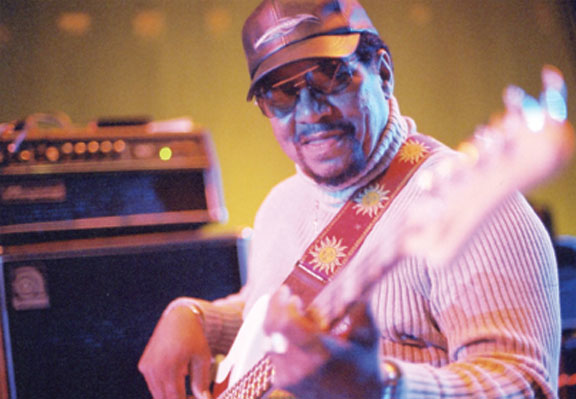
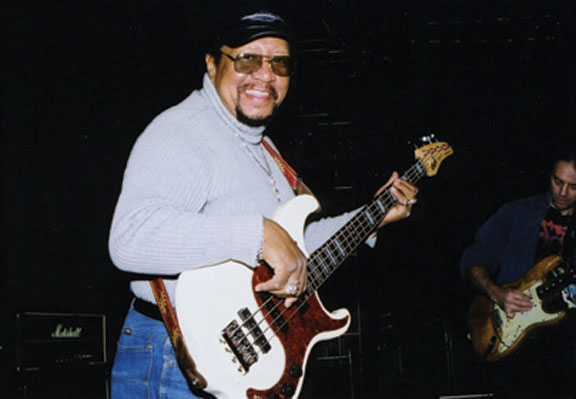
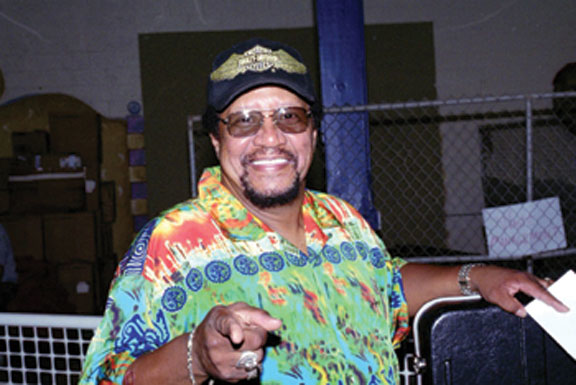

The year was 1961, and Billy Cox ducked into a service club near Fort Campbell, where he was stationed with the Army. There, onstage, was another soldier playing guitar. Cox, just 20, was himself an exceptional bassist, but this guy onstage — man alive. Cox was bowled over. After a quick introduction, the two became fast friends and musical collaborators and remained that way for nine years — until Cox received word that his friend, Jimi Hendrix, had died. He was only 27.
Billy Cox's personal relationship with Jimi Hendrix ended on a September night in 1970. But his professional relationship with the Prometheus of rock guitar has never really ended. They started together as scuffling musicians on Nashville's Jefferson Street R&B circuit, playing in a combo called the King Kasuals and gigging at clubs such as the long-gone Del Morocco, where Hendrix once famously walked 30 feet into the crowd soloing — a taste of things to come. Hendrix went overseas to Europe and stardom, while Cox gigged at home. But the two never lost touch, and when Hendrix made his iconic appearance at Woodstock, the man playing bass beside him was Billy Cox.
Over the 40 years since, Cox has remained a vital part of the Hendrix legacy, from his appearances on various posthumous projects to his participation in the current Hendrix Experience tours. This year, he'll be joined by such ardent Hendrix admirers as Joe Satriani, Eric Johnson, Kenny Wayne Shepherd and Jonny Lang.
Now Cox, a longtime Nashville resident, is prominently featured on the new release Valleys of Neptune (Legacy), the first in an ongoing series of items being issued as part of an extensive new contract with Sony signed by Hendrix's stepsister Janie. Released along with it this week are sparkling reissued versions of Hendrix's three studio albums, Are You Experienced, Axis: Bold As Love and Electric Ladyland — the last of which is the only double LP Hendrix issued during his lifetime, and the only one of his titles to reach No. 1.
With former Hendrix bandmates Noel Redding, Mitch Mitchell and Buddy Miles deceased, Cox is keenly aware of his position as a keeper of the Hendrix torch. Impassioned and thoughtful, Cox detailed his feelings about many things in regard to Hendrix during a freewheeling recent interview that began with Valleys of Neptune, but thankfully wasn't restricted to that disc.
"The first thing that's really important when it comes to me and Jimi Hendrix is the fact we were friends," Cox says. "We did everything together — bowling, hanging out, just talking with each other. He was totally about music, and he was also the most brilliant person I've ever been around when it comes to almost any subject. I used to say he came from a portal to another galaxy. He was so more advanced in so many areas than someone in their 20s."
Cox and Hendrix became familiar faces in Nashville's vital R&B scene of the 1960s, where giants ranging from Etta James to James Brown brushed shoulders with obscure local talents. Back then Hendrix had an apartment above a beauty parlor next to the Del Morocco and was a common sight in Jefferson Street's clubs. But it was clear even then that he heard a signal from the future. The late WLAC DJ Hoss Allen used to tell how Cox, a sought-after session player, had convinced him to hire Hendrix for a run-of-the-mill recording date — only to have the future guitar god drive him to distraction with his psychedelic riffage.
Hendrix, Cox explains, wasn't just a brilliant instrumentalist. "He was a bandleader, a composer, an arranger, a soloist and a singer," he says. "He excelled at all of these, was a genius in every facet when it came to music."
As a result, he's also been the subject of endless theory, conjecture, gossip and urban legend. Cox is less than thrilled with many of the stories that have circulated over the years and most of the books written about Hendrix. He refuses to validate or verify the tales about "cutting" contests in North Nashville clubs involving Hendrix and various local guitarists, or disputes that reportedly occurred on bandstands during visits from R&B and soul luminaries.
"You should only believe about 25 percent of the things that have been written about Jimi over the years," Cox says. "I don't even want to talk about the stuff that happened when we were playing here in Nashville together. For one, I'm writing my own book and I'm going to set the record straight with it. For another, there are people who have deliberately exaggerated things or made up stuff, and I don't want to get into a thing of constantly answering whether this story or that story is true."
Cox has not relished being hounded for the past four decades by biographers, acolytes and amateur rock historians. For many years, he was content to run a Nolensville Road pawnshop, a legend hidden in plain sight while the history he made loomed all the larger. But when he starts to talk about Hendrix, it's clear that he's protecting the man he knew — and the experiences they shared — from the garbled mythology.
"I'll tell you this," Cox says, "Jimi did ask me to go with him overseas when he finally got his big break, and I told him at the time, man, I got three strings on the guitar. We stayed in touch and later he did send for me. We reunited and that period was unforgettable."
He refutes notions that many of Hendrix's finest studio performances resulted from jam sessions rather than preparation. "Jimi and I would talk about music all the time, and I mean, in great detail," Cox says. "He'd work out arrangements beforehand, then when we got in the studio he would expand it.
"I remember there were times in the hotel where he'd just get up at 2 a.m. and start writing stuff down. I'd call that automatic writing. Sometimes he wouldn't even seem like he was totally awake. The next morning there would be three new songs written down, all of them complex and amazing. There would be times in the studio where I had to bear down and not get carried away just hearing the stuff that Jimi was producing on the guitar. That guy's genius on the instrument really can't be overstated.
"Many times we'd put a song together off a riff or lick that I was just experimenting with," Cox adds. "That's how 'Dolly Dagger' got written. I was fooling around with a bass line, playing in the street, and Jimi heard me and yelled out the hotel window, yeah, keep on playing that. Then he began adding his own licks and melody things on top and we kept building till we got 'Dolly Dagger' out of it."
As for the Band of Gypsys, the celebrated funk-rock trio featuring him, Hendrix and drummer Buddy Miles, Cox says it was formed simply because "Jimi had gotten himself into a financial bind with a contract he'd signed that wasn't exactly the greatest. He needed to work and do some things in a hurry that would make some money. So we got together and did the album and toured. It was a wonderful experience, but that's the real reason why that band was formed."
Today, Cox's steady, propulsive bass work can be heard on both singles released thus far from Valleys of Neptune, which contains seven unreleased Hendrix tunes plus other songs culled from previous releases. His playing adeptly fulfills the instrument's traditional rhythm role while simultaneously providing dazzling moments throughout. Cox smartly layers his lines underneath Hendrix's slicing guitar licks on the title tune, while he both drives and frames the lengthy solo and vocal on "Bleeding Heart," Hendrix's jagged cover of an Elmore James signature number.
Cox is also among Hendrix band members and studio/technical figures who contribute interviews and commentary to the making-of DVDs that accompany the CD reissues. Besides Valleys of Neptune and the Band of Gypsys LP, the list of other Hendrix albums featuring Cox includes South Saturn Delta, Live at Woodstock, Live at The Fillmore East, Nine to the Universe and First Rays of the New Rising Sun, the release that came from Hendrix's final sessions. To see them together, check out DVDs such as Live at the Isle of Wight 1970, Live at Woodstock, Rainbow Bridge, and footage from a guest appearance on a broadcast of The Dick Cavett Show.
Since Hendrix's death Cox has continued working with an array of musicians, among them Charlie Daniels, Bruce Cameron and Stevie Ray Vaughan. Inducted last October into the Musicians Hall of Fame, Cox forges ahead. His forthcoming new CD will appropriately be titled Last Man Standing. He also continues work on the book he hopes will correct misconceptions and bogus stories about Hendrix.
Though he enjoys some current players, Cox has no illusions another Hendrix will come along anytime soon.
"There's only two types of guitarists around today," Cox says. "There are those who admit being influenced by Jimi Hendrix, and those who try to pretend they aren't. We will never again see anyone like him, and I was blessed and privileged to know him and have played with him for the time that I did."
Email music@nashvillescene.com.



Post a comment as anonymous
Report
Watch this discussion.
(0) comments
Welcome to the discussion.
Log In
Welcome to the discussion.
Keep it clean. Please avoid obscene, vulgar, lewd, racist or otherwise abusive language. Comments featuring hate speech or threatening or violent content will not be tolerated.
PLEASE TURN OFF YOUR CAPS LOCK.
Be truthful. Don't knowingly lie or mislead.
Be proactive. Use the “report” link on any comment that violates our comment policy.
Share with us. We'd love to hear your feedback.