
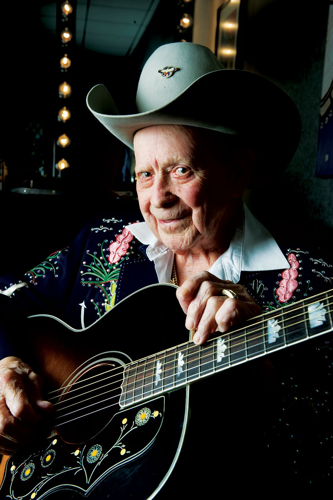
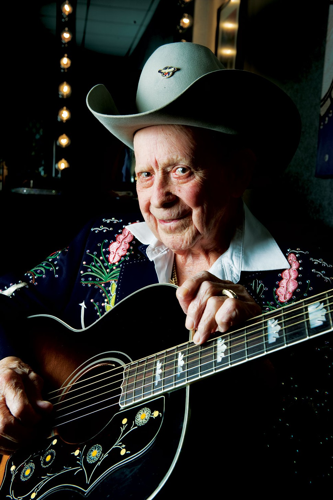

Eight days after suffering a stroke, and just two weeks after his 94th birthday, Grand Ole Opry star Little Jimmy Dickens died of cardiac arrest this afternoon in a Nashville-area hospital.
In a career that spanned more than 65 years, Little Jimmy Dickens played many roles — radio host, hillbilly boogie evangelizer, cornball comedian, master of heartstring-tugging ballads and more. As a member of the Grand Ole Opry, he matured into a country music icon, a living embodiment of country music’s hillbilly pride, medicine-show flash and rollicking vaudevillian humor. When he celebrated his 94th birthday with his last appearance on the Grand Ole Opry on Dec. 20, he still stood tall as a living embodiment of country music’s long and rowdy history.
James Cecil Dickens was born on Dec. 19, 1920, in Bolt, W. Va. Dickens was the oldest of 13 children, and the dangerous life of a coal miner seemed his only option in the small community where he grew up. But with his natural-born talent and boisterous personality, he escaped from a life of hard toil and coal dust. Dickens began performing at an early age as “Jimmy the Kid,” and by the late '30s, he had his own radio show on station WJLS in Beckley, W. Va.
Over the next few years, Dickens worked his way up in hillbilly music through radio appearances and live performances. Standing only 4-foot-11-inches, he had no qualms about billing himself as “The Singing Midget” in those less-than-politically correct times. By 1948, he was performing on WKNX in Saginaw, Mich. — a city with a thriving hillbilly music scene thanks to migrant Southerners who were drawn north by a booming auto industry. It was there that he crossed paths with Roy Acuff, “The King of Country Music.” An invitation to Nashville for a guest shot on the Grand Ole Opry and a recommendation to Columbia Records quickly followed, and Dickens made good on both.
It was at Dickens’ first two sessions for Columbia in 1949 that he recorded songs that changed the course of his career. “Take an Old Cold 'Tater (and Wait)” and “Country Boy” were expressions of pure hillbilly pride brimming with Dickens’ brassy personality. Until that point, Dickens was primarily a ballad singer, even though he occasionally cut loose with comedy onstage. With the success of two up-tempo novelty songs, Dickens went looking for a road band that could deliver the beat. He found it with a group of young Nashville players who had just been handed their pink slips by their previous employer.
Paul Howard was a Western swing band leader who had been a regular on the Opry since 1940. In 1949, he left Nashville for Texas, leaving several members of his band behind — including the formidable trio of Robert “Jabbo” Arrington and Grady Martin on twin electric guitars and bass player Bob Moore. Dubbed the Country Boys, that trio, along with Walter Haynes on steel guitar and Red Taylor on fiddle, set the template for Dickens’ new sound — fast, driving tempos propelled by lightning-fast pickin’. This new sound debuted on record in early 1950 with another manifesto of rural hubris, “Hillbilly Fever.”
Although Martin and Moore soon moved on to other jobs — eventually becoming two of the original members of Nashville’s “A-team” of crack studio musicians — Dickens continued to hire top talent that emphasized a driving beat and blistering guitar work, employing a who’s who of pickers including Kenneth “Thumbs” Carlisle, Jimmy “Spider” Wilson, Howard Rhoton and steel guitar master Buddy Emmons. No matter what the lineup, The Country Boys established a reputation as one of hottest hillbilly bands on the planet, and Dickens followed up with a string of great recordings — “Out of Business,” “I'm Little But I'm Loud,” “Out Behind the Barn” and more — that set the stage for the rise of rockabilly.
Dickens’ live appearances were even more influential. The Country Boys barnstormed across the South playing one-nighters in school gymnasiums, dance halls and civic auditoriums, where many an aspiring hillbilly picker was first exposed to the hot sound of electric guitars. One can’t help but wonder just how many flat-top acoustics were traded in for the latest Gibson or Gretsch electric after one exposure to the twin guitar attack of the Country Boys. Dickens never took the full plunge into the rockabilly reservoir he helped engineer — although a quick listen to his blazing 1958 recording of “(I Got) a Hole in My Pocket” shows that he did test the waters at least once — he was definitely one of the most important performers to blaze the trail that would soon be traveled by hillbilly hepcats and ready-to-rumble rockabillies.
In 1957, Dickens left the Opry for the traveling Phillip Morris Country Music Show, but the hits had slowed. Even without the Opry or hit records, Dickens was able to maintain a high profile on many package tours, and he reinvented himself as tear-jerking balladeer with the 1962 hit “The Violet and a Rose.” In 1965, he returned to comedy with the biggest hit of his career, “May the Bird of Paradise Fly Up Your Nose.” The surreal litany of “up yours” phrases shot to No. 1 on Billboard's country chart and crossed over to No. 15 on the Hot 100. Its success led to multiple TV appearances as Dickens brought Nudie suit sparkle and country corn to mainstream America.
Dickens continued to score minor hits through the late '60s and into the early '70s. He eventually returned to the Grand Ole Opry in 1975, where his cornball jokes, bouncy novelty tunes and sentimental ballads became a fixture for the next four decades. As the Opry lost many of its iconic members and country music moved further and further away from its roots, Little Jimmy Dickens became an even more beloved link to the almost forgotten hillbilly dream of escaping hard times through music, flashy showmanship and cornball country cut-ups.
In a mid-1950s clip from the Al Gannaway-produced Stars of The Grand Ole Opry TV show (watch below), Little Jimmy Dickens belts out a runaway version of the traditional ballad “John Henry” with all the sizzle and steam he brought to a lifetime of performances. As he delivers the final line of the song, Dickens mugs for camera and spins his guitar around with pure hillbilly snazz, proving there were once those rare and legendary heroes — large or little, steel drivers or hillbilly singers — who spent their lives doing what they do best “like a man.”



