
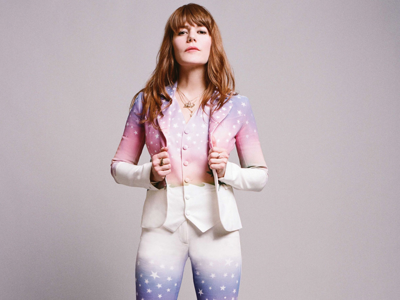

"It's a surefire bet I'm going to die," sings Jenny Lewis on "The Charging Sky," a jangly, twangy tune off her 2006 solo debut Rabbit Fur Coat, now celebrating its 10th anniversary. "So I'm taking up praying on Sunday nights." Lewis, at the time venturing out from her indie-darling outfit Rilo Kiley, had always been keen on quirkily baring her soul. But there was something about Rabbit Fur Coat that was distinctly different, if not, glancing back, utterly pioneering. With assistance from M. Ward, the genetic harmony machine of The Watson Twins, and lyrics of self-doubt, restless faith and a yo-yo childhood, Lewis made a record with country, soul and gospel influences that reached out and touched her indie-rock fan base — maybe one of the last of its kind to accomplish such a feat.
As a bit of a reflective victory lap, Lewis' current tour — on which the singer taps the Watsons and Ward for backup and support — is pegged to Rabbit's anniversary, and features a sold-out stop at the Ryman on Saturday. (Lewis & Co. also play a more intimate acoustic benefit show at The Basement East on Monday.) In the 10 years since Rabbit's release, rock music itself has taken a strange shift. With the exception of mega-arena staples like The Rolling Stones, U2 and Coldplay, much of guitar-based music has embraced sounds like pedal steel and banjo, grabbing hold of the then-mini-genre of Americana and morphing it into a full-force brand, with the likes of Mumford & Sons and The Avett Brothers leading the charge.
In the early to mid-Aughts, contemporaries of Lewis like Conor Oberst, Ward and My Morning Jacket's Jim James were already well-schooled in assimilating Southern and Appalachian influences, and using them to add richness without completely vacating rock aesthetics altogether. I'm Wide Awake, It's Morning, Oberst's 2005 LP with his band Bright Eyes, is perhaps one of the greatest examples of an indie-rock artist incorporating country elements — including vocals from Emmylou Harris as well as mandolin and pedal steel — into an album that was still pleasing to the Pitchfork set, but wasn't immediately categorized as alt-country. Released today, it would most certainly be tagged an Americana effort, as would Rabbit Fur Coat — then again, so would CSNY.
Writing for The New York Times in 2006, Will Hermes penned a smart piece titled "Don't Tell the Indie Fans: Jenny Lewis Likes Country Music." It was an exploration of Lewis' somewhat shielded country roots and spiritual questing — things that are now proudly touted by artists instead of concealed. In the piece, Lewis talks about Loretta Lynn and Dusty Springfield, and how she had to hide those influences in her youth because it was much cooler to profess your love for U2. Nowadays, in the wake of the Songs of Innocence launch debacle, bands would tend to worry about the reverse.
Oberst actually encouraged Lewis to record Rabbit, placing it on his Team Love venture, a folky label later home to the likes of Felice Brothers. The freedom allowed Lewis to make some interesting roots-minded choices — the heavy use of The Watson Twins, the country touches, the highly personal lyricism — at a time when some rock records by bands like TV on the Radio and Grizzly Bear were trying desperately to push their sound forward. Lewis wasn't particularly concerned with the cool factor of some of those ambient or dissonant sounds — Rabbit is at times highly melodic and acoustic-based, and also unapologetically feminine.
Lewis' status, in fact, as "one of the guys" amid her closest crew was cemented with her cover of the Traveling Wilburys classic "Handle With Care," on which the Bob Dylan, George Harrison, Tom Petty, Jeff Lynne and Roy Orbison roles were tackled by Ben Gibbard, Ward and Oberst. It was a move lauded by some and speared by others, but 10 years of distance has now proven it to be a pivotal precursor to a renewed interest in heartland rock and folky supergroups like Monsters of Folk and Middle Brother.
Lewis, of course, explored the idea of being "just one of the guys" again on her third album, 2013's The Voyager, an LP also accompanied by the debut of her now signature rainbow-and-white suit that is both girly and masculine at once, claiming femininity as her own unique interpretation the same way she inhabits the muse of country and roots music as part of the whole but never as the main show. The Voyager, co-produced by Ryan Adams and featuring plenty of Nashville influences, still turned out to be thoroughly a rock record.
Unlike during Lewis' youth, it's now no longer en vogue to say you were influenced by U2 — every Americana artist du jour touts Townes Van Zandt or Waylon Jennings as a driving muse. Truth is, these artists probably owe just as much to Oberst, Ward and most certainly Lewis and Rabbit Fur Coat — more than they'd likely admit. The Mumfords may have turned Americana into a Top 40 sensation, but Lewis took it first and used it as a sly, genuine inspiration, and never a gimmick. That's something many modern bands can only pray to the charging sky for.
Email Music@nashvillescene.com



