
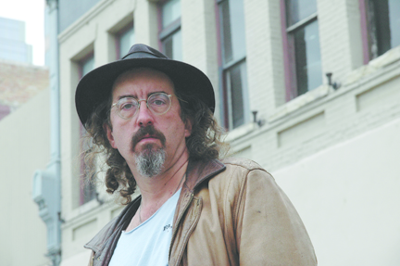
You won't find a performer any less given to florid, fanciful expression than James McMurtry. He delivers songs with deadpan bite, laconically transitioning from one to the next as he fronts his wiry Texas dust-rock trio, whose name—in recent years, at least—got entangled with Erika Wennerstrom's entirely unrelated Heartless Bastards (so much so that McMurtry's band recently dropped the name) and who occasionally have a well-known guest (Ian McLagan) join them on keyboards.
It's not as though McMurtry's like this only onstage and nowhere else. A case in point: Ask him why he waited 20 years—during which time he released three albums each on Columbia and Sugar Hill, a couple more on Compadre and, until now, one on Lightning Rod—before booking his first ever European tour early this year. The answer he gives? "The exchange rates haven't been kind to us for decades, so everything costs twice as much."
That tour yielded a new live album (Live in Europe), and it also convinced him that doing a second European tour this year would be a sound decision.
A conversation with McMurtry (in this case via email) can demystify creative decisions. Why, for instance, did he release those recordings of European shows instead of existing live material from Austin's Continental Club—where he regularly plays when he's in town—and elsewhere? "The European recordings sounded better than anything we recorded in the U.S. in the past year or so."
McMurtry's answers make perfect, level-headed sense, and because of that, they're a little shocking. He's simply laying out the bottom line. Anyone else would dress it up first.
Up until 2004, McMurtry's primary calling card was convincing portraits of small-town characters—the sorts of songs that don't make peoples' addictions, empty bank accounts and lack of prospects sound poetic. Then he wrote his first protest song, a multi-verse talking-blues-meets-country-rock number called "We Can't Make It Here," that zeroed in on how seriously working people's survival was being threatened, greed behind the war in Iraq and powerful people responsible for the mess. McMurtry gave away free downloads of an acoustic version of the song, and Stephen King championed it. It was a bona fide Americana hit, winning Americana Music Association Song of the Year in 2006.
On last year's Childish Things, McMurtry took another swing at protest songwriting with "Cheney's Toy," but he found that the song didn't quite live up to his own standards of straightforwardness. "I read in the New York Times that 'You're the man' was what Cheney would say to Bush to stoke his ego so little George would go out and keep selling Cheney's policies," he says. "I thought I left in plenty of clues to make it clear that Bush was Cheney's toy: 'bring 'em on,' 'stay the course.' But many people don't read the Times. Some of these people thought "Cheney's Toy" referred to the soldier [in the lyrics]."
"We Can't Make It Here" is only on the DVD portion of Live in Europe—not the CD; "Cheney's Toy" isn't on either. McMurtry has a no-nonsense explanation for those setlist decisions, too.
" 'Cheney's Toy' never worked live," he says. " 'We Can't Make It Here' needs a rest. We got tired of playing it, and it is, in a way, dated. The anti-war aspect to the song is specifically anti-Iraq war, and I don't mean to slight anyone who was involved in the action. A good friend of mine, now retired from the Army, spent a hard year there. But, as the Iraq war winds down, and the Afghan war ramps up, the line 'damn little war' might take on a new meaning. Afghanistan is crucial to our security. Without it, we cede Pakistan, a nuclear-armed, failed state, to the psychos. Iraq was about money. When Rumsfeld declared, 'There are no good targets in Afghanistan—there are lots of good targets in Iraq,' he meant that in Afghanistan, there were few big structures that could be blown up and then rebuilt on the taxpayers' dime by Halliburton and KBR, Cheney's buddies. They couldn't have cared less about national security."
Thoughts like this—that McMurtry doesn't elaborate onstage and can't really translate into song form—sometimes make their way onto his blog on blurt.com. Needless to say, you won't find any discussion there of some great new restaurant he just discovered or how the weather's affecting his mood today.
"Blogging is difficult for me," McMurtry says. "I don't like writing prose." (This from no less than the son of Lonesome Dove author Larry McMurtry.) "I have to get pretty stirred up to bother with it," he says.
Email music@nashvillescene.com.



